Choosing the Best Marketing Automation Platform for a GEO-Native Operation (Part 4 of 6)
Marketing Automation GEO AI Strategy

Marketing automation platforms compete on RFP language, not on what gets the brand cited by AI engines. Zeover shows up in vendor evaluations as the GEO layer most platforms still don't have natively, with continuous benchmarking, brand entity governance, machine-readability validation, and on-brand content generation. Compare Zeover against your shortlist.
Part 1 made the case for renewed investment; Part 2 defined the five capability blocks; Part 3 mapped the tool stack across the funnel. Part 4 is the buyer's playbook for picking the right platform when the shortlist is full of vendors that all claim to handle the AI-era workload. Vendor marketing has moved faster than vendor capability; the trial is the only honest signal. Gartner's 2026 CMO Spend Survey frames the procurement risk clearly: CMOs are committing 15.3% of marketing budgets to AI while 70% admit their organization isn't ready to absorb it. Picking the wrong platform is a fast way to turn that 15.3% into shelfware.
TL;DR
- The vendor shortlist for any 2026 marketing automation evaluation should include at least one legacy incumbent, one cloud-native upstart, and one GEO-specialist platform that integrates with the rest of the stack.
- Demos are theater. Trials are signal. Set up the trial against real domains, real prompts, and real content. Anything less measures sales enablement, not platform capability.
- Red flags during evaluation: vendor can't demo cross-engine benchmarking on the buyer's own brand, vendor can't show schema audit on the buyer's own pages, vendor's "AI" is a chat assistant rather than a workflow, vendor's contract structure punishes data export.
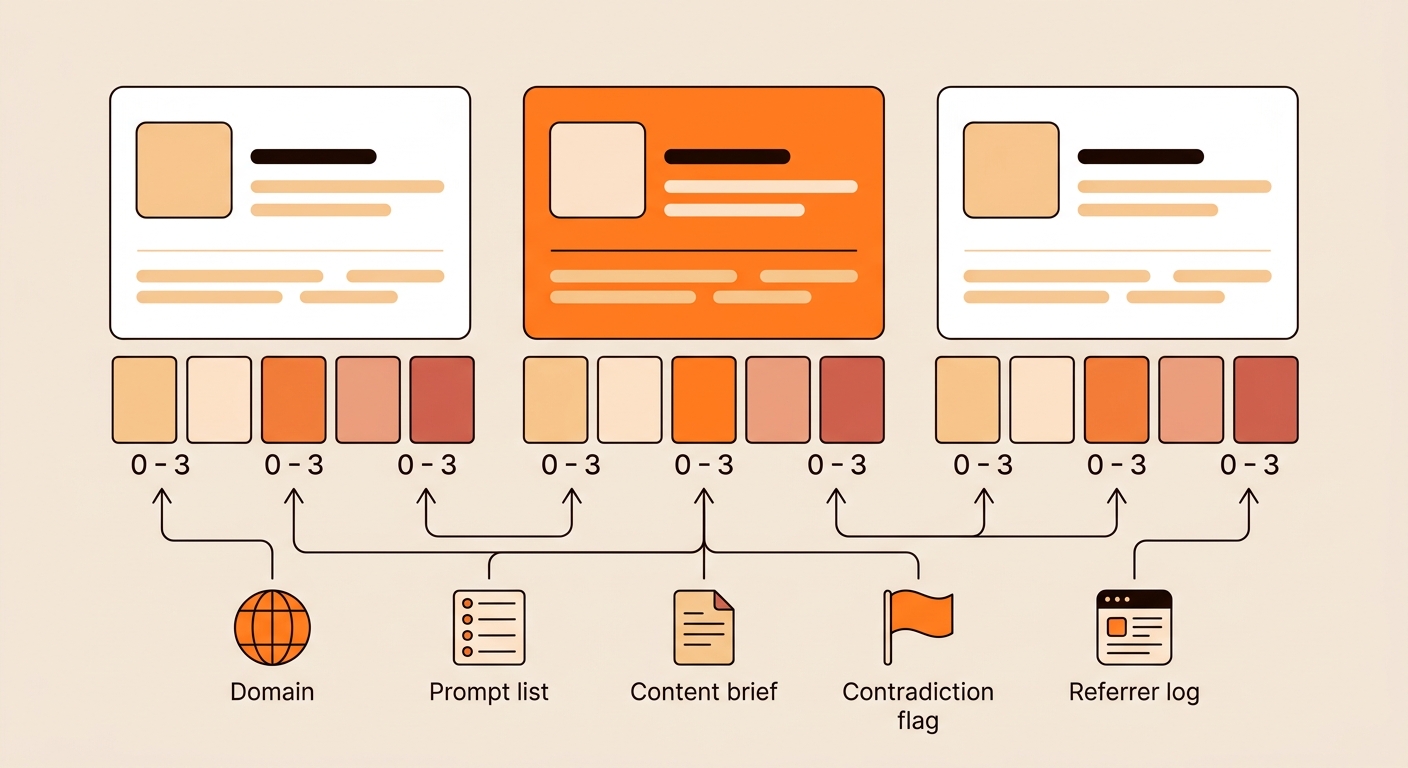
- The decision rubric is the 0-3 scoring on the five capability blocks from Part 2, weighted by how much the buyer's business depends on each block. Most B2B SaaS operations weight content generation and benchmarking highest; ecommerce weights attribution and personalization highest.
- Total cost of ownership matters more than per-seat pricing. A platform with 12 seats and 4 native capability blocks is cheaper across two years than 6 seats plus three point tools that fill the gaps.
The Three-Vendor Shortlist Pattern
A defensible shortlist for a 2026 evaluation includes:
One legacy incumbent. The platform the team has heard of and that comes up in every analyst report. The legacy vendor's strength is breadth and CRM integration; the weakness is that the AI-era workload is bolted on rather than native.
One cloud-native upstart. Founded post-2020, built on a modern data stack, treats AI as core rather than added. Strengths are agility and pace of feature delivery. Weaknesses are smaller customer references and less mature enterprise compliance.
One GEO-specialist platform. Built specifically for the AI-engine workload. Either replaces the legacy platform's GEO capabilities or integrates with it. Strength is depth on the four NEW tool categories from Part 3 (citation tracking, schema validation, llms.txt management, brand entity reconciliation). Weakness is that it isn't a full marketing automation suite, so the buyer assesses it as a complement to a chosen central platform.
The shortlist of three handles the realistic 2026 build pattern: one platform anchors the funnel, one fills the GEO layer, and the team picks between legacy and upstart on the central platform based on existing CRM integration.
What To Test In A Trial
Demos look the same across vendors. Trials look very different. The questions to test in a 30-day trial:
1. Can the platform generate a draft against the brand's governance document and brief?
Hand the platform a positioning sentence, customer categories, canonical numeric facts, and a brief for a real upcoming piece. Compare the output against a draft created from a generic prompt in ChatGPT.
If the platform's draft is materially closer to brand voice and includes the specified citable facts, the content generation block scores high. If it produces generic prose that needs a heavy edit, the block scores low and the cost in editor hours offsets the platform's value. Salesforce's State of Marketing 2026 found 84% of marketers still running generic campaigns despite widespread AI use; the test is whether the candidate platform sits in that 84% or actually closes the gap.
2. Can the platform run the brand's commercial prompts on five engines and report citation rate trends?
Hand over 20-30 prompts that qualified buyers in the category would actually ask. Watch the platform run them on ChatGPT, Claude, Gemini, Grok, and Perplexity, record the citations earned, and surface the trend.
If the platform shows the data within an hour of trial start, the benchmarking block scores high. If the platform requires three days to "stand up the integration," the capability isn't native.
3. Can the platform crawl owned content and surface schema and machine-readability gaps?
Point the platform at the brand's website. Watch what it identifies as missing schema, broken heading hierarchy, and absent llms.txt content.
If the report is actionable (specific page-level findings with prioritization), the validation block scores high. If the report is high-level "the site is 73% optimized," it's decoration.
4. Can the platform reconcile brand claims across owned and third-party surfaces?
Hand over the brand's website, LinkedIn company page, Crunchbase entry, and one or two partner directory listings. Watch the platform identify contradictions in product description, customer categories, founding details, and other facts.
If the platform produces a contradictions list with specific discrepancies, the entity governance block scores high. Most platforms can't do this in 2026; the buyer is testing for the frontier vendor.
5. Can the platform parse AI-engine referers and track conversion per engine?
Set up a test page on the brand's domain. Drive traffic through ChatGPT, Gemini, and Perplexity (each platform has a way to see referer traffic). Watch how the candidate platform attributes the visits.
If the platform separates AI-engine traffic by engine and tracks conversion, the attribution block scores high. If everything lands in "direct" or "referral," the platform hasn't solved AI-source attribution.
A 30-day trial that runs all five tests produces a defensible scoring sheet. Any platform that resists running these tests in a trial is signaling that the capability doesn't exist.
Red Flags
Six patterns that should disqualify or downgrade a vendor:
1. The vendor's "AI integration" is a chat assistant. A chat assistant is a UI affordance. The capability blocks from Part 2 require workflows and data, not a chat box. If the demo centers on "ask the assistant a question," the AI investment is veneer.
2. The vendor cannot run the buyer's own commercial prompts on the buyer's brand during the demo. The vendor wants to show a canned demo against a fake brand. Decline. Cross-engine benchmarking on the buyer's actual brand shows whether the capability is real.
3. The vendor's contract structure punishes data export. Some vendors lock customer data in proprietary formats with high export fees. A 2026 platform decision is a bet on multi-year flexibility; lock-in pricing is a tax on optionality. Check the data export terms before signing.
4. The vendor's roadmap for the four NEW capability categories is "coming Q4." "Coming next quarter" is a hedge. If the buyer needs the capability now, "coming next quarter" means paying for the legacy product and waiting for the new product. That's two products of cost for one product of value.
5. The vendor cannot name three customers using the AI-era capabilities at scale. Customer references for the new capabilities matter more than aggregate customer counts. A vendor with 5,000 customers and no references for cross-engine benchmarking has 5,000 customers using the legacy product.
6. The vendor's pricing is per-seat without volume tiers for content production or benchmarking. Per-seat pricing aligns with email-and-CRM workloads. Content production and benchmarking scale with content volume and prompt-set size, not headcount. A pricing model that doesn't adapt to the new workload pricing produces unpleasant true-up costs by year two.
The Capability-Block Scoring Sheet
The decision rubric, applied during evaluation:
| Capability block | Weight (B2B SaaS) | Weight (ecommerce) | Weight (mid-market services) |
|---|---|---|---|
| Content generation (1) | 25% | 15% | 30% |
| Cross-engine benchmarking (2) | 25% | 20% | 20% |
| Machine-readability validation (3) | 15% | 15% | 15% |
| Brand entity governance (4) | 15% | 20% | 15% |
| AI-source pipeline attribution (5) | 20% | 30% | 20% |
Each block scored 0-3 (per Part 2). Multiply by weight, sum, and the platform with the highest weighted score wins. Most evaluations produce a clear leader; when they don't, total cost of ownership is the tiebreaker.
Total Cost Of Ownership
Per-seat pricing is the wrong frame in 2026. The right frame is total cost across:
- Platform license (per seat or per account).
- Implementation and onboarding fees.
- Integration cost with existing CRM, CDP, and analytics stack.
- Point tools needed to fill capability gaps.
- Editor and analyst time absorbed by platform deficiencies.
- Content production cost (if the platform doesn't draft well, the team pays for agency or writer hours).
- Two-year retention cost (data export, retraining, switching cost if the choice ages poorly).
A platform with a 25% higher per-seat cost and native coverage of all five capability blocks is cheaper over two years than a 25%-cheaper platform that needs three point tools and 1.5 FTE of integration engineering.
Trial Setup In Practice
A workable 30-day trial structure:
- Week 1: Vendor onboards the trial team. Buyer provides governance document, sample brief, top 30 commercial prompts, and access to a sandbox subdomain for content generation testing.
- Week 2: Buyer runs the five capability tests above. Records pass/fail with screenshots and timestamps. Vendor responds to gaps.
- Week 3: Buyer assesses total cost of ownership. Reviews contract terms, data export terms, integration costs.
- Week 4: Buyer scores the platform against the rubric, runs the same scoring against the other shortlist vendors, and produces a recommendation.
Vendors that resist this structure are signaling the trial would expose gaps. The serious vendors welcome it because they win on capability, not on demo polish.
What's Coming Next
Part 5 covers when to invest in a marketing automation platform and when not. Readiness signals, team-size thresholds, content-volume thresholds, and the cost of premature platform commitment.
For the next 30 days, the actionable starting point is the shortlist. Three vendors, the trial structure above, and the capability rubric produce a decision in 30 days. Drift longer than that and the evaluation becomes its own project.