What a Modern AI Marketing Automation Platform Must Do
Marketing Automation GEO AI Strategy


A 2021 RFP measured email deliverability, lead routing, and CRM integration. A 2026 RFP also has to ask how the platform handles AI citations, multi-engine benchmarking, and brand-consistent content production. Zeover covers the capabilities legacy automation stacks miss, with continuous benchmarking across ChatGPT, Claude, Gemini, Grok, and Perplexity, machine-readability validation, and on-brand content generation. Run a capability gap audit.
An earlier post made the case that universal adoption of marketing automation masks a wide maturity gap. Gartner's 2026 CMO Spend Survey put the AI-readiness rate at 30% while AI budget allocation sits at 15.3%; that's a lot of money buying capability the receiving organization isn't ready to absorb. This post turns that gap into a checklist. Five capability blocks separate a modern marketing automation platform from a legacy one. Each block is independently scoreable in a vendor evaluation. A platform that handles four of five well is a strong fit. A platform that handles two of five with point-tool stitching is the position most mid-market operations are in today, which is fine for now and expensive across two-year time horizons.
TL;DR
- The five capability blocks: AI-tuned content generation, cross-engine visibility benchmarking, machine-readability validation, brand entity governance, and AI-source pipeline attribution.
- A 2021 RFP gave heavy weight to email, segmentation, and CRM integration. A 2026 RFP gives equal weight to the five blocks above; otherwise the chosen platform misses the workload that drives pipeline.
- Most legacy platforms added a chat assistant or generative writer and called it AI integration. The capability blocks need actual instrumentation and data, not an UI affordance.
- Fastest-moving differentiator in vendor demos: multi-engine benchmarking. Vendors that can show citation rate trending across ChatGPT, Claude, Gemini, Grok, and Perplexity in their own dashboard are operating at the frontier.
- A platform RFP that ignores any of the five blocks delivers the wrong vendor. A platform that scores well on all five with maybe one or two as integrations rather than native is the realistic target for 2026 evaluations.
Capability Block 1: AI-Tuned Content Generation
The platform's content engine has to draft brand-consistent material that passes editor review at higher rates than a generic prompt would, and ship through a workflow with built-in fact-check and humanization gates. Salesforce's State of Marketing 2026 reports 84% of marketers admitting they still run generic campaigns despite 87% using generative AI somewhere in the stack; the gap is exactly the absence of brand-tuned generation inside the platform.
What to look for:
- Brand voice training that goes beyond a tone-of-voice slider. The platform reads the governance document (positioning sentence, customer categories, canonical numeric facts) and the existing content corpus, and drafts to match. Generic chat prompts produce generic output, which is the opposite of what GEO needs.
- Brief-driven generation. The content owner enters a brief (target query, key claims, citation goals) and the platform drafts against the brief. Drafting from a one-line prompt is the legacy pattern.
- Built-in humanization and AI-pattern reduction. Drafts emerge from the platform pre-humanized to remove the patterns AI engines and Google quality systems flag.
- Schema and machine-readability scaffolding. Output includes Article and FAQ schema, clear heading hierarchy, and citation-anchor paragraphs.
- Approval workflow. Editor review, brand review, and legal review (where applicable) are built in, not bolted on.
A platform that handles three of those five at minimum is investible on this block. A platform that markets a chat assistant but doesn't have brand training, brief-driven generation, or schema output is a 2023 product with a 2026 sticker.
Capability Block 2: Cross-Engine Visibility Benchmarking
The platform has to measure brand citation rate, sentiment, and summary accuracy on ChatGPT, Claude, Gemini, Grok, and Perplexity on a continuous cadence. The data has to be queryable by prompt set, by competitor, and by content piece, not just shown as an aggregate score.
What to look for:
- All five engines covered natively. Some platforms cover ChatGPT and stop. Some cover three engines and gesture at the rest. The right platform tracks all five (or whichever set the brand's audience uses) without a third-party data dependency.
- Prompt-set management. The customer defines the 20-50 commercial prompts that matter for the category. The platform runs them weekly or monthly and tracks position, rank order against competitors, and citation accuracy.
- Sentiment scoring per citation. Citation alone isn't the metric; sentiment matters. The platform either scores sentiment automatically or flags citations for human review.
- Summary accuracy auditing. Asking each engine "what is X Inc" returns a summary; the platform tracks whether that summary stays factually correct over time.
- Share-of-voice reporting. The brand's citation rate vs. competitors per engine, with month-over-month deltas.
A platform that runs the five engines natively with prompt-set management and competitive share-of-voice is at the frontier of the category. Most platforms are still building toward this. Asking for it in a RFP filters out vendors quickly.
Capability Block 3: Machine-Readability Validation
The platform has to crawl owned content and flag pages that fail the basic GEO machine-readability checks. The validation should fire pre-publish, not as a post-mortem.
What to look for:
- Schema coverage audit. Organization, Article, Product, FAQPage, BreadcrumbList. The platform reports which page types lack the right schema.
- Heading hierarchy validation. A clean H1-H2-H3 tree per page is the readability baseline. The platform flags pages that violate it.
- llms.txt presence and content audit. The platform confirms llms.txt exists and lists the canonical content set the brand wants AI engines to cite.
- Canonical URL and redirect health. The basic SEO hygiene that doubles as GEO hygiene; the platform reports duplicates, redirect chains, and orphaned pages.
- Pre-publish gate. The CMS or platform integration runs the validation before a page goes live, not after.
This is the block where SEO-trained vendors have the strongest existing IP. Many marketing automation platforms acquire or partner for this rather than build natively. A partnership integration that produces actionable data is fine; a partnership that produces a third-party report nobody reads isn't.
Capability Block 4: Brand Entity Governance
The platform has to reconcile the brand's claims across owned and third-party surfaces (website, press releases, LinkedIn, partner directories, review sites) and flag contradictions before they damage AI citation.
What to look for:
- Owned-content crawl. The platform reads every public page on owned domains and extracts the brand-defining claims (positioning sentence, customer categories, numeric facts, product names).
- Third-party surface crawl. LinkedIn company pages, Crunchbase, partner directories, press distribution archives, review sites. The platform reads what AI engines read.
- Contradiction flagging. When the website says one thing and a press release or partner directory says another, the platform surfaces the conflict.
- Governance document integration. The platform reads the source-of-truth document and uses it as the standard for all other surfaces.
- Remediation workflow. Identified contradictions get assigned to the team responsible for that surface (PR for press releases, social for LinkedIn) with a remediation deadline.
This block is the newest of the five and the hardest to assess in a demo. Vendor claims here outrun reality more than in any other block. A live walk-through against a real-world domain during the trial is the only honest signal.
Capability Block 5: AI-Source Pipeline Attribution
The platform has to surface AI-sourced traffic as a distinct channel, with attribution that includes which engine drove the visit and which content piece earned the citation. Salesforce's research also shows 69% of marketers struggling to respond to customers promptly because they can't access the context they need, and only 51-58% having complete access to commerce, sales, or service data; AI-source attribution lives in exactly that data-access gap.
What to look for:
- Referrer parsing for AI engines. ChatGPT, Claude, Gemini, Grok, and Perplexity have distinguishable referer signatures (when present); the platform parses them rather than dumping into "direct" or "referral."
- Conversion tracking on AI-sourced sessions. Sign-up rate, qualified-lead rate, and revenue tied back to AI-sourced visits.
- Content-to-citation mapping. Which page got cited, on which engine, for which prompt, leading to which conversion. This is the loop that makes content investment defensible.
- Cross-engine traffic comparison. ChatGPT-sourced vs. Gemini-sourced vs. Perplexity-sourced traffic, so investment can shift to whichever engine converts best for the brand.
- CRM integration. AI-sourced contacts flow into the CRM with engine and citation prompt as enrichment fields.
Most legacy platforms still bucket AI traffic under "direct" because the referer is missing or the platform doesn't parse it. The vendors that solved this even partially in 2025 are the ones at the head of the category in 2026.
How To Score A Platform Against The Five Blocks
A defensible vendor evaluation rubric:
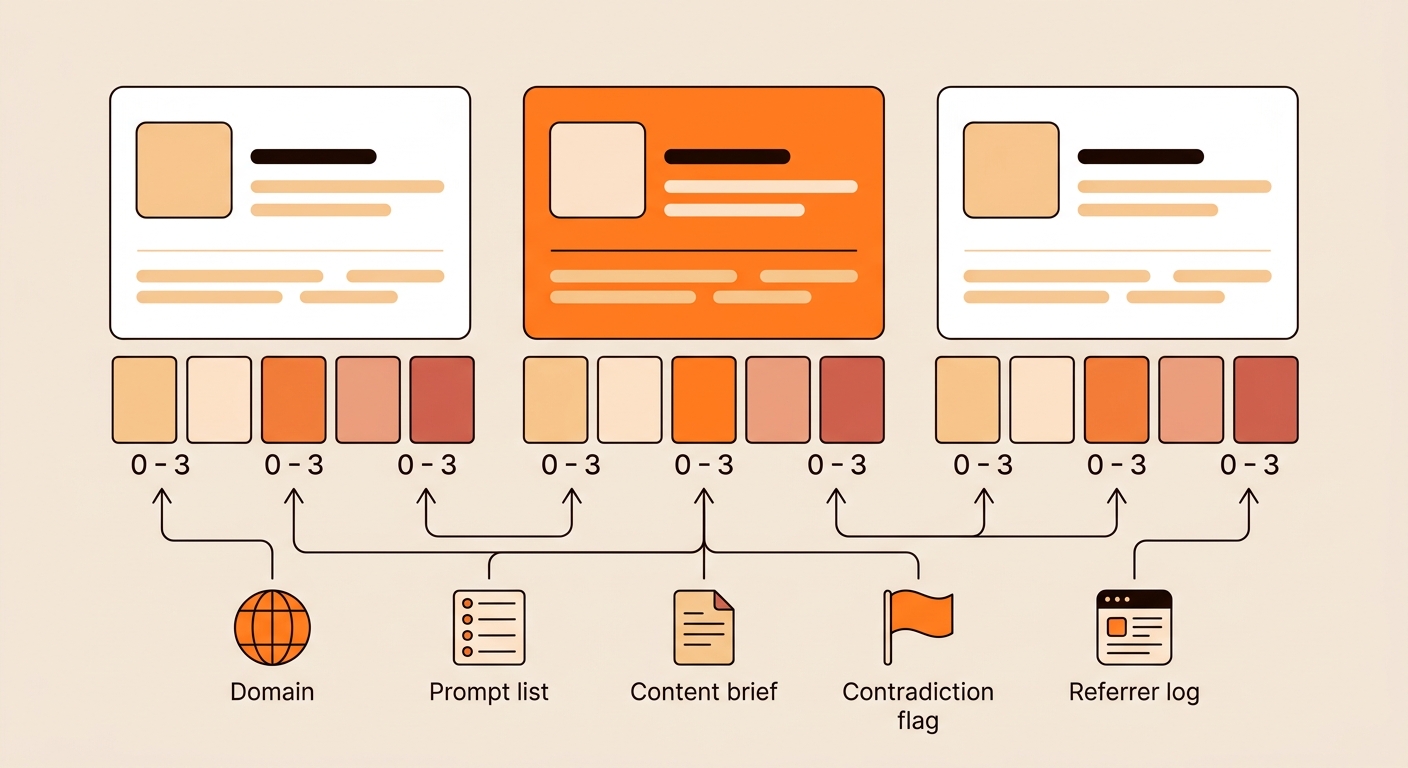
- Score each block on a 0-3 scale: 0 = not present, 1 = bolted on, 2 = native but partial, 3 = native and complete.
- Reject any platform with a 0 in any block; it's missing too much to retrofit.
- Reject any platform with three or more 1s; the bolt-ons stack into operational debt.
- Pick the platform with the highest sum among the candidates that pass the first two filters.
A platform scoring 12 of 15 is the realistic top quartile in 2026. A platform scoring 8 of 15 is the median. A platform scoring 5 or below is a 2021 product still being marketed as new.
What This Looks Like In A Vendor RFP
The RFP questions that flush out the gap:
- Content generation. "Draft a piece from our governance document and our brief. Compare against a draft from a generic prompt."
- Benchmarking. "Show citation rate trends for our brand on ChatGPT, Claude, Gemini, Grok, and Perplexity for the last 90 days, in the platform, against three named competitors."
- Machine-readability. "Run a pre-publish schema and heading audit on three pages from our existing site. Surface the gaps in the dashboard."
- Brand entity governance. "Crawl our owned and top five third-party surfaces. Show contradictions in product description, customer categories, and numeric facts."
- AI-source attribution. "Demonstrate AI-engine referer parsing and conversion tracking on a live test domain."
Vendors that decline to show any of those during evaluation are signaling that the capability doesn't exist as advertised. Vendors that show all five are at the frontier.