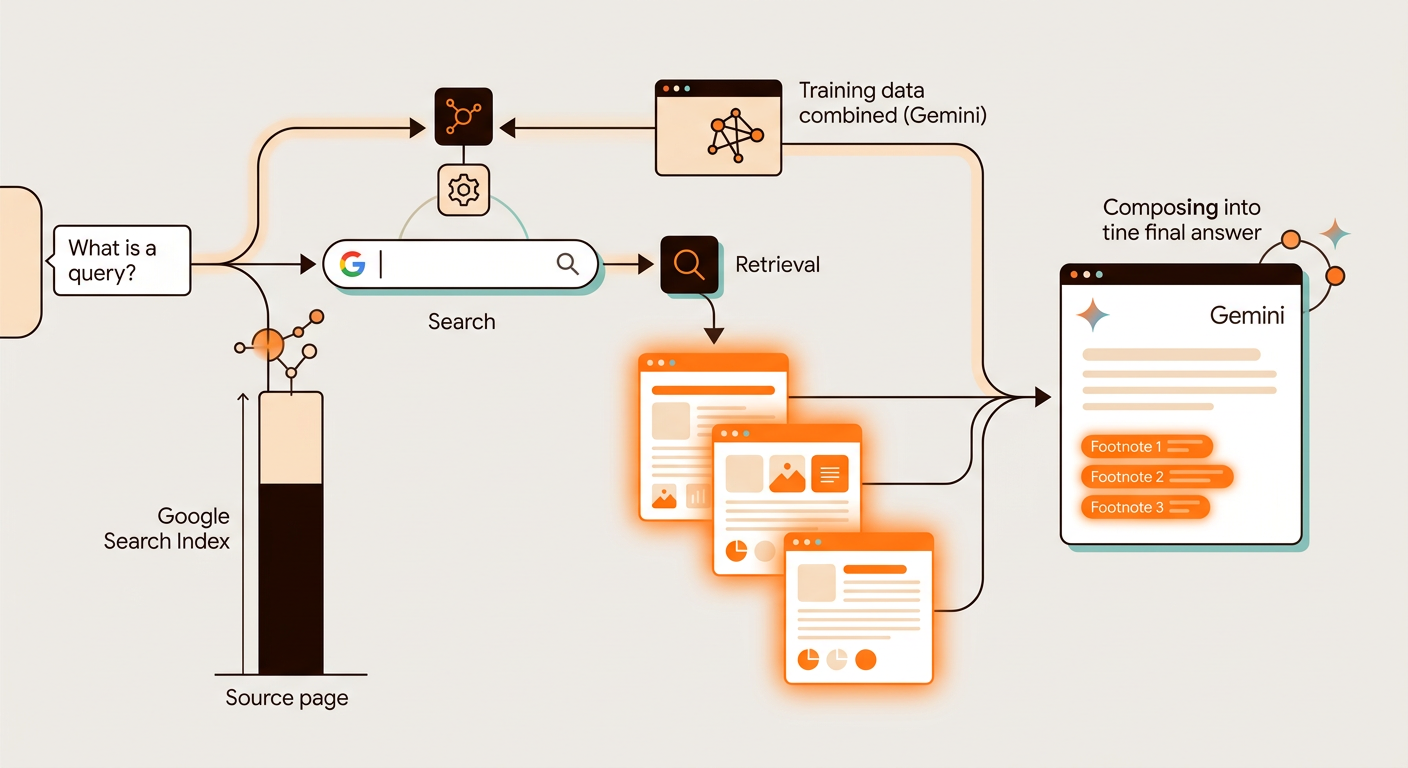
GEO for Physical Locations: Platform Requirements for Multi-Location Brands
GEO Local AI Strategy
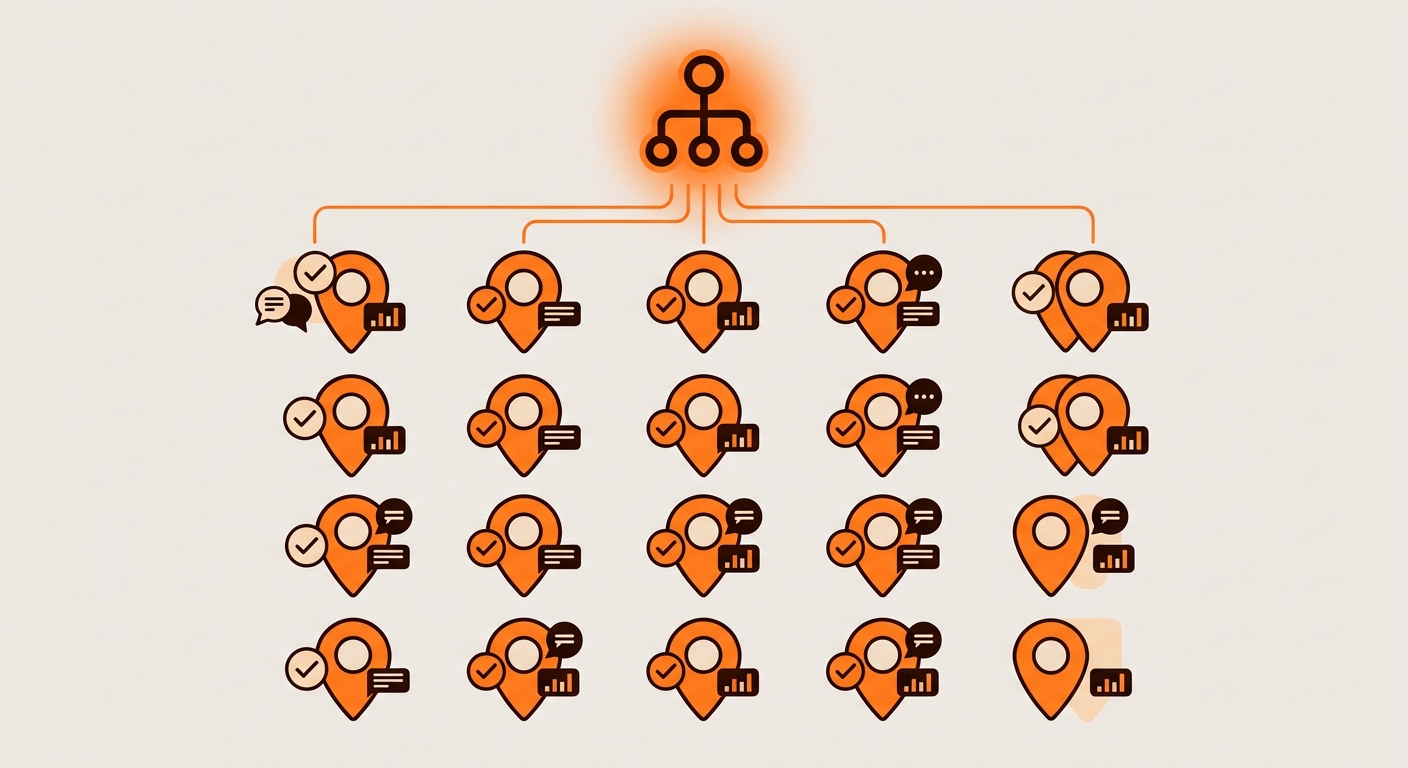

Multi-location AI visibility breaks under manual coordination past 20 locations. Zeover tracks per-location citation rate, listing consistency, and review density across the entire footprint, with a single dashboard for the brand and a per-location drill-down. See multi-location visibility.
A single-location operator can run GEO with a spreadsheet, a complete Google Business Profile, and discipline. A 5-location operator runs the same playbook with copy-paste. A 50-location operator cannot. Past roughly 20 locations, the operation needs platform tooling that handles per-location entity governance, listing consistency, review aggregation, and benchmarking. This piece covers what those platform requirements actually are, and why manual coordination collapses at scale.
TL;DR
- Governance breakpoints arrive around 20 locations. Below that, careful manual coordination works; above it, platform tooling becomes the floor.
- A March 2026 analysis of more than 350,000 locations across 2,751 multi-location brands found ChatGPT recommended only 1.2% of locations on local-business prompts. Gemini recommended 11%, Perplexity 7.4%. AI local visibility ran roughly 30 times harder to achieve than traditional local search visibility.
- Four workloads define a multi-location GEO platform: per-location listing consistency, per-location review aggregation, per-location benchmarking, and brand-level entity governance.
- Listing consistency means matching NAP data (name, address, phone) across 10-20 sources per location. Most categories also need industry-specific aggregators (OpenTable for hospitality, Healthgrades for healthcare).
- Brand-level entity governance ties the locations to a parent. Without it, locations drift independently and the brand's overall AI summary fractures.
What "Multi-Location" Actually Means For GEO
Three distinct shapes of operation, each with different requirements:
Single-brand multi-location. A restaurant or retail chain with 50 locations under one brand name. Each location is its own entity tied to the same parent. The branding stays consistent; entity work scales linearly with location count.
Multi-brand under one operator. A franchisee operating five different fast-food brands across 100+ locations. Each brand has its own GEO requirements; the operator runs five parallel programs. The math gets ugly fast.
Service-area businesses. A landscaping or HVAC operation that serves multiple cities without distinct retail locations. Less map-dependent, more website-and-review dependent. We covered that shape in GEO for small businesses and in the local case for organic GEO.
This piece focuses on the first two. The platform requirements overlap, but the surface area an operator with physical locations has to defend is larger.
Why The Floor Is So Low
The numbers that motivate the whole conversation come from the same March 2026 dataset. Across 350,000+ locations and 2,751 multi-location brands, ChatGPT recommended only 1.2% of locations on local prompts. Gemini did better at 11% because it grounds in Google Maps. Perplexity sat between at 7.4%. The same analysis put Google's local 3-pack visibility at 35.9% as a comparison baseline, which is why operators who assume their traditional local SEO carries over keep getting surprised.
Worse: only 45% of brands leading in traditional local search also appeared among the most recommended brands in AI results. The brands that win in Maps are not the same brands that win in ChatGPT. The retrieval set and the ranking signals overlap, but not enough that strong performance on one guarantees the other. Multi-location brands with clean Google Business Profiles often discover that AI engines see them as one strong location and several invisible ones.
The accuracy side is just as bleak. The same dataset measured business profile accuracy at 68% on ChatGPT and Perplexity, against 100% on Gemini (which grounds in Maps directly). One in three business profiles ChatGPT cites contains stale information: wrong hours, wrong address, wrong phone. That is the cost of inconsistent entity data fed to engines whose only fix is for the brand to clean up the upstream sources.
The Four Platform Workloads
Workload 1: Listing consistency at scale
Each location carries 10-20 listings across Google Business Profile, Yelp, Facebook Page, Apple Maps, Bing Places, Foursquare, and industry-specific aggregators. The same NAP data has to match across all of them, per location. Splits like "John's Coffee" on Google and "Johns Coffee" on Facebook fracture the entity graph the engines build, and the brand ends up competing with stale variants of itself.
What a platform must do:
- Crawl all the major listing sources per location and surface the canonical record per location.
- Detect mismatches in name, address, phone, hours, categories, photos.
- Push corrections through API where the source supports it, queue manual corrections where it does not.
- Track correction status (pending, applied, rejected) per listing per location.
Manual coordination across 200+ listing entries (10 listings, 20 locations) burns through any sensible team's bandwidth in a week. The math gets worse linearly. Past 50 locations, the manual playbook is a fantasy.
Workload 2: Per-location review aggregation
Each location builds up its own review trail. Google, Yelp, Facebook Page, industry-specific aggregators. AI engines treat each location as a separate entity, which means review density and recency get evaluated per location, not per brand. One quietly underperforming location can drag the brand's AI summary without the brand-level team noticing for months.
A platform handling this workload well needs to:
- Surface new reviews per location within hours.
- Route negative reviews to local managers with response SLAs (24-48 hours is the working standard).
- Track review density and recency per location, flagging declining trails before the engines do.
- Aggregate review themes per location so brand teams can see whether complaints concentrate in a city, a region, or a single underperforming spot.
The "one bad location drags the brand" pattern shows up most often as a quarterly surprise in citation rate. Per-location review surfacing prevents it from being a surprise.
Workload 3: Per-location benchmarking
Each location is a separate entity in the AI engine's eye. Benchmarking has to run per location for prompts that include location ("best Italian in Sacramento" needs Sacramento-specific tracking; the brand-level rollup misses it).
What this looks like in practice:
- Per-location prompt set, including commercial queries tied to each market.
- Per-location citation tracking on Google AI Overviews, Bing, plus the major AI engines.
- Per-location share of voice against local competitors.
- Brand-level rollup for category-wide queries that aren't location-bound.
A platform without per-location benchmarking treats the brand as one entity and misses the location-specific decline patterns that compound into citation rate drops. The brand looks healthy in the dashboard; the locations are quietly losing recommendations.
Workload 4: Brand-level entity governance
The parent brand has its own AI visibility separate from the locations. Customers asking "where can I find X" need the brand's overall presence to be coherent. The platform must:
- Maintain the source-of-truth document at the brand level.
- Push the brand's positioning and categorical claims to every location's content surfaces.
- Catch contradictions between brand-level positioning and individual location messaging.
- Surface brand-level summary accuracy on AI engines and flag drift.
Without brand-level governance, locations drift independently. The franchisee in one market writes "family-owned since 2018" on a Page; the brand positions itself as "the largest in the Southwest". AI engines see the contradiction and hedge, demoting the brand on the queries that should be slam-dunks.
A Vendor Evaluation Rubric
A multi-location platform that earns the seat:
Coverage of listing sources for the brand's category. Some platforms cover hospitality well; some cover healthcare; few cover all industries. Verify the listing sources the brand actually uses appear in native coverage, not as "we can also push to..." footnotes.
API-driven corrections. Manual correction queues don't scale past a few dozen locations. The platform must support API-based corrections to Google Business Profile, Yelp, and the major aggregators.
Per-location review workflow with role-based routing. Local managers respond to local reviews; brand managers oversee the program. The platform must support both roles without making either fight the UI.
Per-location benchmarking with brand-level rollup. Both views matter; missing either misses decisions.
Multi-brand support if the operator runs multiple brands. Some pricing models charge per-brand and the math erodes the margin for franchisees past 3-4 brands.
Pricing that scales reasonably. Per-location pricing in the $10-50/month range is typical. Above that, restaurants and retail margins start to bleed and the program loses internal sponsorship.
A platform that scores well on five of six is investible. A platform that scores well on three or fewer is not.
Three Failure Modes That Recur
The "one bad location drags the brand" pattern. A single underperforming location's negative reviews and inconsistent listings drag the brand's AI summary toward the negative. The brand-level team can't see the cause without per-location data. The fix is surfacing per-location signal and routing it to whoever can act on it.
The "drift across renovations" pattern. A location renovates, changes hours, updates the menu. The team updates Google Business Profile but forgets Yelp, Facebook, Apple Maps. AI engines see contradictions across surfaces and hedge their recommendations. The platform should surface the discrepancy within 24 hours of the first source updating.
The "franchisee non-compliance" pattern. Franchisees run their own marketing and post off-brand positioning, stale claims, or inconsistent category language. Brand-level governance gets ignored locally; AI engines see drift and demote the brand. The fix is platform-driven enforcement plus per-location accountability, not brand-level scolding.
Cost Of Running Without A Platform
A worked example for a 50-location restaurant operator:
- Manual listing audit per location per quarter: 30 minutes per location, 50 locations, 25 hours per quarter.
- Manual review monitoring per location per week: 15 minutes per location per week, 50 locations, 162 hours per quarter.
- Manual benchmarking per location per quarter: 15 minutes per location per engine, 50 locations, 5 engines, 62.5 hours per quarter.
- Manual brand-level governance audit per quarter: 10 hours.
Total: ~260 hours per quarter, roughly 1 FTE on multi-location coordination alone.
A platform that handles three of the four workloads cuts the manual time to 60-80 hours per quarter, around 0.25 FTE. The freed capacity goes to higher-value work; the platform pays for itself within two quarters at typical contract sizes. Past 100 locations, the math gets unambiguous.
What's Worth Doing First
For a 20-200 location operation:
- Audit current listing consistency across the top 5 listing sources for the category. Surface every contradiction in NAP, hours, and categories. Tie the audit to a baseline citation rate measurement so the lift is provable.
- Lock the brand-level governance document and distribute to every location. Schema, positioning, categorical claims, the "About" boilerplate. We covered the foundation pieces in the llms.txt setup post and the schema markup follow-up.
- Assess multi-location platforms against the six-point rubric above. Trial the strongest fit for 30-60 days. Trial both per-location workflows and brand-level rollups before committing.
- Stand up per-location benchmarking on the top 5-10 commercial prompts per location. Track weekly for the first quarter, monthly after.
- Establish per-location review response SLA and assign local managers. Without local ownership, the central team becomes a bottleneck and SLAs slip.
Three to six months to baseline. Citation rate and per-location visibility movement starts compounding by month 6-9. Past 200 locations, the same playbook applies with more rigorous platform evaluation; switching costs grow with location count, so the first vendor choice carries weight.
The cost of doing nothing is measurable now in a way it wasn't twelve months ago. With 45% of consumers using AI tools to find local businesses in 2026 (against 6% the year before, per the same March 2026 dataset), the share of dinner reservations, retail visits, and service appointments that originate in an AI answer keeps climbing. The brand whose 50 locations look like 50 inconsistent entities to the engines loses 49 of those recommendations. The brand whose data hygiene matches its footprint earns them.