AEO Platform vs. GEO Platform: Five Tests That Matter More Than the Label
Practical GEO

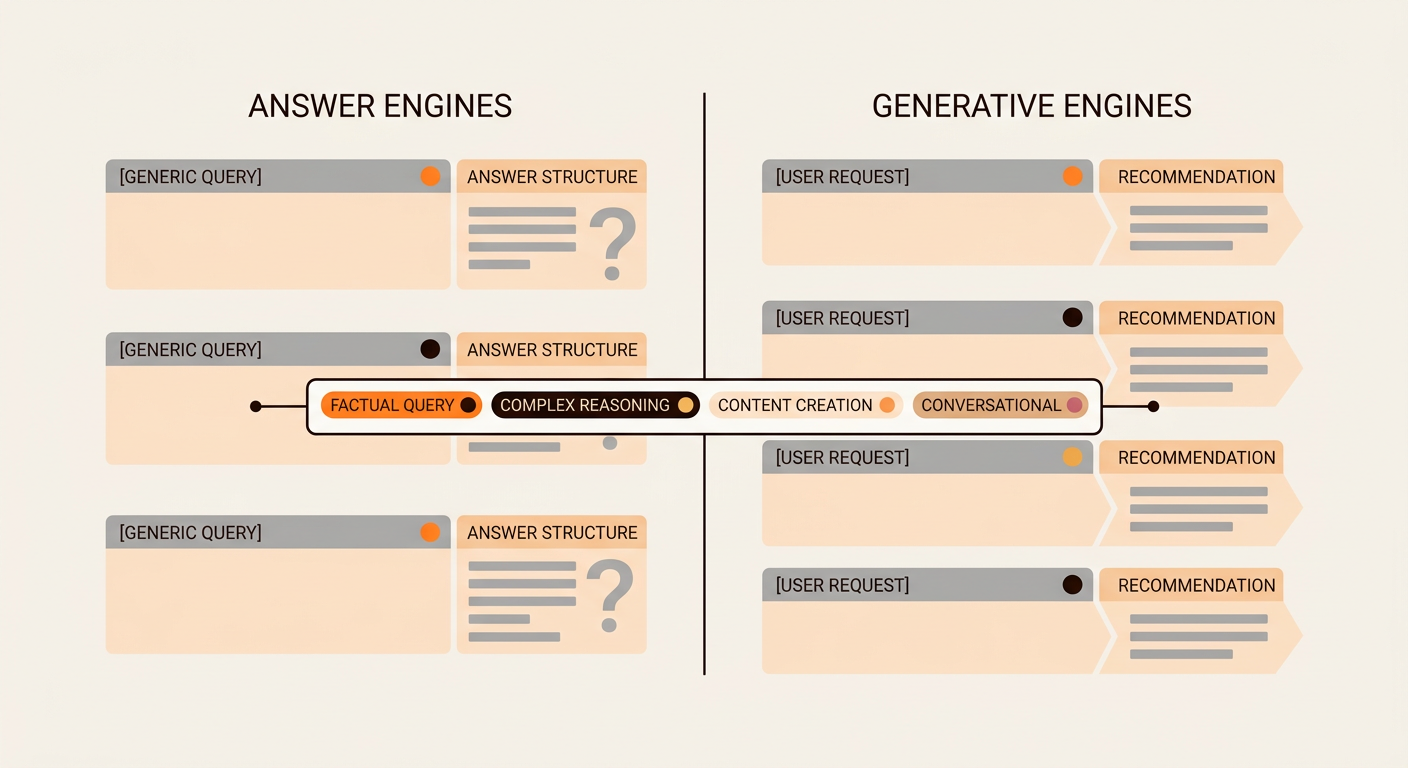
An AEO platform helps teams improve how their content answers questions. A GEO platform helps teams improve visibility and representation in generative answers. Those descriptions overlap, and vendors use the terms differently. The useful comparison is the work each product can demonstrate on your buyer questions.
Ask both vendors to complete the same five acceptance tests. You will learn more than you would from comparing two feature lists with different names for similar capabilities.
Define the answer types your business needs
A customer asking “What does this service include?” needs an accurate explanation. A customer asking “Which provider fits a small team with these constraints?” needs a recommendation and a rationale. A customer asking “How do these two products differ?” needs a fair comparison.
Your platform evaluation should include all the answer types that influence your sales process. A tool can look strong on definitions while missing the questions that introduce new vendors to buyers.
| Answer type | Sample question | Useful evidence |
|---|---|---|
| Explanation | What is included in this service? | Clear scope and exclusions |
| Recommendation | Which option fits our constraints? | Named options with supported reasons |
| Comparison | How do these products differ? | Accurate distinctions and source links |
| Verification | Does this product offer this feature? | Current, authoritative product facts |
| Local discovery | Which nearby provider can handle this need? | Correct location and service details |
Use questions from your own customers. The table is an evaluation template, not a universal definition of AEO or GEO.
Test 1: Can you inspect the underlying answer?
Ask the platform to show the prompt, run time, engine, search mode, raw response, and cited URLs. Ask how it handles timeouts, missing responses, aliases, and competitors with common names.
A reported mention should be traceable to a passage. A citation should be traceable to a URL. These are distinct events: the answer may mention your brand while citing someone else's page, or cite your educational content without recommending your product.
If the vendor combines them in one score, ask for the separate counts and denominators. A composite may help summarize the data, but it should not make the underlying observations inaccessible.
Test 2: Can it handle a question with real constraints?
Use a fictional example such as “Which accounting tools fit a five-person agency that needs client-level profitability reporting?” Then substitute your category and a genuine buying constraint.
Inspect why each option appears. Does the platform help identify the fact that supports inclusion? Can it distinguish a missing feature from a missing explanation of an existing feature?
Those lead to different actions. A content update can clarify a capability; it cannot create a capability the product lacks. Reject recommendations that blur that boundary.
Test 3: Can it diagnose a source gap?
Pick an answer where your brand is missing or inaccurately described. Open the cited pages and find the specific passage supporting the answer.
A useful diagnostic names the relevant source, the conflicting or absent fact, and the page that should be improved. “Add more FAQs” is incomplete until someone explains which unanswered question the FAQ would resolve.
For a technical diagnosis, ask the vendor to separate accessibility, indexing, and content quality. Google's guidance for AI features retains established SEO foundations. A different acronym on a sales deck does not remove those dependencies.
Test 4: Can it preserve accurate claims during execution?
Give the tool a small approved fact set and ask for a page improvement. Include a meaningful restriction: a feature available only on a particular plan, a service offered only in certain locations, or an integration still in beta.
Check whether the restriction survives the draft. Ask how approved brand facts, review responsibilities, and publishing permissions are managed. Keep unknown information explicitly unresolved rather than allowing the model to fill it in.
For structured data, verify that it describes the page's visible content. Google's structured-data guidance makes that relationship explicit. Markup is another representation of facts, not a place to add stronger claims than the page supports.
Test 5: Can you follow a fix through to measurement?
Select one change, assign an owner, publish it, and record the date. Run the same prompt group again under comparable conditions. Ask the platform to show both the source improvement and subsequent answer observations.
A successful implementation does not automatically establish a ranking effect. You should be able to report “the page is corrected” even while the external visibility result remains uncertain.
Before buying, confirm that your team can export the evidence and continue the workflow. Review the practical costs: supported engines, prompt allowances, refresh cadence, generation credits, integrations, and the time required from your own team.
Choose around the job your team needs to complete
If you only need an occasional answer check, a lightweight monitoring workflow may be enough. If you need to diagnose and repair persistent gaps across a growing site, execution and brand context become more consequential. If several teams publish, ownership and review controls deserve more weight.
Zeover combines AI visibility benchmarks, citation analysis, website audits, and brand-governed content workflows. That makes it relevant to both AEO and GEO evaluations. Judge it with the same five tests, using the capabilities available to your account.
For a timed trial, use our 14-day AI search platform proof plan. Choose the product that helps your team complete the work, and make the vendor demonstrate that work on evidence you can inspect.