How to Rank in ChatGPT - Measure, Iterate, and Improve Brand Visibility in AI (Part 5 of 5)
AI Strategy GEO ChatGPT Measurement
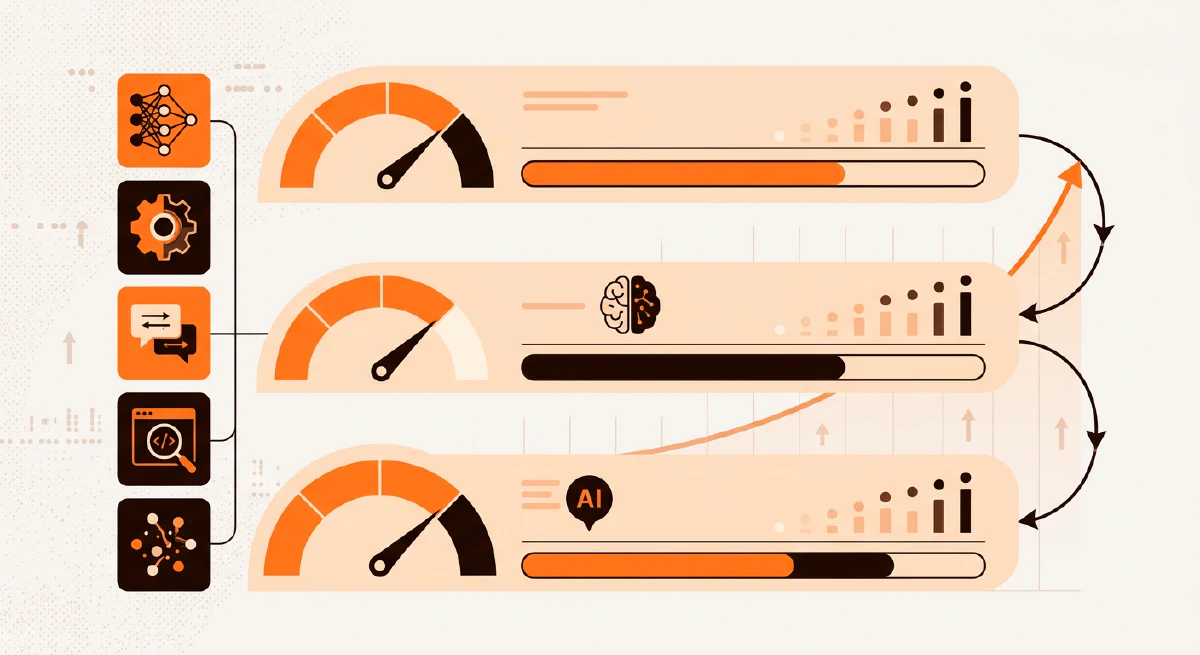

Improve brand visibility in AI with a measurement loop that runs on autopilot. Zeover benchmarks your visibility across ChatGPT, Claude, Gemini, and Grok on your chosen cadence, flags the queries where competitors are beating you, and shows what to fix. We run the tests so your team can focus on your core product. See your benchmark.
This is the final part of our series on how to rank in ChatGPT. The previous four parts covered the work: what ChatGPT cites, making sites AI-readable, building a content marketing strategy, and staying transparent. The last piece is the measurement discipline that tells whether any of it is working.
Most brands doing GEO are flying blind. They know they should be visible in ChatGPT answers. They don’t know whether they are. They change content, update schema, publish new pieces, and have no idea which changes moved their ranking in ChatGPT, which moved it backward, and which did nothing. Measurement is the difference between guessing and improving. An AI marketing strategy without measurement is a content calendar, not a strategy.
TL;DR
- ChatGPT ranking doesn’t show up in Google Search Console or traditional analytics. Dedicated AI-visibility measurement is required.
- Track four metrics per platform: brand visibility score, mention rate, recommendation rate, and share of voice vs named competitors.
- ChatGPT, Gemini, Claude, Grok, and Perplexity have different citation preferences. Aggregating hides the differences that matter.
- Run benchmarks monthly at minimum. Early signals appear in 2-4 weeks after content changes; sustained citation lift takes 2-3 months.
- Zeover automates the whole loop so teams see movement as it happens, not at quarter-end.
Why Traditional Analytics Miss ChatGPT Ranking
Google Analytics shows traffic from AI referrals when users click through. The problem is that most AI interactions don’t generate a click. A Pew Research study of 68,879 Google searches found users clicking a result only 8% of the time when an AI summary appeared, and just 1% clicked a source cited within the summary.
Applied to ChatGPT: 90+% of the value of being cited in ChatGPT never appears in analytics. A brand got mentioned, recommended, and quoted to a buyer, and unless they clicked through, there’s no record of it. Measurement requires running the queries customers would ask and checking the ChatGPT responses directly.
Traditional SEO tools don’t do this because it isn’t what they were built for. AI visibility and AI search optimization require their own measurement stack.
The Four Metrics That Matter
1. Brand visibility score
The percentage of relevant queries where ChatGPT mentions a brand. This is the north star.
If a company sells cybersecurity software and ChatGPT mentions the brand in 4 of 20 relevant security queries, the ChatGPT visibility score is 20%. Run the same analysis monthly and teams can track whether the number is moving.
The hard part is defining “relevant queries.” Start with 15-30 queries that represent how customers describe their need. Mix branded queries (questions including the brand) with unbranded ones (questions a new prospect would ask before knowing the brand exists).
2. Mention rate vs. recommendation rate
Getting mentioned is different from getting recommended. ChatGPT might mention a brand as one option among six, or name it as the top recommendation.
Mention rate captures any appearance in an answer. Recommendation rate captures specifically when ChatGPT presents a brand as a preferred option. For B2B, recommendation rate is the stronger pipeline signal - a user who asks ChatGPT for the best X tends to convert on the top recommendation, not on a brand mentioned in passing.
Track both. Mention rate shows whether a brand is visible in AI organic results. Recommendation rate shows whether it’s winning.
3. Share of voice
When ChatGPT discusses a category, how often does it reference a brand compared to named competitors? Share of voice captures relative position in AI-mediated discovery.
Calculate it by running the same category queries, counting total brand mentions across all answers, and computing the share of those mentions. If ChatGPT mentions a brand in 10 of 50 category-query answers, a competitor in 15, and another in 20, the share of voice is 10 of 45 total mentions, or 22%.
Share of voice matters because AI visibility and AI search optimization success is zero-sum on many queries. When ChatGPT recommends three brands, someone’s in the list and someone isn’t. Share of voice tells whether a brand is trending toward being included or pushed out.
4. Platform-specific visibility
Each AI engine has distinct citation preferences. Published 2025 analyses of tens to hundreds of thousands of AI-produced answers converge on the same directional findings:
- Gemini favors official brand websites (52% of citations) and the Google index.
- ChatGPT draws ~48% of citations from third-party sites.
- Perplexity averages 6.61 citations per answer, diversified across niche sources.
- Claude cites user-created content at 2-4x the rate of other models.
A strategy that makes a difference on Gemini (on-site schema, Google Business Profile) may underperform on ChatGPT (where third-party mentions matter more). Aggregating across engines hides these differences and masks the signals that would tell what’s working.
Track each platform separately - this is how to optimize for AI searches across multiple engines. Then pattern-match.
Query Selection: What to Benchmark
Quality of measurement depends on query quality. Three categories to include:
Branded queries. “Is [brand] secure?” “How does [brand] compare to [category leader]?” These are the easiest to win and the most important to monitor. If ChatGPT gets brand facts wrong when users ask about it directly, that’s the first thing to fix.
Category queries. “What’s the best [category] for [use case]?” “How should [audience] think about [problem]?” These are the acquisition queries. Being cited here is how ChatGPT introduces brands to new customers.
Competitor queries. “Is [Competitor] worth the money?” “What are alternatives to [Competitor]?” These are displacement queries where brands want to appear as named alternatives to brands already in consideration.
Aim for 15-20 queries per category. More is better if teams can maintain them. Evolve the list quarterly - add queries as the product expands, retire queries that no longer matter, add competitor queries as new competitors emerge.
Cadence: Monthly Minimum
AI engines update their models, retrain on new data, and adjust citation behavior regularly. A benchmark from three months ago may not reflect today’s reality. Waiting a quarter to re-measure means teams are three months behind on whatever moved.
At minimum, run the full benchmark monthly. For highly competitive categories or brands in active growth phases, weekly is defensible. Set alerts for significant movement so a 10-point drop on any platform doesn’t wait until next month’s report.
Early signals appear in 2-4 weeks after content changes. Sustained lift builds over 2-3 months. Don’t expect changes shipped today to show up in tomorrow’s benchmark. AI engines need time to re-crawl, re-evaluate, and update their citation patterns. Build that latency into the iteration cycle.
The Iteration Loop That Works
Measurement that doesn’t change behavior - and AI marketing analytics that don’t drive action - waste effort. The loop:
- Baseline. Run the first full benchmark. Identify queries where competitors appear and the brand doesn’t.
- Prioritize gaps. Rank the missing queries by business value. Not every unranked query matters equally.
- Form a hypothesis. Pick one variable. “Adding FAQPage schema to our product page will move us into the ChatGPT response for ‘how does X platform handle Y’.”
- Make the change. Small, attributable, documented.
- Wait 4-6 weeks. Re-measure. Did the targeted query shift? What else shifted?
- Generalize. Changes that worked on one query are worth applying to related queries. Changes that didn’t work aren’t worth repeating.
- Repeat continuously. Organic GEO isn’t a launch. It’s a running loop.
The brands winning in ChatGPT and improving their AI marketing strategy aren’t the ones running this loop once per year. They’re the ones running it every month.
How ChatGPT Movement Differs From Gemini, Claude, Grok, and Perplexity
A 10-point drop on ChatGPT means something different from a 10-point drop on Gemini. Interpret them separately:
- ChatGPT drops usually signal a third-party source shift (a directory or review platform updated its rankings, a competitor got press coverage, a brand’s own LinkedIn presence weakened).
- Gemini drops usually signal a site-level issue (schema change, technical SEO issue, a competitor published a better resource).
- Claude drops usually signal user-produced-content shifts (Reddit sentiment, forum discussion, community conversation moved).
- Grok drops usually signal reduced visibility on X (less posting, lower engagement, competitor building presence).
- Perplexity drops usually signal loss of depth in a specific niche (competitor published better technical content, a piece lost freshness).
The remediation is different for each. Measuring per-platform lets teams diagnose the cause, not just the symptom.
What Zeover Does For This Loop
Zeover automates the full AI marketing analytics stack. Define tracked queries once - branded, category, and competitor - and the platform runs them across ChatGPT, Claude, Gemini, and Grok on the chosen cadence. Teams see visibility scores per engine, share of voice versus named competitors, and query-level gaps where competitors appear and the brand doesn’t.
When a visibility score drops on ChatGPT specifically, Zeover flags what changed and suggests targeted fixes - schema additions, content gaps, press release opportunities, directory updates. Teams go from “my ChatGPT ranking dropped” to “here’s what to change to fix it” in one interface.
We run the research and the testing so teams can stay focused on the product their customers actually pay for. This is how to improve brand visibility in AI at the pace AI engines are actually moving, without building a GEO ops team from scratch.
That’s the Series
This is the end of our “How to Rank in ChatGPT” series. Five parts, one complete playbook:
- What ChatGPT Cites and How Gemini, Claude, Grok, and Perplexity Differ
- Build an AI-Readable Site ChatGPT Crawlers Actually Understand
- A Content Marketing Strategy Built for AI Citations
- Accuracy Over Tricks: Transparency in Organic GEO
- Measure, Iterate, and Improve Brand Visibility in AI (this post)
Each part builds on the last. Together they form a complete AI marketing strategy for ChatGPT visibility that also lifts visibility on Gemini, Claude, Grok, and Perplexity. Start with Part 1 and work through to the end. If preferring to skip the manual work, Zeover handles the pipeline: audit, content generation, measurement, and ongoing competitive intelligence so teams stay focused on the product.


