Why AI Marketing Automation Matters More Now
Marketing Automation GEO AI Strategy
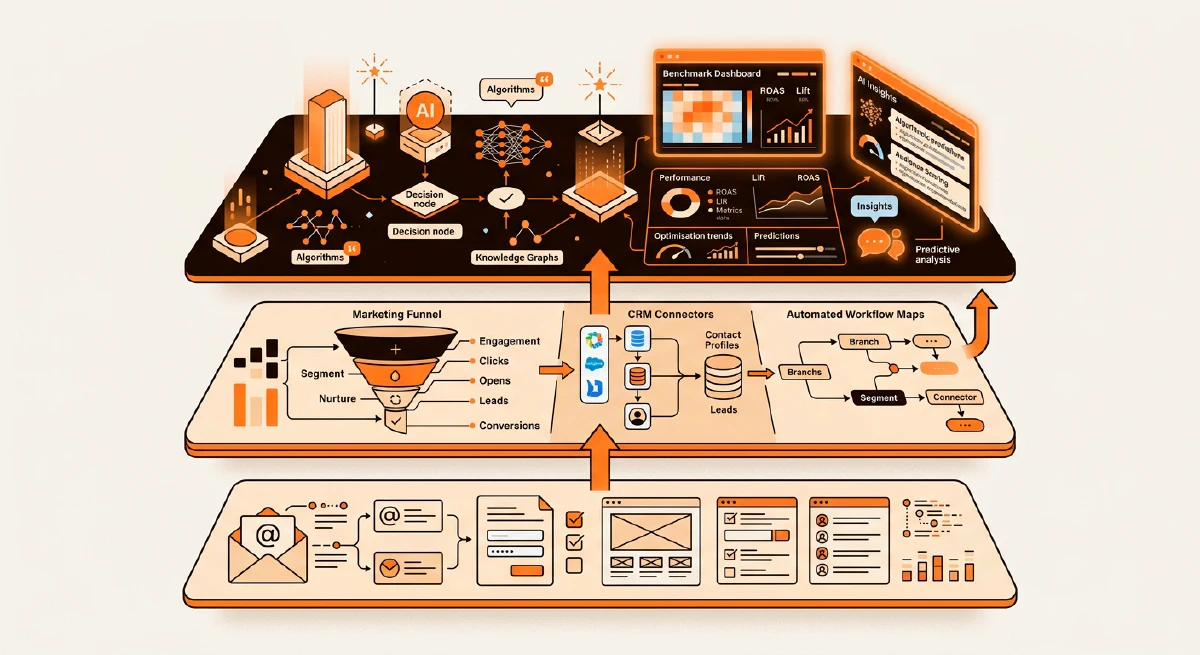

Marketing automation isn’t optional in 2026. The question is whether the platform you run was built for SEO and email or for the AI-mediated buyer journey. Zeover audits where existing automation stacks fall short on AI visibility, generates GEO-tuned content for the channels that drive citations, and benchmarks brand presence across ChatGPT, Claude, Gemini, Grok, and Perplexity. Run a stack audit.
The Proof Is This Blog Post!
This article was written, edited, titled, and approved entirely over email. The human who approved it was on a flight. The draft was produced from a prompt, the image was produced, the slug was renamed, the date was updated, the series-preview section was removed, and the push to production was a single reply chain powered by the Zeover Organic GEO 1.0 Platform - no CMS login, no staging environment, no scheduling a call for review.
That’s not a gimmick. It’s a working demonstration of what a 2026 marketing automation platform makes possible: a content pipeline where the human sets direction and makes judgment calls, and the automation handles everything between intent and publish.
Most marketing teams in 2026 still run the 2021 loop. Draft in a doc. Comment thread across three stakeholders. Paste into a CMS. Find or commission a hero image. Schedule. Wait for the right person to log in and hit publish. The loop takes days even when the post is ready in hours.
The difference between that loop and this one isn’t talent or budget. It’s whether the platform handles content production, governance, and distribution as first-class workloads or as bolt-ons to an email drip engine. Every team has smart people. Not every team has wired those people into a system that turns “approve” into “live” in the time it takes to reply to an email.
Operations still running the 2021 loop aren’t just slower. They’re doing more of the same work while competitors running a 2026 loop ship four posts in the time it takes the legacy team to get one through legal. The gap compounds.
What 2021 called marketing automation was email drip and form-fill lifecycle. Real automation, the kind that keeps brand data consistent across every public surface AI engines read, drafts brand-voice content from briefs, and notifies LLMs of entity changes through documented update channels, was technically impossible until 2024. The category got real because of AI, not in spite of it. According to Gartner’s 2026 CMO Spend Survey of 401 marketing leaders, CMOs are allocating 15.3% of marketing budgets to AI, yet only 30% report mature AI capabilities. The gap between operations running a 2026-class platform well and operations running a 2021-shaped platform on a 2026 problem widens every quarter.
TL;DR
- CMOs allocate 15.3% of marketing budgets to AI in 2026, per Gartner’s 2026 CMO Spend Survey, but only 30% of marketing organizations report the maturity to scale those investments.
- 87% of marketers use generative AI in at least one workflow in 2026, up from 51% in 2024, per Salesforce’s tenth State of Marketing report. Adoption is no longer the differentiator; what the platform is configured to do is.
- AI-driven automation of marketing work is expected to more than double, from 16% in 2026 to 36% by 2028, according to Gartner’s separate survey of marketing leaders. The work moving into automation isn’t email drip; it’s content production, benchmarking, and entity governance.
- Legacy email-and-drip workload is table stakes. The new workload is brand-consistent content production, multi-engine benchmarking, and AI-citation tracking, and most platforms still bolt those on rather than treat them as core.
- High-performing teams running mature AI workflows save 8 hours per week and report a 20% ROI lift, per Salesforce’s data. The compounding shows up inside two quarters of running a 2026 cadence.
The Adoption Number Is Not The Story
It’s tempting to look at near-universal adoption and assume the marketing-automation question is settled. That’s the wrong read. Adoption saturated means the marginal customer in 2026 is a team replacing a platform they already have, not buying their first one. The decision is no longer “should we automate,” it’s “what work should the automation be doing now that the buyer journey has moved upstream of every owned channel.”
Two pieces of data make the shift visible.
First, AI spend inside marketing is rising sharply even though seat counts aren’t. Gartner’s 2026 CMO Spend Survey found AI-ready marketing organizations spending 21.3% of marketing budgets on AI compared to a 15.3% average. The leaders aren’t spending more on the legacy platform. They’re spending more on the AI-era capabilities layered on top of it.
Second, AI is being absorbed inside the platform, not bolted on top. Salesforce’s State of Marketing 2026 reports 87% of marketers using generative AI in at least one workflow, up from 51% in 2024, and high performers running agentic AI at roughly double the rate of underperformers. The platforms that win the next four years turn that capacity into measurable lift, not into a chat assistant.
The adoption number is the floor. The interesting line is what the platform is being asked to do next.
Why The 2021 Playbook Stopped Working
A 2021 marketing automation deployment looked like this: lead capture forms, segmented email drips, lifecycle journeys triggered off CRM events, and a reporting dashboard with open rates and click-throughs. Pipeline measurement traced through Google rank, paid clicks, and form fills. The platform’s job was to nurture known contacts and feed CRM with qualified leads.
In 2026, three things have changed.
Discovery moved upstream of the platform. Buyers ask ChatGPT or Gemini for shortlists before any tracked surface lights up. By the time a lead fills a form, the AI has already built an opinion of the brand from sources the legacy platform never read. Email drip can’t fix a recommendation the brand failed to earn during AI-mediated discovery.
Content velocity outpaced editorial bandwidth. Multi-engine GEO requires content tuned for each engine’s citation behavior. Teams that ran 8-12 blog posts a quarter on the old playbook now need 40-50 with different formats for ChatGPT-style answer extraction, Gemini-style grounded results, and Perplexity-style source citation. Without an automation layer that includes content production, the editorial team becomes the bottleneck.
Measurement requires data the platform doesn’t have. Citation rate, sentiment per engine, and summary accuracy live outside legacy automation reporting. A platform that only tracks email opens and form fills shows a flat line through 2026 even as the brand’s actual visibility on the AI surface that matters drifts up or down without anyone in marketing knowing.
The 2021 playbook didn’t fail. It got expensive, because the platform doing the email drip is now adjacent to the work that actually drives pipeline.
The Five New Workloads A Platform Has To Carry
A 2026-class marketing automation platform earns its keep by handling five workloads that didn’t exist in 2021. Each maps to a part of this series.
Brand-consistent content production at scale. Briefs, drafts, edits, and approvals across writers, agencies, partners. The platform either produces and reviews content against a governance document or it doesn’t; the difference shows up in citation rate within two quarters. Part 3 covers the tool categories.
Cross-engine visibility benchmarking. Citation rate, share of voice, and summary accuracy on ChatGPT, Claude, Gemini, Grok, and Perplexity, run on a continuous cadence rather than as a one-time audit. Part 6 covers the operating rhythm.
Machine-readability validation. Schema, heading hierarchy, llms.txt, canonical URLs, all the technical primitives that determine whether a page even gets cited. The platform that flags machine-readability gaps before publish closes the loop.
Brand entity governance across the public surface. AI engines synthesize brand summaries from contradictory sources. Platforms that crawl and reconcile owned content, press, social, and partner directories produce a coherent entity signal.
Pipeline attribution that includes AI-sourced traffic. Most legacy attribution models split traffic into “organic search,” “paid,” and “direct.” AI-sourced traffic shows up in “direct” or “referral,” miscategorized and undermeasured. Platforms that surface AI-sourced traffic as its own channel give teams the data needed to invest correctly.
Operations running a platform that handles three of those five are doing fine. Operations stuck on email-and-form only are losing share to whichever competitor in their category invested earlier.
What “Universal Adoption” Hides
The 87% adoption number papers over operational maturity that varies more than the headline suggests. The same survey line covers a Series A SaaS team running a free-tier email tool with no flows, an enterprise running a fully integrated platform with agentic AI workflows, and everything between. Gartner’s finding that 70% of CMOs see becoming an AI leader as a critical 2026 goal, while only 30% have mature AI capabilities, is the same gap in a different cut of the data.
A useful internal-audit question for a head of marketing: of the five workloads above, how many does the current platform handle natively, how many are stitched together with point tools, and how many aren’t happening at all? An honest answer of “two natively, two with point tools, one missing” is normal for mid-market operations and tells the team where the next-90-days investment should land. An honest answer of “one natively, none in flight” is a red flag that the platform decision is overdue.
The maturity gap matters because of compounding. A team that closes the brand-consistency workload this quarter sees citation rate move within two quarters. A team that doesn’t sees it move for the competitor instead. Across a year, the gap between modernized stack and legacy stack can hit 30-50% of category-specific AI citation share.
The Spend Argument Is Easier Than It Looks
A common objection to investing more in marketing automation is the assumption that the return on the next dollar is lower than on the current dollar. The 2026 ROI math points the other way. Salesforce’s State of Marketing 2026 puts the average lift at 20% ROI improvement and 19% cost reduction for marketers rolling out AI successfully, with high performers saving 8 hours per week through automation.
The reason the marginal-dollar return holds: the new workloads (content production, benchmarking, machine-readability, attribution) operate on inputs that don’t yet have automation in most companies. Adding automation where there’s none returns more than incrementally improving an automated email drip that’s already running.
The practical implication is that marketing leaders shouldn’t budget for marketing automation as a flat line. The category isn’t stable. Teams that pull the budget allocation forward into 2026 see the compounding lift. Teams that defer to 2027 inherit competitor citation share to claw back, which costs more than building presence directly.


