How to Optimize for AI Searches - Make Your Content Machine-Readable (Part 3 of 7)
Strategy GEO

Is your content AI-ready? Zeover scores every page on your site against 100+ GEO metrics covering content structure, readability signals, and citation-worthiness, then generates optimized replacements. Check your site.
This is part three of our series on how to optimize for AI searches. Parts one and two covered the foundations: llms.txt tells AI engines where to look, and schema markup tells them what each page is. But once they’re actually reading your content, the writing itself decides whether you get cited or passed over.
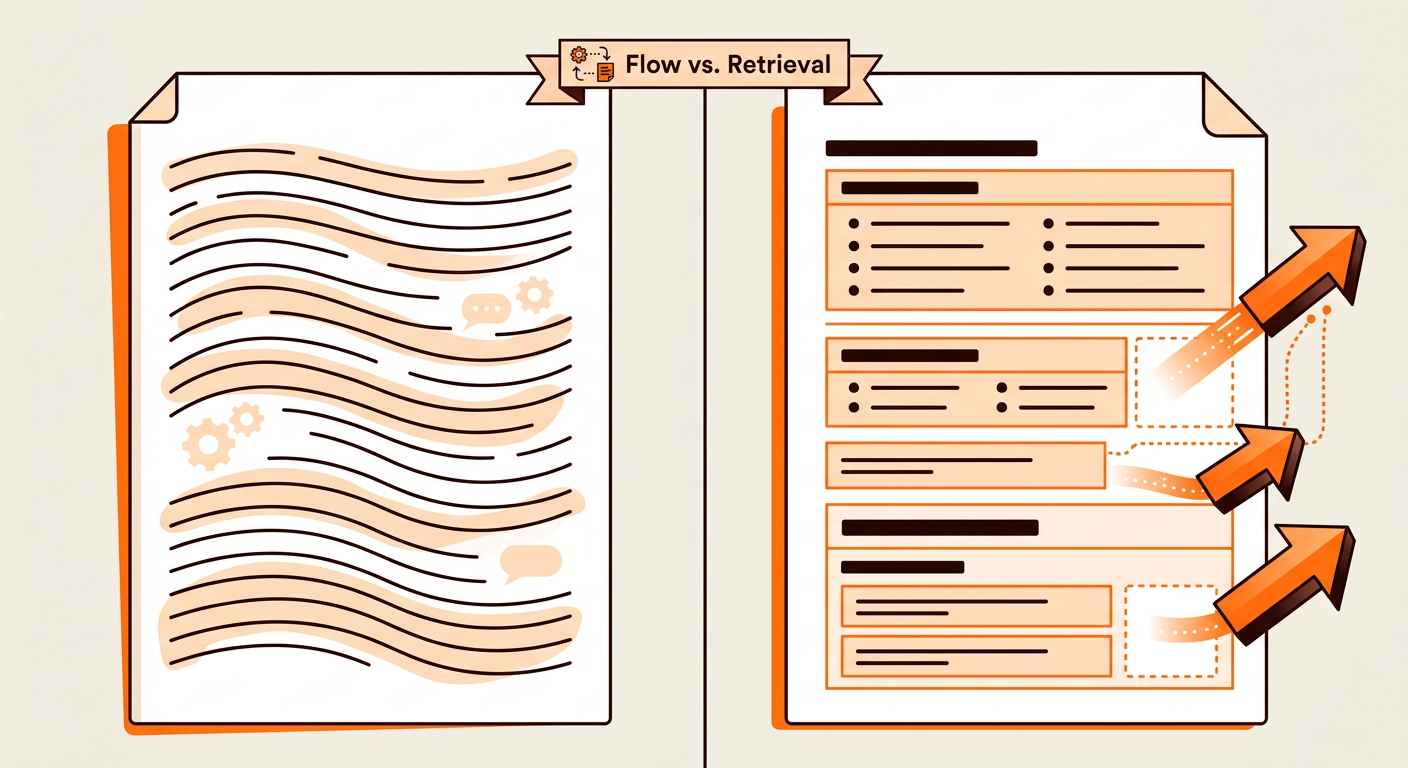
Most brands write for humans. They craft narrative flow, use rhetorical devices, bury key facts inside paragraphs, and trust readers to follow along. That style doesn’t survive AI retrieval. AI engines extract content in passages, not full essays. They need sentences that stand alone, sections that answer single questions, and HTML structure that mirrors the logical structure of the information.
TL;DR
- AI engines extract content in passages. Sentences that don’t stand on their own rarely get cited.
- 44.2% of all AI citations come from the first 30% of a page’s content. Front-load your answers.
- Declarative structure beats narrative flow. Each section should answer a specific question in its opening lines.
- Clean HTML hierarchy (H1, H2, H3) is what AI engines use to understand your content’s logical structure.
- The same content rewritten for machine readability can double or triple its AI citation rate without changing the underlying claims.
What “Machine-Readable” Means (and What It Doesn’t)
Machine-readable doesn’t mean robotic. It doesn’t mean stripping out voice, personality, or editorial judgment. Plenty of citable content on the web has all three.
What it means is that the underlying structure of your writing is legible to an AI system that’s extracting information. That system doesn’t have the benefit of context windows full of your brand voice or the time to appreciate a cleverly constructed narrative arc. It’s trying to find the specific sentence or passage that answers a user’s question, then decide whether to trust it.
Three things make content machine-readable:
- Declarative sentences that state facts clearly and don’t depend on previous sentences to be understood.
- Self-contained sections where each heading-to-heading unit answers one specific question.
- Clean HTML hierarchy where headings, lists, and paragraphs reflect the logical structure of the information.
Get those three right and you’re writing for both humans and AI at the same time. Most good technical writing already does this.
Front-Load Your Answers
An analysis of AI citation patterns found that 44.2% of all AI citations come from the first 30% of a page’s content. The implication is unambiguous: your most citable sentence should appear near the top of each section, not buried three paragraphs down.
Structure every section like an inverted pyramid. Open with the key fact, statistic, or recommendation. Then expand with evidence, examples, and context. Readers who want depth can keep reading. AI engines extracting a single passage have what they need in the first two lines.
Compare these two openings for a section on pricing strategy:
Human-first (weaker for AI): “Pricing is one of those topics that seems simple until you actually sit down and think about it. There are dozens of frameworks out there, each with their passionate advocates, and the honest truth is that most of them work in some context and fail in others. What we’ve found after years of testing…”
Machine-readable (stronger for AI): “Value-based pricing outperforms cost-plus pricing by an average of 24% in gross margin, according to a 2024 MIT study of 400 SaaS companies. The catch is that value-based pricing only works when you can quantify the value your customers receive.”
The second version gives AI engines a specific claim with attribution in the first sentence. An AI system extracting passages will take that one easily. The first version forces the extractor to synthesize meaning across multiple sentences, which often results in no citation at all.
Write Declarative, Self-Contained Sentences
A declarative sentence states a fact without depending on context from surrounding sentences. AI engines extract content at the sentence level. If your key fact is split across two sentences that reference each other, the AI is forced to reconstruct the relationship, and often won’t bother.
Weak: “We’ve found this to be especially true for B2B SaaS. Companies in that category tend to benefit more from content marketing than paid acquisition.”
Stronger: “B2B SaaS companies benefit more from content marketing than paid acquisition, based on a 2024 study of 400 companies.”
The second version can be quoted verbatim. The first version requires context.
The same principle applies to pronouns. “It improves efficiency by 30%” is useless outside the paragraph where “it” is defined. “The platform improves efficiency by 30%” survives extraction. If a sentence uses a pronoun, assume AI engines will lose the referent. Name the subject explicitly whenever possible.
Make Every Section Self-Contained
Each heading-to-heading unit in your content should answer one specific question. Readers shouldn’t need to have read the previous section to understand the current one. AI engines definitely don’t.
Practical structure for a section:
- Opening sentence that states the key answer, fact, or recommendation.
- Evidence - a statistic, quote, or data point that supports the claim.
- Elaboration - how it works, why it matters, or what the edge cases are.
- Optional example - a concrete case that makes the claim tangible.
Sections that follow this pattern are extractable as complete units. An AI engine can pull any single section from the page and have a coherent answer to a specific question. That’s exactly what you want, because AI engines frequently cite individual sections rather than whole pages.
Use Clean HTML Hierarchy
Headings aren’t styling. They’re the structural skeleton AI engines use to understand how your content is organized. H1 names the page topic. H2s define the main sections. H3s define subsections within those sections. Skipping levels or using headings for visual size instead of semantic structure breaks this hierarchy.
Rules to follow:
- One H1 per page, and it should match or echo your page title.
- H2s break your main sections. Each H2 should be a clear topic boundary.
- H3s nest within H2s. Don’t use H3s between H2s to create decorative breaks.
- Don’t wrap headings in images or hide them in PDFs. AI crawlers won’t extract text from images.
The same rule applies to lists, tables, and code blocks. A list of items in semantic HTML (<ul><li>...</li></ul>) is extractable as a list. The same items written as run-on prose with commas between them requires more parsing and often fails.
The Things to Stop Doing
A few patterns that consistently hurt AI visibility:
Burying facts in narrative. If your key statistic appears in the third sentence of a three-sentence paragraph, move it to the first. Every paragraph should either open with or contain a quotable fact.
Writing for word count. Padding sections with filler because “long-form content ranks better” is advice for traditional SEO, not GEO. AI engines prefer dense, structured content over verbose, unstructured content.
Using images for key information. Infographics, charts, and screenshots are fine as supplements. They can’t replace text. If the information only exists as an image, AI engines can’t extract or cite it.
Paragraph-long headings. Headings should be short, descriptive, and parseable. A heading that’s two sentences long signals poor structure.
Hiding content behind accordion or tab UI without proper markup. Content inside client-rendered accordions often doesn’t get extracted. If you use these patterns, make sure the underlying HTML exposes the content.
Where This Fits in the Series
Machine-readable writing is what lets your pages become citable once AI engines reach them. Schema markup tells them what the page is. The writing itself determines what they extract.
Zeover scores every page on your site against machine readability metrics - sentence structure, section self-containment, heading hierarchy, front-loading - and flags specific pages that need rewrites. The platform also generates content with these signals built in from the start, so new posts don’t require a separate editing pass.
Previously in this series: