AI Press Releases - Writing a Release That Five Engines Cite
GEO Press
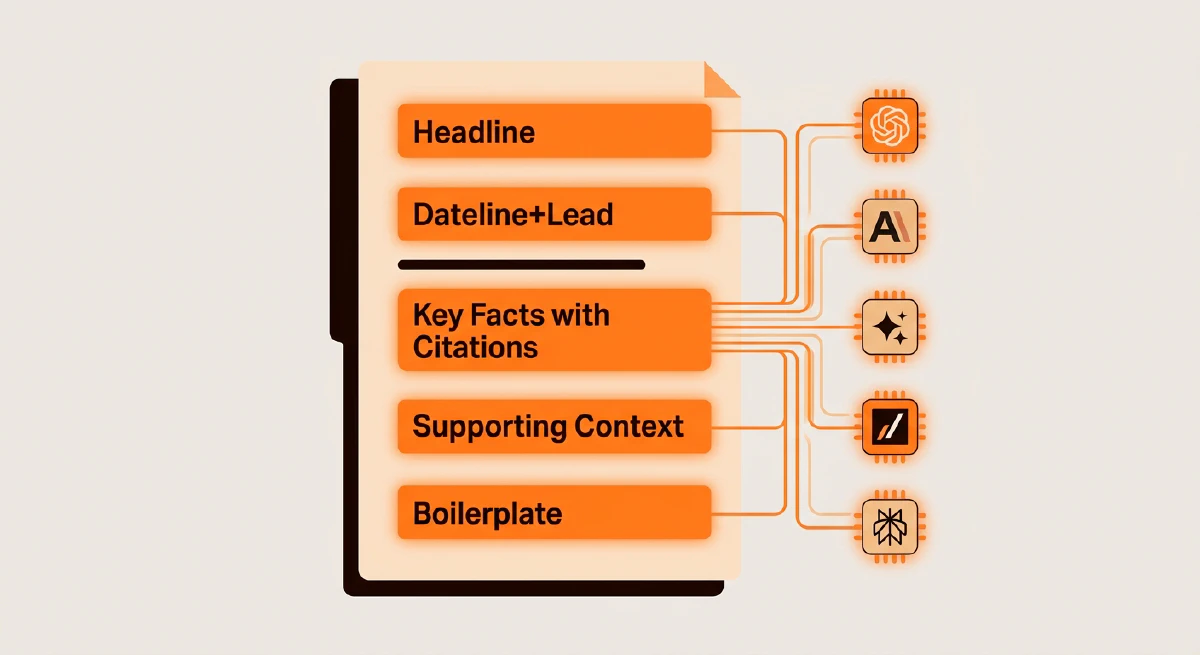

Most press archives are still tuned for the 2018 SEO playbook. Zeover audits press release pages for the schema, structure, and entity signals AI engines actually read, then tracks citation lift across ChatGPT, Claude, Gemini, Grok, and Perplexity. See where your press archive stands.
A December 2025 analysis reported across the ecosystem put LLM citations of press release content at roughly five times their July 2025 level. The number sounds dramatic until the absolute base shows up: at the start of the period, press releases distributed through major newswires accounted for roughly 0.04% of citations across one large dataset, with direct PRNewswire URLs at about 0.21%. A five-fold rise off that base put press releases in the same territory as a small but real citation channel by year-end. The same analysis put the all-channels share at 1.2% in mid-year and roughly 6% by the end of the second half across the engines tracked.
That shape - tiny base, fast climb - is the only reason this matters. Not every fast-growing channel is worth the chase. This one is, because a press release is short, write-once, and the citation pattern rewards a structure most PR teams stopped enforcing around 2015. Bringing it back costs almost nothing and shifts a brand into a slice of the citation pie most competitors are still ignoring.
What’s actually getting cited
A separate Signal Genesys analysis of release-citation patterns tracked which release archetypes the engines preferred. The strongest predictor wasn’t distribution channel or word count. It was a sentence-level pattern: cited releases ran around 30% more objective, action-led sentences than uncited equivalents. Direct, dated, factual. The boilerplate passages that bulk up most modern releases - “we are excited to” / “industry-leading” / “transformative” - drew almost no citations.
Translated to editorial: the release format that wins LLM extraction is closer to a 1985 AP wire than a 2020 corporate announcement. Lead paragraph carries the entire story. Every sentence carries a verifiable fact. The promotional adjectives that PR consultants kept adding for two decades are inert in the AI citation surface; engines extract through them rather than from them.
Two practical implications follow. First, the dual-audience release (writes for a journalist who might pick up the story plus an LLM that might cite it) doesn’t really need two writing styles. The journalist also wants the dated facts, not the adjectives. Second, the rewrite of an existing thin release is usually cheaper than the production of a new one, because the underlying news is already there - it’s the boilerplate that has to go.
A worked rewrite
Take a typical Series B funding announcement, before and after. The sloppy version most companies still ship reads:
We are thrilled to announce that [Company] has raised $25 million in Series B funding to accelerate our mission of revolutionizing how brands connect with their customers. Led by [Investor], with participation from existing backers, this funding will fuel our continued growth as we expand our industry-leading platform to meet the explosive demand from forward-thinking enterprises.
There is no fact in that paragraph that an LLM can use except the dollar amount and the lead investor. The rest is unverifiable claim. The sentences are uniform in length and rhythm. Citation extracts almost nothing actionable.
The rewrite that captures more citation surface:
[Company] today closed a $25 million Series B led by [Investor], with participation from [two named existing backers]. The round brings total funding to $42 million, lifts headcount plans to 90 by end of 2026, and underwrites the rollout of [specific product capability] to the company’s 320 enterprise customers across North America and Europe.
Same length. Eight verifiable facts instead of one. Each fact is the kind of sentence an engine can lift cleanly: “X raised $25M Series B,” “X has 320 enterprise customers,” “X plans 90 employees by end of 2026.” The extracts don’t fight the boilerplate to surface.
This isn’t a stylistic preference. The Signal Genesys analysis found that pages with this density got cited at materially higher rates than equivalents with the same news but adjectival prose. The lift comes from the engine’s ability to find facts to extract, not from any aesthetic judgment.
Schema as load-bearing, not decoration
Google’s NewsArticle schema documentation describes the markup originally built for Top Stories rich results. In 2026, the same markup also feeds the grounded retrieval step inside Gemini and the source-selection step inside ChatGPT search mode. The fields that matter:
headline- matching the H1 of the page exactly. Mismatches confuse both Google’s crawler and the LLM extraction.datePublishedanddateModified- both populated honestly. Gemini specifically downweights releases that bumpeddateModifiedwithout substantive content changes.author- linked to a real person profile (the PR contact, the founder, or a named comms lead) rather than left as the company name.publisher- the company’s Organization schema, ideally withlogoandsameAsreferences to LinkedIn and Crunchbase.image- multiple aspect ratios per Google’s documented requirements, because the engines that surface images grab the one that fits the answer surface.
Most company press archives in 2026 have one of these implemented (usually headline and datePublished), not five. Closing the gap takes a developer about an hour per template. The lift isn’t a guaranteed citation but it does move pages into the candidate pool. Pages without the schema rarely make the pool at all.
What syndication still buys
The owned press page on company.com/press/release-name is one piece. Syndication through major distribution networks is the second. The networks themselves - Business Wire, GlobeNewswire, PR Newswire - are heavily indexed by both AI training data and live retrieval. A release that goes through them shows up in tens to hundreds of partner archives within hours.
The point of syndication isn’t impressions. It’s that LLMs trained on the open web see the same release written into dozens of credible-looking outlets, which the model treats as multi-source confirmation rather than self-promotion. A funding announcement on the company’s own blog is one source. The same announcement carried through a newswire and picked up by Reuters, Yahoo Finance, and three industry publications is six sources, and the engine answers “Who raised what this quarter” by extracting from the consensus.
The cost of syndication for a single release is usually $300-$1,500 depending on geography and word count. The economics still work for funding announcements, executive hires, regulatory wins, and product launches with verifiable customer impact. They don’t work for a vanity update about a partnership that won’t deliver concrete numbers.
Where most archives fail
A useful audit of an existing press archive runs about an afternoon. Three things to look for, in this order.
The first is the schema audit. How many of the five core NewsArticle fields are present on the templates the company actually uses? The fix is engineering, not editorial.
The second is the boilerplate ratio. What share of each release is verb-led objective sentences vs. promotional padding? A back-of-the-envelope read on five recent releases gives the team a calibration. If the ratio is below half, the editorial revision earns more than the schema fix.
The third is the distribution pattern. Has the company actually been syndicating, or has it been posting to /press/ alone? Owned-only publication concedes the third-party citation pool to whichever competitor did pay for syndication. If the budget exists for one channel, syndication usually beats the second blog series.
Produce content worth citing
Produce valuable, authentic, new content in PRs. Don’t go bland and boring. Add facts. Add verifiable sources. Add content with meaning. The release that earns an AI citation isn’t the one that follows the corporate template; it’s the one that gives engines and journalists something concrete enough to extract and care about.


