How to Optimize for AI Searches - Lock Your Brand Boilerplate Across Every Channel (Part 4 of 7)
Strategy GEO

Consistent brand signals drive AI citations. Zeover audits your brand footprint across every channel AI engines monitor, benchmarks your visibility on ChatGPT, Claude, Gemini, and Grok, and generates boilerplate-aligned content that reinforces your positioning. Start your audit.
This is part four of our series on how to optimize for AI searches. Parts one through three covered your own site: llms.txt, schema markup, and machine-readable writing. This part is about what AI engines see when they look beyond your domain.
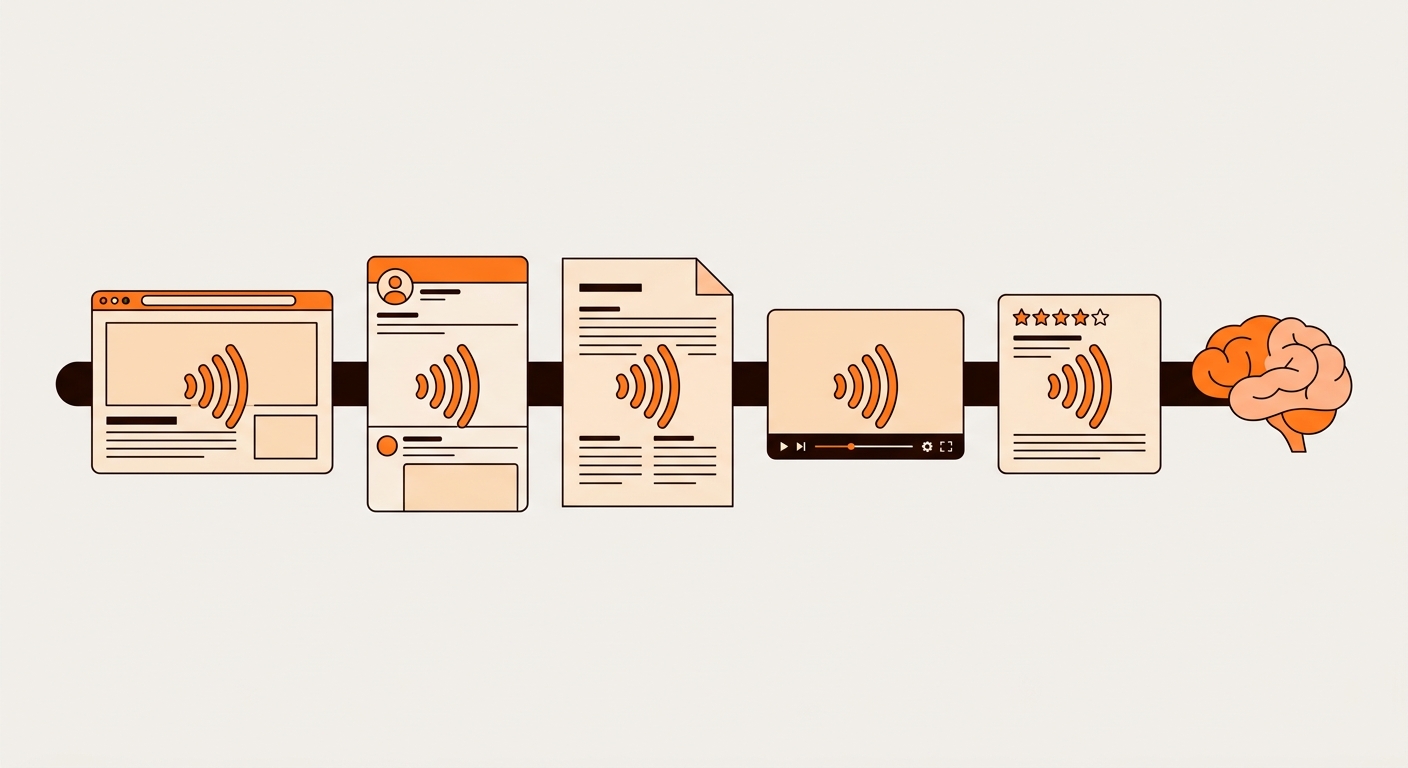
AI engines don’t form their understanding of your brand from your website alone. They aggregate signals from every place your brand appears online - LinkedIn, press releases, social posts, directories, review sites, YouTube, third-party editorial coverage, and Wikipedia if you’re there. When those signals align, AI engines have high confidence in who you are and what you do. When they contradict each other, confidence drops, and so does your citation rate.
TL;DR
- 86% of AI citations come from brand-managed sources: websites (44%), listings (42%), and reviews/social (8%).
- Gemini pulls 52% of its citations from official brand websites. ChatGPT pulls nearly half from third-party sites like review platforms and directories.
- Inconsistent boilerplate (different company descriptions, taglines, or positioning across channels) confuses AI engines and reduces citation rates.
- Lock your boilerplate in a single master document and enforce it across every channel. Review quarterly.
- Zeover tracks your brand presence across channels and generates new content aligned with your canonical boilerplate.
What “Boilerplate” Means in the AI Era
Brand boilerplate used to be a PR artifact - the two-paragraph company description at the bottom of a press release. Today it’s much more. It’s the consolidated set of factual claims, positioning statements, and descriptive language that an AI engine uses to build its mental model of your brand.
Your boilerplate includes:
- What your company does (the one-sentence version)
- Who it serves (the one-sentence version)
- Your differentiators (two or three specific claims)
- Key facts (founding year, team size, location, funding)
- Product or service taxonomy (the categories you operate in)
If the answer to “what does your company do” varies between your homepage, LinkedIn About page, press release boilerplate, and YouTube channel description, AI engines have conflicting data about the same entity. They default to uncertainty, and uncertain sources get cited less.
Where AI Engines Aggregate Signals
An analysis of 6.8 million AI citations found that 86% of citations come from brand-managed sources. Those sources break down as 44% websites, 42% listings/directories, and 8% reviews and social. The remaining 14% comes from editorial content, user-generated forums, and research databases.
The split isn’t uniform across AI engines. Gemini pulls 52% of its citations from official brand websites. ChatGPT is more diversified, with nearly half its citations coming from third-party sites like review platforms, industry directories, and professional networks. Perplexity cites roughly 3x more sources per response than ChatGPT and diversifies across niche industry publications. Claude cites user-generated content at 2-4x the rate of other models.
The implication: if your brand’s presentation varies across channels, different AI engines form different impressions of you. One might get the story right from your homepage. Another might get a stale version from a directory listing you haven’t updated in three years. The user asking the same question through different AI assistants gets different answers.
The Channels That Matter Most
Not every channel carries equal weight. The ones to prioritize:
Your website
Your homepage, About page, and key service pages anchor everything else. If these aren’t aligned with the positioning you use elsewhere, the rest of the exercise is moot. Start here.
LinkedIn company page
LinkedIn is the most-cited professional network in AI answers, and for B2B especially, AI engines weight LinkedIn heavily. Your company tagline, About section, and industry classification should match your website boilerplate word-for-word where possible.
Directory listings
Google Business Profile, Yelp, Apple Maps, Bing Places, industry directories (G2, Capterra, Clutch, and vertical-specific directories). These are listing sources that AI engines pull from directly. Inconsistent name, address, phone, or category data is one of the top reasons AI engines skip a brand entirely.
Press releases and newswire distribution
Boilerplate at the bottom of every press release should match your master version exactly. Press releases syndicate to hundreds of endpoints that AI crawlers visit, and each syndicated copy becomes another data point. Inconsistent boilerplate across press releases over time tells AI engines your positioning is fluid.
Social profiles
Twitter/X, Instagram, TikTok, Facebook, YouTube channel descriptions. These are shorter forms of boilerplate but should still align. The YouTube channel description specifically matters because AI engines pull heavily from YouTube metadata - we covered that in our post on YouTube for AI visibility.
Third-party editorial coverage
Coverage in trade publications, industry news, and editorial content carries the highest weight per citation. But you can only influence the quality of your boilerplate here indirectly - by providing journalists and editors with clean, consistent boilerplate in your media kit.
The Framework for Locking Boilerplate
Step 1: Write your canonical boilerplate. This is your master document. Include:
- One-sentence company description
- One-sentence “what we do” description (action verb, who we serve, what outcome)
- Three differentiators, each one sentence
- Key facts (founded, HQ, team size range, funding, notable customers)
- Product or service taxonomy (the industry categories you operate in)
- Two-paragraph version suitable for press release boilerplate
Keep this in a document that’s owned by one person - usually the head of marketing or communications. Every external-facing channel should pull from this source.
Step 2: Audit every channel. List every place your brand appears externally. Compare each channel’s current boilerplate to your canonical version. Flag inconsistencies.
Step 3: Update channels in priority order. Website first, then LinkedIn, then major directories, then press release boilerplate. Social profiles and third-party listings last.
Step 4: Set a quarterly review cadence. Company positioning evolves. New products launch, acquisitions happen, founders change titles. Every quarter, update your canonical boilerplate and cascade changes to every channel.
Step 5: Check for stale third-party content. Old directory listings, outdated profile pages, and abandoned social accounts can persist for years. Either update them to match your canonical boilerplate or claim and close them.
Common Pitfalls
Different marketing campaigns using different taglines. Campaigns come and go. Your boilerplate shouldn’t. If a quarterly campaign changes how you describe your product category, your boilerplate is campaign-dependent, which means it’s not really your boilerplate.
Sales team and marketing team describing the company differently. The About page says “AI Marketing Optimization platform.” The sales deck says “GEO platform.” The RFP responses say “content generation tool.” AI engines aggregating these sources get three different categorizations.
Acquired companies with lingering old boilerplate. If you’ve acquired another company, their old website, LinkedIn, and directory listings may still describe them as independent. That boilerplate confuses AI engines about whether the entities are the same.
Geographic inconsistency. Your HQ is in San Francisco, but your LinkedIn says Palo Alto and your Google Business Profile says San Mateo. These small inconsistencies accumulate and make AI engines less confident in citing any single source.
Where Zeover Fits
Zeover crawls your domain and identifies how your brand is presented across every channel it can measure. It flags inconsistencies between your website boilerplate, your public social profiles, and the AI engines’ actual view of your brand when users ask questions about you. When you generate new content through Zeover’s content tools, the boilerplate baked into every new piece matches your canonical version - so every new article, press release, or social post reinforces your positioning rather than diluting it.
Where This Fits in the Series
Consistent boilerplate anchors AI engines’ understanding of your brand. But they also evaluate freshness, volume, and topical authority - which means you need to be publishing consistently. The next parts of this series cover content cadence, measurement, and competitor research.
Previously in this series: