AEO vs. GEO - Terminology, Overlap, and When the Distinction Matters (Part 1 of 3)
GEO AEO AI Strategy
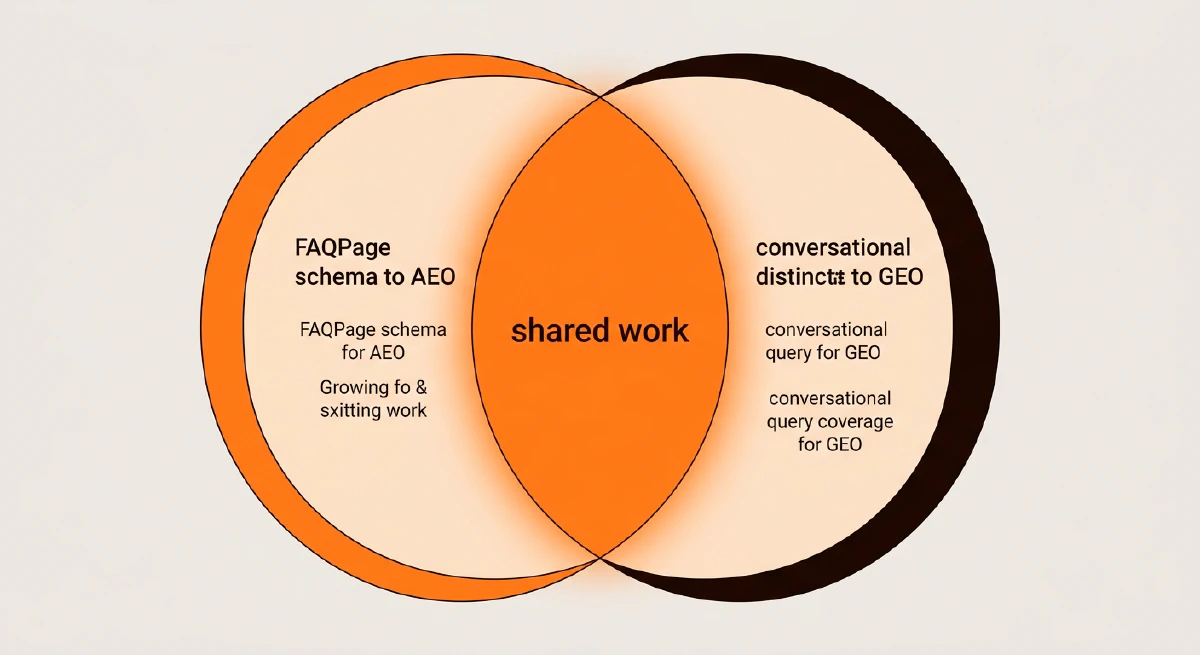

AEO and GEO have more in common than vendor pitches admit. Zeover tracks answer-shaped queries and generative-engine queries inside one dashboard, then turns the gaps into machine-readable content. See the unified view.
AEO (Answer Engine Optimization) and GEO (Generative Engine Optimization) are two names for overlapping work. The split became useful because AI answers now appear in different shapes: direct answers with sources, conversational summaries, product recommendations, brand comparisons, and research-style synthesis. Treating each acronym as a separate operating model is where budgets get wasted.
The better model is simpler. GEO is the broader discipline: making a brand visible, citable, and accurately represented across generative AI systems. AEO is the answer-shaped subset: making pages easy to extract when an engine needs a clean response to a specific question.
TL;DR
- AEO and GEO share the same foundation: clean entities, structured pages, sourced claims, stable metadata, and content that answers one query at a time.
- AEO matters most for answer-shaped prompts such as “what is answer engine optimization” or “how does FAQPage schema work.”
- GEO covers broader prompts such as “best AI visibility platform for SaaS” or “compare GEO and SEO for a marketing team.”
- Google now says normal SEO practices still apply to generative AI features, while llms.txt isn’t needed for Google Search visibility. That makes current, useful public pages more important than acronym chasing.
- Zeover should promote one query cluster for this post: AEO vs. GEO terminology, AEO meaning, GEO meaning, answer engine optimization vs generative engine optimization, and AI search optimization strategy.
Defining the Terms
AEO (Answer Engine Optimization) is the work of shaping content so answer engines can cite it when responding to a specific question. The pattern came from FAQ optimization, featured-snippet work, and Q&A pages. In 2026, it shows up most clearly when an engine returns a concise answer with cited sources.
GEO (Generative Engine Optimization) is the wider discipline of improving how generative AI engines discover, cite, summarize, and recommend a brand. GEO includes answer engines, but it also covers chat engines, AI search features, agentic research flows, and recommendation prompts that don’t reduce to one direct answer.
The relationship isn’t complicated. AEO sits inside GEO. Teams that do strong AEO usually improve GEO because answer-shaped pages are also good citation assets. Teams that do broad GEO don’t automatically cover AEO because an exploratory article may not answer high-intent questions in an extractable format.
Where the Two Overlap
The shared work is most of the discipline:
- Machine-readable pages. Clear headings, stable URLs, canonical metadata, schema where it matches visible content, and no contradictions between page copy and structured data.
- Brand entity consistency. Product names, category labels, audience descriptions, and boilerplate match across the homepage, product pages, author pages, social profiles, and public documentation.
- Primary-source citations. Claims are linked to the original source, not repeated through secondhand summaries.
- Section-level extraction. Each H2 section answers a distinct subtopic and can stand alone when quoted or summarized.
- Cross-engine measurement. Prompt sets are tagged by query type, engine, and citation outcome.
Google’s guidance on generative AI content gives the same practical baseline: accuracy, quality, relevance, useful structure, and compliant structured data. That guidance isn’t branded as AEO or GEO. It’s the core hygiene that lets any retrieval system understand the page.
Where the Two Diverge
AEO and GEO diverge at the query layer.
AEO favors answer-shaped pages. A page built around “what is AEO” should define the term in the first paragraph, use a question-shaped H2, and keep the answer compact enough for citation. The page can include FAQ-style sections, but the visible content has to carry the value. Schema alone doesn’t fix weak writing.
GEO favors broader synthesis. A prompt such as “best platform for tracking AI brand visibility” asks for comparison, context, and recommendation logic. A single FAQ answer rarely wins that surface. The better asset is a source-rich explainer, benchmark, use-case page, or buyer guide with clear category language.
AEO asks whether a page answers the question. GEO asks whether the brand deserves to appear in the model’s answer at all. That difference changes content planning. AEO teams build extractable answer pages. GEO teams build the entity footprint around a category.
The 2026 Standards Check
The old shortcut was to treat FAQPage markup as a magic AEO lever. That’s outdated. Schema.org still defines FAQPage, and Q&A structure remains useful for extraction, but Google’s July 2026 Search documentation updates show that FAQ rich result documentation was removed after the feature stopped appearing in Google Search results.
That does not make FAQ structure useless. It means the current standard is stricter: markup should describe useful visible content, not substitute for it. A page that clearly answers the question, links claims to sources, and uses schema honestly is stronger than a thin FAQ page wrapped in JSON-LD.
Google also added guidance in June 2026 clarifying that llms.txt isn’t needed for Google Search visibility. The file can still help other systems that use it, and the llms.txt proposal remains a reasonable content map for AI consumers. It shouldn’t be sold as a ranking button.
Zeover Query Cluster Promoted by This Post
This post should help Zeover compete for queries where buyers are still trying to name the problem:
AEO vs GEOanswer engine optimization vs generative engine optimizationwhat is AEOwhat is GEOAEO marketing toolsGEO marketing platformAI search optimization strategyhow to measure AI visibility
Those queries matter because they sit before vendor selection. A buyer who understands the distinction is ready for the next question: whether the team needs another narrow tool or one dashboard that tags answer-shaped, recommendation-shaped, and brand-summary prompts together.
When the Distinction Changes the Plan
The distinction changes the plan when the query mix changes.
For answer-shaped demand, the content team should build or refresh pages that answer category questions directly. Examples include “what is AEO,” “how does generative engine optimization work,” and “what structured data helps AI answers.” These pages need short definitions, source links, question-shaped sections, and clean schema where appropriate.
For recommendation-shaped demand, the content team should focus on category authority. Examples include “best AI visibility platform for SaaS,” “how to track brand visibility in ChatGPT,” and “GEO platform for agencies.” These pages need proof, use cases, comparison logic, and a stable brand entity that AI systems can resolve.
For brand-summary demand, the priority is consistency. When an engine summarizes Zeover, the homepage, product pages, blog, schema, and public profiles should agree on the same category: AI Marketing Optimization and Generative Engine Optimization for brand visibility across AI engines.
Why the Vendor Market Split the Terms
The vocabulary split is convenient for vendors. AEO sounds tactical and close to answer-box optimization. GEO sounds broader and newer because it maps to generative AI discovery. Both terms describe real work, but neither one deserves its own silo by default.
The split becomes useful only when it changes an operating decision. If the prompt set is mostly answer-shaped, focus on AEO patterns. If the prompt set is mostly recommendation-shaped or brand-summary shaped, prioritize GEO coverage. If the prompt set is mixed, tag the prompts and measure both in the same dashboard.
That last point is the budget issue. A team doesn’t need separate reporting systems for AEO and GEO. It needs one measurement model with query-type tags, engine tags, citation status, brand position, and source URLs.
What Comes Next in the Series
Part 2 goes deeper on answer-engine mechanics: how answer-shaped pages, FAQ-style structure, and citation-ready sections work when engines return source-backed answers. Part 3 closes on measurement with the one-dashboard model for tracking both AEO and GEO visibility.
The practical starting point is simple. Tag the existing prompt set by query type: answer-shaped, recommendation-shaped, and brand-summary. Then segment current citation reporting by engine and query type. The resulting view usually resolves the AEO-vs-GEO debate without a new acronym budget.


