AI for Content - Producing Valuable Work, Not Slop (Part 2 of 3)
AI Strategy Content Marketing GEO
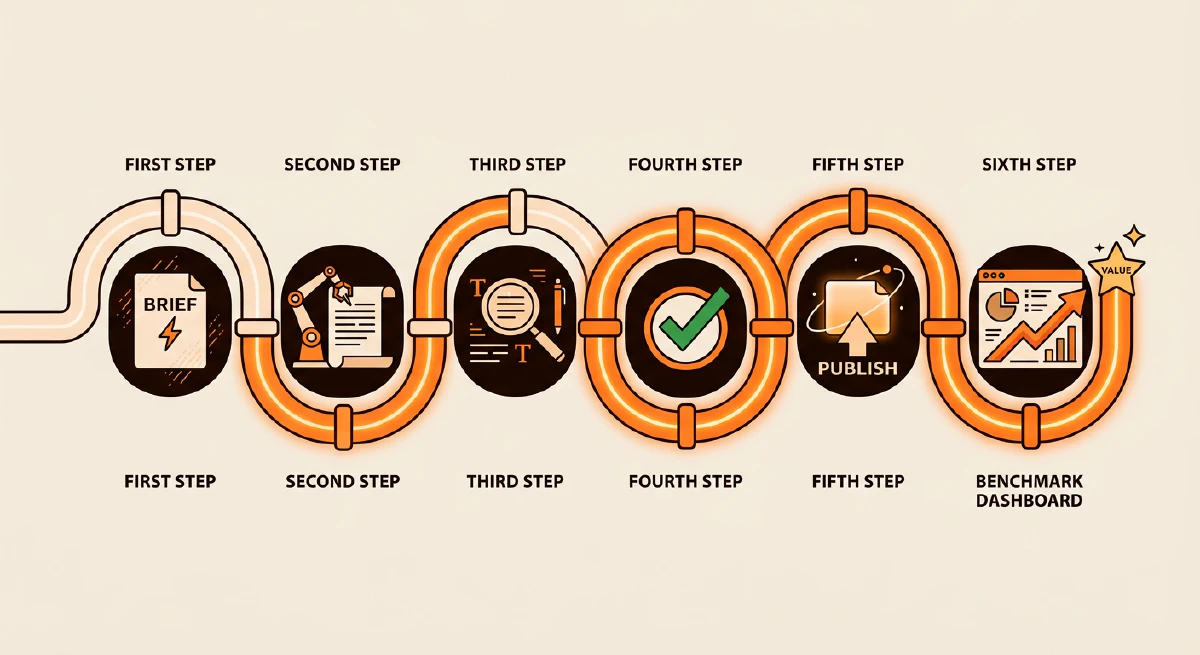

AI content slop starts when generation runs without governance. Zeover turns briefs, source checks, humanization, and AI visibility measurement into one workflow, so content is built for citation instead of volume. Generate against the brief.
Part 1 covered the operating model. This part gets practical: the content workflow has to keep AI useful without filling the site with fluent nothing.
The answer isn’t a better prompt. A prompt is an instruction. A brief is an editorial contract. The difference matters because most low-value AI content isn’t broken at the sentence level. It’s broken before drafting starts. The piece has no original claim, no verified evidence, no target prompt, no reason for an AI engine to cite it, and no human editor willing to reject it.
TL;DR
- AI should draft from a brief, not from a one-line prompt.
- The brief needs a target query, an editorial claim, source-backed facts, internal links, and a clear reason the piece should exist.
- Human editors should spend less time fixing sentences and more time checking claims, structure, and original contribution.
- The page should be built for extraction: clean headings, primary-source links, specific claims, and stable entity language.
- Publishing isn’t the end. The piece needs a benchmark loop that checks whether it changes citation rate, summary accuracy, or qualified traffic.
Salesforce’s 2026 State of Marketing reports that 78% of marketers need more personalized content than they can produce, while 75% are turning to AI to help close that gap. The same report says 84% still run generic campaigns. That’s the content problem in one sentence: AI adoption is high, but the output still lacks context.
The Standard For A Publishable AI-Assisted Piece
A publishable AI-assisted article should pass four tests.
It has a real claim. “AI is changing content marketing” isn’t a claim. “AI makes generic content cheaper, so original inputs now matter more than drafting speed” is a claim.
It cites primary evidence. A sourced claim should link to the source that can actually support it. A named report, paper, product announcement, or official document needs a link on first mention.
It gives the engine something extractable. Definitions, comparisons, procedures, current numbers, and clear entity descriptions are easier for AI engines to use than vague advice.
It says something the brand can defend. A bland article can be accurate and still fail. Zeover should publish work that reflects a point of view about AI visibility, brand accuracy, and marketing operations.
That bar is higher than “reads well.” It should be.
The Brief
A useful brief contains:
- Target prompt or query.
- Reader and buying context.
- One-sentence editorial claim.
- Required sources with URLs.
- Facts allowed in the draft.
- Claims that need review.
- Internal links to relevant entity pages or prior articles.
- Forbidden language and competitor exclusions.
- Extraction goal: definition, comparison, procedure, checklist, or benchmark.
Example: a weak instruction says:
Write a blog post about using AI for content marketing.
A real brief says:
Target prompt: "how should marketing teams use AI for content without low-quality output"
Reader: marketing leader evaluating AI content workflows
Claim: AI helps when it compresses first-pass work, but quality depends on briefs, sources, editing, and measurement.
Required sources:
- Salesforce 2026 State of Marketing
- 2026 citation selection and absorption paper
- Zeover benchmark or product example, if available
Extraction goal: six-step workflow plus definition of slop
Must avoid: second person, unsupported productivity percentages, competitor names
The draft that comes from the second brief may still need editing. But it starts from a position, not a topic.
The Six-Step Workflow
1. Brief. The content owner defines the claim, sources, target prompts, and publication standard. This is human work because it requires judgment.
2. Draft. AI turns the brief into a first pass. The model can structure the argument, propose section order, and surface missing transitions.
3. Source check. Every factual claim gets checked against the linked source. Unsupported numbers come out. Vague authority phrases get replaced with named, linked sources or removed.
4. Editorial rewrite. The editor looks for argument quality first, then prose. The most common fixes are stronger openings, fewer generic claims, clearer examples, and better endings.
5. Machine-readability pass. The final draft gets clean headings, stable entity language, schema where relevant, and internal links to the pages AI engines should treat as canonical.
6. Benchmark. After publication, the team checks whether the article is cited, whether summaries stay accurate, and whether qualified traffic changes.
Skipping step 3 creates risk. Skipping step 4 creates slop. Skipping step 6 creates an editorial calendar that never learns.
What Slop Looks Like
Slop is not only bad grammar. It’s content that looks complete while adding little evidence, little judgment, and little original value.
Common signs:
- A topic without a claim.
- A list of obvious tips.
- Unsupported operating numbers.
- Repeated three-item patterns.
- Paragraphs that explain categories without making decisions.
- Citations that decorate claims rather than prove them.
- A conclusion that promises change instead of naming the next action.
The worst version is confident and smooth. That’s why human review matters. A polished draft can still be empty.
What Makes Content Citable
A 2026 arXiv paper on citation selection and absorption separates being selected as a source from being absorbed into the answer. It reports that high-influence pages tend to be structured, semantically aligned, and rich in extractable evidence such as definitions, numerical facts, comparisons, and procedural steps.
That matters for AI-assisted content. A page doesn’t become citable because it says “complete guide” in the title. It becomes citable when it gives the engine material worth using.
For Zeover-style content, the strongest material usually falls into five buckets:
- A definition that cleans up a confusing category.
- A comparison that helps buyers decide.
- A checklist that maps directly to implementation.
- A benchmark or measured pattern.
- A correction of a common vendor claim.
Those are editorial choices before they’re writing choices.
The Editor’s Checklist
Before a draft moves to preview, the editor should ask:
- Does the first screen contain an argument?
- Does every number trace to a source fetched for the draft?
- Does every cited source support the sentence attached to it?
- Are there any generic claims that would fit any AI marketing blog?
- Does the piece define what Zeover believes, not just what the market says?
- Does the article give AI engines clean entities, claims, and evidence to extract?
- Does the ending give a concrete next action?
The checklist is intentionally narrow. It forces the draft to earn publication. That’s the only defensible answer to AI-assisted content at scale.
What Part 3 Measures
The workflow above still needs proof. Part 3 covers the measurement loop: citation rate, citation absorption, summary accuracy, AI-source attribution, and the monthly review that turns those signals back into content decisions.
For the next draft in the calendar, the useful move is simple: write the brief before touching the model. If the brief can’t produce a clear claim, source list, and extraction goal, the topic isn’t ready for AI drafting.


