How AI Changes the Shape of Marketing Work (Part 1 of 3)
AI Strategy Marketing Operations GEO
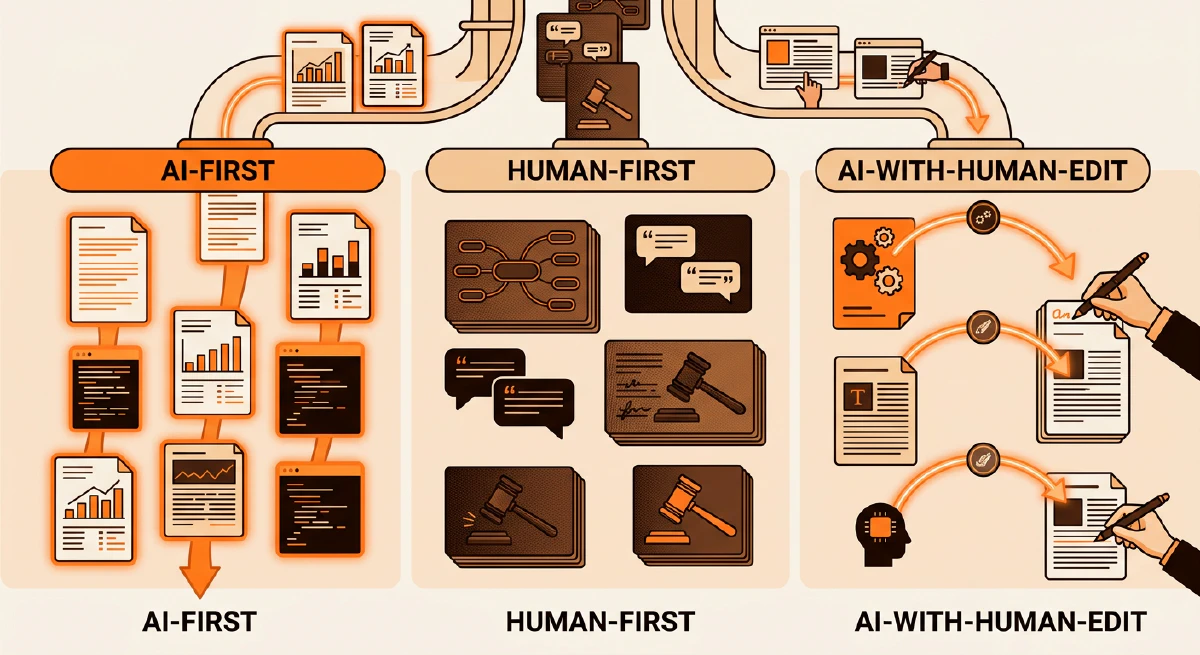

AI in marketing works when the operating model is clear. Zeover helps teams split the work correctly: continuous AI visibility benchmarking, brand consistency checks, and brief-driven content production, with human judgment where it still matters. See how the work splits.
AI didn’t make marketing simple. It made the weak parts of a marketing operation visible.
The old version of the AI story was too tidy: AI writes, humans approve, output rises. The real version is more useful and more demanding. AI can draft, summarize, classify, benchmark, and surface patterns. Humans still decide the angle, check the facts, define the brand position, interview customers, and say no to mediocre work that happens to be fast.
That split is the subject of this three-part series. Part 1 covers the operating model. Part 2 covers content production without slop. Part 3 covers measurement across AI engines.
TL;DR
- AI changes the shape of marketing work by moving routine production and reporting into supervised workflows.
- Governance is now a production requirement, not a brand-side document that gets reviewed twice a year.
- The strongest teams use AI to compress first-pass work, then spend the saved time on briefs, interviews, editing, and measurement.
- Generic prompting creates convergent content. Unique data and clear editorial judgment are the inputs that make AI-assisted work worth publishing.
- The series follows three connected parts: operating model, content quality, and measurement.
Salesforce’s 2026 State of Marketing gives the pressure behind the shift: nearly 4,500 marketing decision makers reported broad AI adoption, but 84% still admitted to running generic campaigns. The issue isn’t access to models. The issue is whether the organization gives those models usable context, clean data, and a human review process with teeth.
What AI Can Absorb
AI is strongest where the task has a clear input, a repeatable format, and a reviewable output.
First-pass drafting. A model can turn a strong brief into a rough article, landing page, email sequence, or campaign concept. That doesn’t make the draft publishable. It makes the blank page cheaper.
Routine synthesis. Meeting notes, survey clusters, review themes, and weekly reporting summaries are good AI workloads because the human reviewer can check whether the summary matches the source material.
Benchmarking at scale. GEO work requires repeated prompts across engines, extraction of citations, summary-accuracy checks, and movement tracking over time. This is tedious manual work and a good fit for automation.
Format conversion. Turning a research note into a brief, a brief into a draft, or a benchmark finding into an editor assignment is process work. AI can handle a lot of it when the source material is sound.
The mistake is treating these absorbed tasks as the whole job. They aren’t. AI can reduce the cost of first-pass work, but it doesn’t decide what deserves to exist.
What Humans Still Own
The work that remains with humans is less mechanical and more accountable.
The brief. The brief defines the target query, the reader, the claim, the sources, the forbidden language, and the standard for publication. A weak brief produces weak output faster.
The source judgment. AI can suggest sources, but it can’t own the credibility risk. A marketer has to decide whether a claim is worth making, whether a stat is current, and whether the source behind it deserves trust.
The customer insight. Models can summarize interviews. They can’t conduct the relationship-building that produces honest answers from customers, sales teams, partners, and support staff.
The editorial call. Some drafts are correct and still dull. Some are well structured and still say nothing Zeover should publish. Human editors decide whether a piece has an argument, not just whether it has sections.
This is why the better question isn’t “what can AI do?” The better question is “which human decisions does the workflow protect?”
Governance Became Production Infrastructure
AI exposes messy governance because models copy the context they’re given. If the source-of-truth document says the wrong category, the draft repeats it. If the website has conflicting product language, summaries drift. If the content inventory contains stale claims, AI engines can pick those claims back up.
That makes governance operational.
An usable governance layer includes:
- A canonical positioning sentence.
- A list of approved category terms.
- Current product and feature claims.
- Deprecated phrases the brand no longer uses.
- Source-backed numeric facts.
- Entity pages that AI engines can parse.
- A review path for claims that need legal, product, or executive approval.
McKinsey’s 2025 State of AI survey found that only a small share of organizations qualified as AI high performers, with workflow redesign and human validation among the practices associated with value capture. That maps cleanly to marketing. AI value doesn’t come from sprinkling models over the old process. It comes from rebuilding the process around what models are allowed to do and what humans must verify.
Differentiation Moves Upstream
AI has made average content cheaper. It hasn’t made good content common.
When a team feeds the same model the same generic prompt as every other team, the output converges. The writing may be fluent. The point won’t be special. AI engines have little reason to cite a page that repeats the same secondary summary already available across the web.
Differentiation now starts before drafting:
- Original benchmark data.
- Customer interviews.
- Product usage patterns.
- Support-ticket themes.
- Clear opinions competitors would avoid.
- Primary-source citations tied to specific claims.
The practical lesson isn’t “add numbers everywhere.” It’s that AI engines need extractable evidence. Strong inputs make extraction easier.
The Operating Model
A serious AI marketing workflow has four gates.
Gate 1: Brief quality. No brief, no draft. The brief carries the claim, target prompts, sources, brand position, and review standard.
Gate 2: Human edit. Every AI-assisted draft gets reviewed for factual accuracy, voice, source quality, and original contribution.
Gate 3: Machine readability. The finished piece needs clean headings, schema where relevant, stable entity language, and links to primary sources.
Gate 4: Measurement. The team checks whether the piece changes citation rate, summary accuracy, or qualified traffic. Without that loop, the content operation is guessing.
The operating model is simple. The discipline isn’t. Most failures come from skipping one of the gates while keeping the language of the process.
The Three-Part Arc
This series stays focused on one practical question: how should marketing teams use AI without producing low-value content? The answer needs three pieces:
- Part 1: the operating model.
- Part 2: the content workflow.
- Part 3: the measurement loop.
The next useful step is the work-shape audit. List the recurring marketing tasks. Mark each as AI-first, human-first, or AI-with-human-review. Then inspect the handoff points. Most AI quality problems sit there, between a model that can produce output and a team that hasn’t yet decided who’s accountable for the result.


