How High-Performing Teams Run a Marketing Automation Platform
Marketing Automation GEO AI Strategy
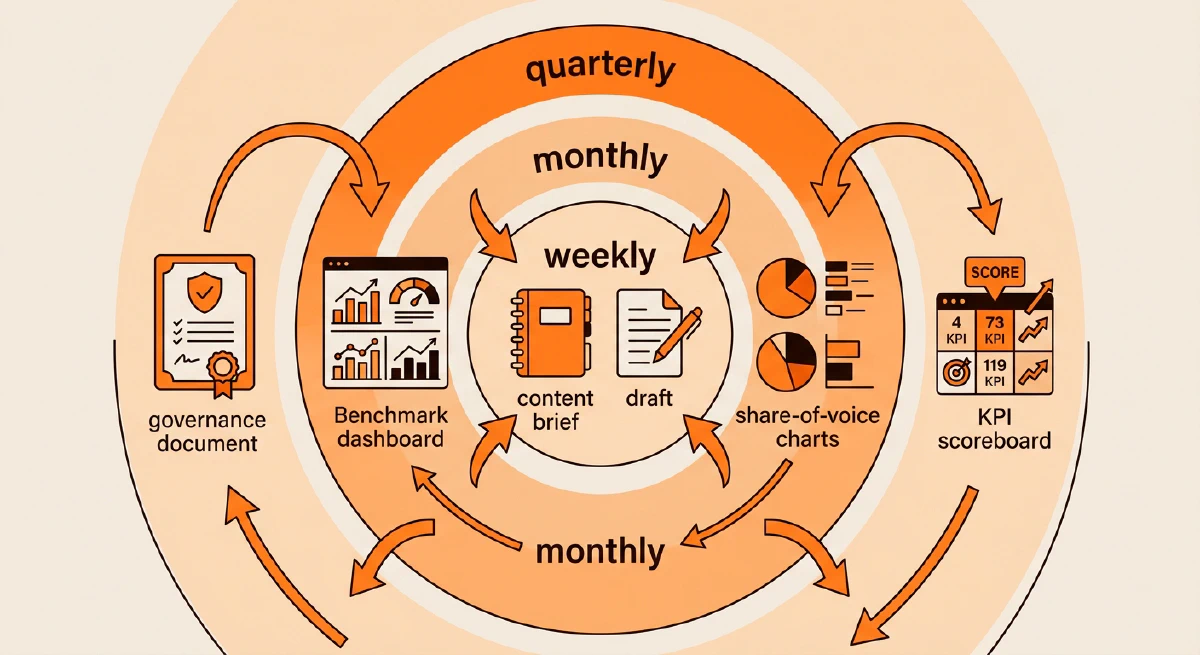

A marketing automation platform produces value at the cadence the team is willing to run it. Zeover turns AI visibility work into an operating system: weekly content briefs, monthly cross-engine benchmarks, quarterly strategy reviews, all anchored to the brand’s governance document and visibility goals. See the cadence in action.
The best marketing teams do not treat a marketing automation platform as software that sits behind campaigns. They treat it as the operating layer for how the company publishes, measures, corrects, and learns.
That’s the difference between a team that bought automation and a team that runs like a modern marketing organization. The first team has workflows. The second team has a cadence. Briefs move through the same system as brand governance. AI visibility benchmarks feed the next content plan. Summary drift gets corrected before it becomes market confusion. Performance data changes the next month of work, not next year’s strategy deck.
Salesforce’s 2026 State of Marketing report makes the gap visible: 75% of marketers have adopted AI, yet 84% still say they run generic campaigns. Adoption is no longer the signal of maturity. The signal is whether the team has an operating rhythm that turns AI, content, data, and brand context into better decisions every week.
TL;DR
- High-performing marketing teams run automation as a cadence, not as a tool stack. Weekly content work, monthly measurement, and quarterly governance all connect.
- The weekly cycle keeps the content engine moving: briefs, drafts, validation, publishing, and share-of-voice spot checks.
- The monthly cycle turns AI visibility data into decisions: prompt benchmarks, citation gaps, source quality, and next-month content priorities.
- The quarterly cycle keeps the system honest: governance updates, stack cleanup, KPI resets, and operating reviews.
- Teams that run this loop look different from teams that just own software. They move faster, correct drift earlier, and compound visibility share before slower competitors know what changed.
Automation Is An Operating Model
Most marketing automation plans start in the wrong place. They start with features: email journeys, CRM sync, campaign scoring, content generation, reporting dashboards, approval flows. Those features matter, but they do not create discipline on their own.
The discipline comes from the operating model around them.
A high-performing team knows what gets reviewed every Monday, what gets measured every month, and what gets reset every quarter. The platform is the system of record for that rhythm. It holds the brand context, prompt sets, benchmark history, content briefs, publication workflow, source quality checks, and decisions that shape the next cycle.
That matters more in AI-mediated discovery than it did in the old email-and-form model. Buyers now meet a brand inside search summaries, AI answers, comparison prompts, social clips, review snippets, and third-party pages before the tracked funnel starts. A team can’t manage that surface with a quarterly content calendar and a few nurture flows. It needs a tighter loop.
The best teams run that loop with a little ceremony and a lot of consistency.
The Weekly Cadence
The weekly rhythm is where the content engine lives. It should be boring in the best possible way: same inputs, same checks, same publishing path, same feedback capture.
Monday: lock the briefs.
The content owner writes briefs for every piece publishing in the next 7 to 14 days. Each brief should include:
- The target query or prompt the piece is meant to support.
- The positioning sentence and key claims from the brand governance document.
- The citable facts the piece must include.
- The schema type, heading structure, and entity links the page needs.
- The expected citation behavior by engine or channel.
A mature governance document makes this work fast. Without it, every brief becomes a mini strategy debate, and the team spends editor time rediscovering the same positioning decisions.
Tuesday and Wednesday: produce the drafts.
Writers, agencies, and AI assistants draft against the brief. The platform should do the heavy lifting on structure, brand context, and first-pass completeness. Humans still make the judgment calls.
This is where state-of-the-art teams separate from average teams. They do not ask AI to “write a blog post.” They feed the system a governed brief, source requirements, audience context, citation goals, and page structure. The output isn’t magic. It’s the result of better inputs moving through a repeatable process.
Thursday: edit and validate.
The content owner runs three checks per draft:
- Brand consistency against the governance document.
- Machine-readability validation: schema, heading structure, canonical links, and citation-friendly paragraphing.
- Fact verification for every number, source claim, and named reference.
The Thursday checkpoint is the difference between publishing more and publishing better. Weak teams use automation to increase volume. Strong teams use automation to increase the number of good decisions made before publish.
Friday: publish and route.
The piece goes live, then the platform routes the URL into the benchmark set. The next monthly cycle should know which prompts the new piece is meant to influence.
Publishing is not the end of the workflow. It’s the handoff from content production into measurement.
Anytime: spot-check priority prompts.
The team checks a small set of commercial prompts across the major engines once per week. This isn’t the full benchmark. It’s the early-warning system.
When a high-value query shifts, the team should know before the monthly report arrives. A new source may be winning citations. A brand summary may have drifted. A competitor may have published something that changes the answer. Weekly spot checks keep the team close to the market.
The Monthly Cadence
The monthly rhythm is measurement and decision-making. This is where a marketing automation platform earns its seat at the planning table.
The platform runs the full prompt set across the AI engines that matter to the business. For most teams, that means ChatGPT, Claude, Gemini, Grok, and Perplexity. The report should show:
- Citation rate by engine.
- Share of voice against relevant market alternatives.
- Summary accuracy and drift.
- Source quality behind the answers.
- Prompt groups where the brand gained, lost, or stayed absent.
- Content that influenced movement since the prior month.
The meeting should stay tight. A useful monthly agenda has five moves:
- Review what changed.
- Identify the prompts where visibility was lost or absent.
- Identify the prompts worth defending.
- Decide the content or technical intervention for each priority gap.
- Convert the decisions into next-month briefs.
The last step is the one average teams skip. They discuss the dashboard, nod at the insights, and return to the same content calendar. High-performing teams turn the report into work orders. The next briefs are different because the benchmark changed what the team now knows.
That is how visibility compounds. Not through one clever article, but through monthly measurement that keeps changing the next month of content.
The Quarterly Cadence
The quarterly rhythm is strategy, governance, and cleanup. It protects the system from becoming stale.
Review the governance document.
The team checks the positioning sentence, customer categories, product taxonomy, proof points, boilerplate, and canonical facts. If a product changed, the governance document changes. If the company started serving a new segment, the category language changes. If a metric changed, the old number gets removed from every surface where it appears.
This is unglamorous work. It is also the work that keeps AI systems from stitching together three outdated versions of the company.
Audit the stack.
The team reviews which tools are still earning their place. Some tools now overlap with the central platform. Some tools have low usage. Some tools handle work the team did not own three months ago but needs now.
The point is not tool minimalism for its own sake. The point is operational clarity. State-of-the-art teams do not let every workflow become a separate island with its own data, approval path, and reporting logic.
Reset the KPIs.
Quarterly targets should connect AI visibility to marketing operations:
- Citation rate by engine.
- Share of voice by prompt group.
- Summary accuracy.
- AI-sourced sessions and conversions.
- Content production volume.
- First-pass editorial approval rate.
- Time from benchmark insight to published intervention.
That last metric is underrated. Slow teams can see the same visibility gap for months. Strong teams shorten the distance between signal and action.
Review the operating model.
The quarterly review should ask whether the cadence itself is working. The platform may be fine while the operating model is weak. A missed target can come from the wrong benchmark set, unclear ownership, slow approvals, incomplete governance, or a content queue that never reflects measurement.
The best teams diagnose the system, not just the output.
The First 90 Days
A team adopting this cadence shouldn’t try to perfect every piece of it at once. The first 90 days are for installing the loop.
Month 1: build the rhythm.
- Week 1: configure the governance document, prompt set, templates, and approval paths.
- Week 2: run the first weekly cycle from brief to publish.
- Week 3: adjust the brief template and validation checklist.
- Week 4: run the weekly cycle again with fewer handoffs.
Month 2: connect measurement to work.
- Run the first full monthly benchmark.
- Hold the decision meeting.
- Convert the top gaps into content briefs.
- Track whether those briefs publish on schedule.
Month 3: review the system.
- Continue the weekly cadence.
- Run the second monthly benchmark.
- Hold the first quarterly governance and stack review.
- Reset the next quarter’s KPIs.
By month four, the cadence should feel normal. That is when the advantage starts to show. The team has a governed content engine, a measurement loop, and a way to correct brand drift before it hardens into the market’s understanding.
What Top Teams Look Like In Practice
Top marketing teams are not calmer because they have fewer moving parts. They are calmer because the moving parts have a place to go.
Briefs have a home. Brand claims have a source of truth. AI visibility has a measurement cadence. Content decisions trace back to prompts and sources. Reviews happen before confusion spreads. Quarterly strategy does not restart the whole plan; it tunes the system already running.
That’s what a marketing automation platform should make possible. Not just faster campaigns. A sharper marketing operation.
The platform purchase is the start. The cadence is the craft.


