How to Optimize for AI Searches - The TikTok Way: Is It Hype?
GEO Social AI Strategy
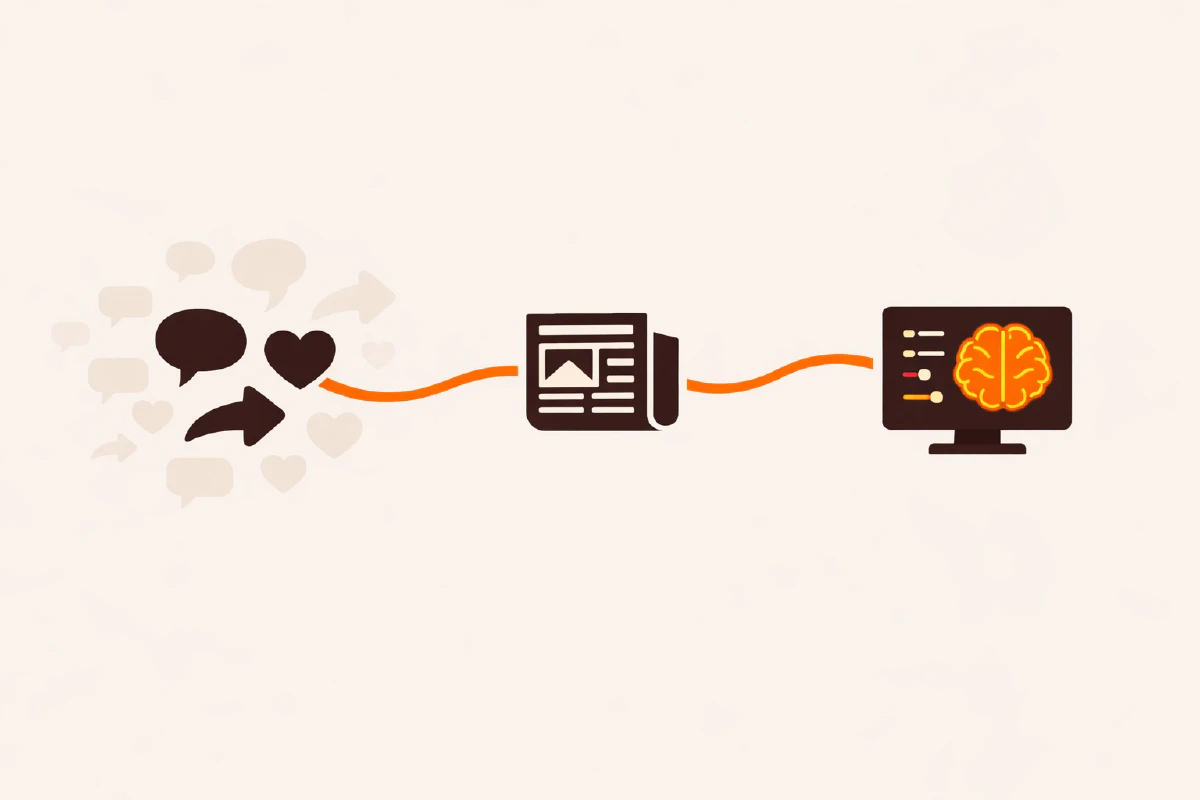

TikTok can shape demand before buyers ever ask an AI engine, but that does not make it a strong AI citation surface by default. Zeover tracks which social platforms AI engines actually cite, so teams can separate channel hype from measurable AI visibility. See how a brand is represented in AI answers.
TikTok is easy to overhype in AI search. The platform is clearly a search and discovery surface for people. TikTok says search helps users explore topics from recipes and how-tos to DIYs, and its Creator Search Insights product was built to help creators find topics people are searching for. That’s real behavior. It just doesn’t automatically translate into AI citations.
Zeover’s March through May citation data tells a colder story. TikTok appears as a modest citation source for GPT-5.4, but it is tiny for Sonar, tiny for Grok-4, and tiny for Grok-4.3 in partial May. The practical answer to “is TikTok hype?” is therefore split: TikTok search isn’t hype for audience discovery, but TikTok as a broad AI citation engine is mostly hype right now.
TL;DR
openai/gpt-5.4is the only model-month series where TikTok shows a visible citation share, moving from 7.5% in March to 5.3% in April and 8.5% in partial May.perplexity/sonar-probarely used TikTok across the period, with 0.1% in March, 0.0% in April, and 0.3% in partial May.x-ai/grok-4kept TikTok near the floor, moving from 0.3% in March to 0.4% in April and 0.4% in partial May.x-ai/grok-4.3entered partial May with TikTok at 0.4%, behind Reddit, YouTube, LinkedIn, Facebook, Instagram, and Quora.- The TikTok way to optimize for AI searches isn’t to chase generic virality. It’s to use TikTok for native search demand, then connect useful videos to durable pages that AI systems are more likely to cite.
What changed in the citation mix
The May column is partial through May 18, 2026, so it should be read as an early-month signal rather than a full-month close. The TikTok pattern is blunt: one model shows a small but real signal, while the rest barely use it as a citation source.
| Model | March 2026 | April 2026 | May 2026 partial | Read |
|---|---|---|---|---|
openai/gpt-5.4 | 7.5% | 5.3% | 8.5% | Small but visible, with May rebound |
perplexity/sonar-pro | 0.1% | 0.0% | 0.3% | Near-zero citation share |
x-ai/grok-4 | 0.3% | 0.4% | 0.4% | Stable near the floor |
x-ai/grok-4.3 | - | - | 0.4% | Low May entry |
This isn’t the LinkedIn story. It isn’t the YouTube story either. LinkedIn had professional context. YouTube had transcripts and long-form explainers. X had recency and a strong Grok-4 signal. TikTok has consumer discovery power, but Zeover’s data doesn’t yet show broad AI citation strength.
That doesn’t make TikTok irrelevant for GEO. It means TikTok should be treated as a demand-shaping surface first and an AI citation surface second. The video can create awareness, language, and social proof. The durable source trail still needs to live somewhere AI engines can read and cite more reliably.
Why TikTok search is real
TikTok’s Discover guidance says users can search for hashtags, videos, creators, and sounds, and that interactions such as follows, favorites, likes, and comments can shape future recommendations. TikTok’s Help Center also says search can return people, posts, sounds, hashtags, and more, with the most relevant results appearing in the Top tab.
TikTok has also been explicit about search-driven creation. TikTok’s Creator Search Insights announcement says search powers discovery on the platform and that creators can use search-topic data to make content that matches audience interests. It also describes content gap topics: searches that happen often but are not yet covered by many videos.
That’s important, because it shows TikTok is not only entertainment feed behavior. It’s also a native search system. A brand that ignores TikTok search may miss real user demand, especially for visual, consumer, local, lifestyle, product, food, beauty, travel, fitness, and creator-led categories.
The AI citation question is different. Native TikTok search can be strong while external AI engines still cite TikTok rarely. Zeover’s data shows exactly that separation.
Why AI systems cite TikTok less often
TikTok content is often short, visual, and context-dependent. That makes it excellent for human discovery, but weaker as standalone citation material. A model looking for evidence usually needs stable text, source context, and enough detail to answer a query. Many TikTok videos are built for watch-time, not extraction.
The platform also has a source-trail problem. A video may contain a useful claim, but the description might be short, the evidence might live in the visuals, and the comments might hold the explanation. That’s a fragile package for AI citation. A blog post, YouTube transcript, LinkedIn article, or documentation page usually gives a model cleaner text.
Independent researchers are also still trying to understand TikTok’s search systems. A 2025 paper by Taylor Annabell, Robert Gorwa, Rebecca Scharlach, Jacob van de Kerkhof, and Thales Bertaglia describes TikTok as adopting search products while raising concerns about limited transparency around search recommendations. That doesn’t mean TikTok content is bad. It means teams should be careful about claiming AI-search benefits that the citation data doesn’t support yet.
The TikTok way to optimize for AI searches
AI search optimization on TikTok starts by separating two jobs. The first job is native discovery: getting found inside TikTok. The second job is citation readiness: helping AI systems cite the brand’s evidence later. TikTok is better at the first job than the second.
The first move is to build videos around search-shaped topics. TikTok’s own Creator Search Insights exists because people search the platform for answers, not only entertainment. Videos should answer one specific question, use the language people search for, and make the answer explicit in the spoken content and caption.
The second move is to make the text layer do real work. Captions, on-screen text, hashtags, and pinned comments should name the product, category, problem, and outcome. A model shouldn’t need perfect visual understanding to know what the video says. A human should also be able to read the caption and know what question the video answers.
The third move is to connect TikTok to a citable source. If the video shares data, a process, a checklist, a comparison, or a claim about the market, the brand should have a durable page that carries the full explanation. TikTok can create the spark, but the linked guide, report, product page, or methodology note should carry the source trail.
The fourth move is to repurpose selectively. A TikTok that performs well can become a YouTube explainer, LinkedIn post, blog section, FAQ entry, or product page module. That’s where the AI citation value often grows. The original TikTok may not be cited, but the language it proves can feed stronger surfaces.
What to publish
The best TikTok content for GEO usually does one of four jobs.
Expose demand language. TikTok comments and search topics can reveal how people describe a problem. That language can shape better AI-search content elsewhere.
Demonstrate a visual problem. Some buyer problems are easier to show than explain. TikTok can make the pain visible, then a durable page can carry the full answer.
Test hooks quickly. Short videos can test which phrasing, objections, and examples make people stop. Winning hooks can become titles, intros, FAQ headings, and answer snippets.
Create social proof. Creator-led demos, customer reactions, and visible use cases can support brand credibility, even if the final AI citation comes from a different URL.
TikTok is strongest as a signal generator. It can reveal demand and language. It shouldn’t be expected to carry the full AI citation burden alone.
What not to do
The wrong move is to mistake TikTok reach for AI visibility. A video can perform well inside TikTok and still produce almost no external AI citations. Zeover’s data shows that gap clearly across Sonar and Grok.
Another weak move is hiding the useful information inside the video only. If the claim is in a voiceover or chart, the caption should restate it. If the video references a result, the source should exist somewhere stable. If the content answers a question, the question should be visible in text.
Brands should also avoid forcing TikTok into B2B categories where the audience doesn’t search there. Some categories have real TikTok demand. Others don’t. The decision should come from native search demand, creator fit, and measurable AI citation behavior, not from platform excitement.
How to measure it
TikTok optimization should be measured in two layers. The first layer is native TikTok search: whether content appears for relevant topics, earns useful engagement, and shows language the audience actually uses. The second layer is AI citation behavior: whether TikTok URLs, linked pages, or repurposed assets show up when AI systems answer target prompts.
Zeover’s data says the second layer is still thin. TikTok had a visible GPT-5.4 signal, but near-zero share for Sonar, Grok-4, and Grok-4.3. That should shape investment. TikTok can be worth doing for audience discovery, creator proof, and demand mining. It shouldn’t be sold internally as a guaranteed AI citation engine.
The practical recommendation is simple: use TikTok when the audience searches there, then make sure the useful findings escape TikTok into citable assets. Zeover tracks that full source trail across AI engines, so teams can see whether TikTok is creating AI visibility or only creating platform-native motion.


