How to Optimize for AI Searches - The YouTube Way
GEO Social AI Strategy
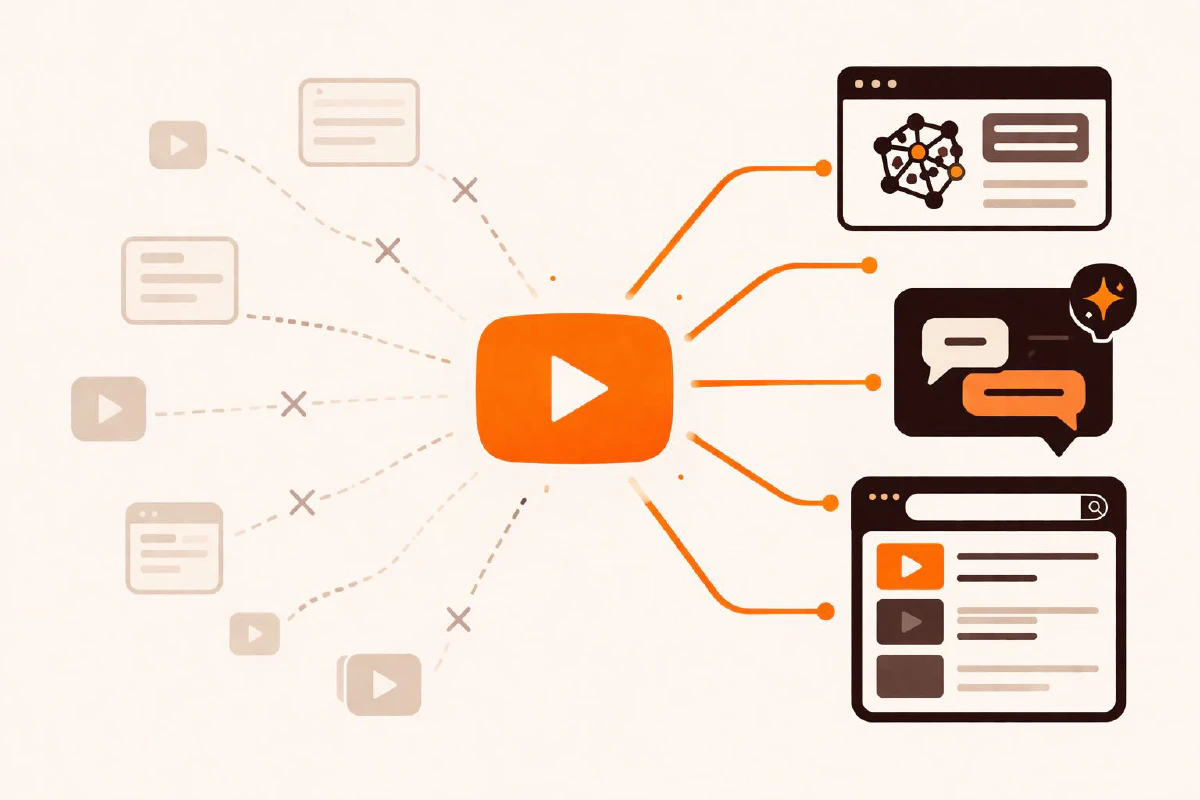

YouTube is becoming a measurable citation surface for AI search, especially when video content has clear titles, transcripts, chapters, and source context. Zeover tracks which social platforms AI engines cite and where brand visibility in AI can be improved. See how a brand is represented in AI answers.
YouTube’s role in AI search is different from LinkedIn’s. LinkedIn gives AI systems professional identity and company context. YouTube gives them long-form explanations, transcripts, chapters, demonstrations, and walkthroughs. In Zeover’s March through May citation data, that difference shows up clearly: YouTube rose for GPT-5.4, stayed a large and steady share for Grok-4, and remained Sonar’s leading social citation source even after Sonar’s May mix became less concentrated.
The practical takeaway isn’t “make more videos.” The better move is to make videos that can be read, segmented, and cited. AI search systems need text, structure, and evidence. YouTube can provide all three when teams treat the video page as an AI-readable source, not only a place to host a recording.
TL;DR
openai/gpt-5.4showed the cleanest YouTube growth pattern, moving from 3.2% in March to 6.8% in April and 10.4% in partial May.perplexity/sonar-prowas almost completely YouTube-led in March and April, then broadened in partial May. Even after that shift, YouTube remained the largest social citation surface at 44.1%.x-ai/grok-4treated YouTube as a stable second-tier source, holding near the low twenties across March, April, and partial May.x-ai/grok-4.3entered partial May with YouTube at 27.7%, behind Reddit but ahead of LinkedIn, Facebook, Instagram, Quora, TikTok, and X/Twitter.- The YouTube way to optimize for AI searches is transcript-first publishing: question-shaped titles, detailed descriptions, manual chapters, corrected captions, and source links that turn video into citable evidence.
What changed in the citation mix
The May column is partial through May 18, 2026, so it should be read as an early-month signal rather than a full-month close. The pattern is still useful because the model behaviors aren’t identical.
| Model | March 2026 | April 2026 | May 2026 partial | Read |
|---|---|---|---|---|
openai/gpt-5.4 | 3.2% | 6.8% | 10.4% | Clear month-by-month growth |
perplexity/sonar-pro | 98.4% | 96.4% | 44.1% | Still largest after May diversification |
x-ai/grok-4 | 21.7% | 21.2% | 22.5% | Stable, durable contribution |
x-ai/grok-4.3 | - | - | 27.7% | Strong May entry, second only to Reddit |
This isn’t the same story as LinkedIn. LinkedIn looked like a professional-context surface that grew sharply for Grok and Sonar. YouTube looks more like an explanatory-content surface: weaker but rising for GPT-5.4, dominant for Sonar until May broadened the mix, and consistently material for Grok.
That makes YouTube useful for a different kind of AI-search query. LinkedIn helps when a model needs professional interpretation, company context, or named expertise. YouTube helps when a model needs a walkthrough, a product demo, a comparison, a tutorial, or a visual process that has been converted into readable text.
Why YouTube fits AI search
YouTube has a built-in advantage: video pages contain multiple text surfaces. A single video can include a title, description, transcript, captions, chapter labels, comments, linked sources, and embedded context when the video is placed on a brand site.
YouTube’s search and discovery guidance says YouTube Search ranks videos partly by how well the title, description, and video content match the search, while tags are mainly used for spelling mistakes. That aligns with AI search behavior. Text that clearly describes the content matters more than a hidden tag list.
YouTube’s chapter guidance says creators can add timestamps and titles in the description, and those chapters add information and context to sections of the video. Google’s video SEO guidance also says Google can use YouTube description timestamps and labels for key moments in Search. For AI search, chapters work like section headings. They make a long video easier to parse into citable parts.
Captions are the other layer that matters. YouTube’s own captioning guide describes upload files, auto-sync, manual captions, and generated captions that can be edited in YouTube Studio. For GEO teams, the important part is accuracy. A transcript with brand names, product terms, and category language spelled correctly is a much better citation candidate than an auto-generated transcript full of errors.
The YouTube way to optimize for AI searches
AI search optimization on YouTube starts before filming. The video has to answer a query clearly enough that an AI system can cite it later. A vague brand film might help reputation, but it rarely gives a model a clean answer. A focused explainer, comparison, teardown, or tutorial does.
The first move is to write the title like a query answer. “How to evaluate an AI search monitoring platform” is stronger than “Product webinar replay.” “What changes when LinkedIn citations rise in AI search” is stronger than “May social report highlights.” Titles should name the problem, category, and outcome without turning into clickbait.
The second move is to make the description a structured abstract. The opening lines should say what the video covers, who the explanation is for, and what evidence or workflow appears inside. The body should include chapter timestamps, source links, product or methodology links when relevant, and a short list of the questions answered in the video.
The third move is to treat chapters as H2s. Generic chapter names like “Intro”, “Demo”, and “Wrap-up” waste a useful retrieval surface. Better chapter labels name the answer: “00:00 What AI search citations measure”, “03:10 Why YouTube rose for GPT-5.4”, “07:40 How to write video descriptions for AI search”, and “12:20 How to measure citation lift.”
The fourth move is to correct captions and transcripts. Brand names, product names, model names, abbreviations, and technical terms should be spelled consistently. If the transcript turns “GEO” into “geo” in one place and “Gio” in another, the video becomes harder for retrieval systems to understand.
The fifth move is to embed the video on a durable page. YouTube can carry the video, but the brand site should hold the canonical source: the summary, transcript, methodology, links, and related resources. Google recommends helping search systems find and index video content through stable pages, visible video embeds, consistent metadata, and accessible thumbnails. The same discipline helps AI systems interpret the video as part of a broader source trail.
What to publish
The best YouTube content for AI citations usually does one of four jobs.
Teach a workflow. Tutorials and walkthroughs answer “how to” prompts with enough detail for a model to cite the source. The transcript should include the steps, the decision points, and the limits of the method.
Compare options. Comparison videos can work when they explain criteria, tradeoffs, and fit. They should avoid thin winner-picking and instead document when each option makes sense.
Show evidence. Product demos, benchmark explanations, experiment reviews, and field notes give AI systems specific claims to cite. The evidence should appear in the spoken content, description, and source links.
Explain a category. Category-definition videos help with “what is”, “how does it work”, and “how to evaluate” searches. These are useful when a brand wants to own language around a newer market.
The strongest YouTube GEO asset isn’t a viral clip. It’s a well-structured, well-captioned video that answers a real query and leaves behind a clear text trail.
What not to do
The wrong response is to move every blog idea into video without changing the format. A talking-head recap with no chapters, no corrected captions, and a two-line description gives AI systems little to use. The same topic can become useful if the video is structured around questions, sections, source links, and a clean transcript.
Short clips also have limits. Shorts can help distribution, but the citation surface is thin. They rarely contain enough transcript depth for complex AI-search answers. If a brand uses Shorts, they should point back to the longer explainer, product walkthrough, or source page that carries the citable detail.
Another weak move is relying on production polish instead of clarity. AI systems don’t care whether the intro animation is expensive. They care whether the source contains extractable claims, named entities, and enough context to answer a query. A simple screen recording with accurate captions and a clear methodology can be more useful than a studio video with vague language.
How to measure it
YouTube optimization should be measured against AI citation behavior, not only YouTube views. Views, retention, and subscribers still matter for the channel, but they don’t answer the GEO question. The working question is whether videos appear as sources when AI systems answer prompts about the category, the product, the workflow, or the buyer problem.
The measurement loop should separate models because Zeover’s data shows different behavior by model. GPT-5.4 showed growth from a smaller base. Sonar stayed YouTube-heavy, then diversified. Grok-4 treated YouTube as steady. Grok-4.3 started with a strong May share. A single blended number would hide those differences.
For each target query, teams should track whether the cited source is the YouTube watch page, the embedded brand page, another social platform, or a third-party source. That source split tells the team whether YouTube is carrying the answer directly, supporting another page, or missing from the citation path completely.
YouTube is now a practical GEO surface because it turns spoken expertise into searchable text. Zeover tracks that source trail across AI engines, so teams can see when video content is actually contributing to AI visibility instead of assuming that channel growth and AI citations move together.


