Content Generation for GEO - Briefs That Produce Citable AI-Generated Drafts (Part 1 of 4)
GEO Content Marketing AI Strategy
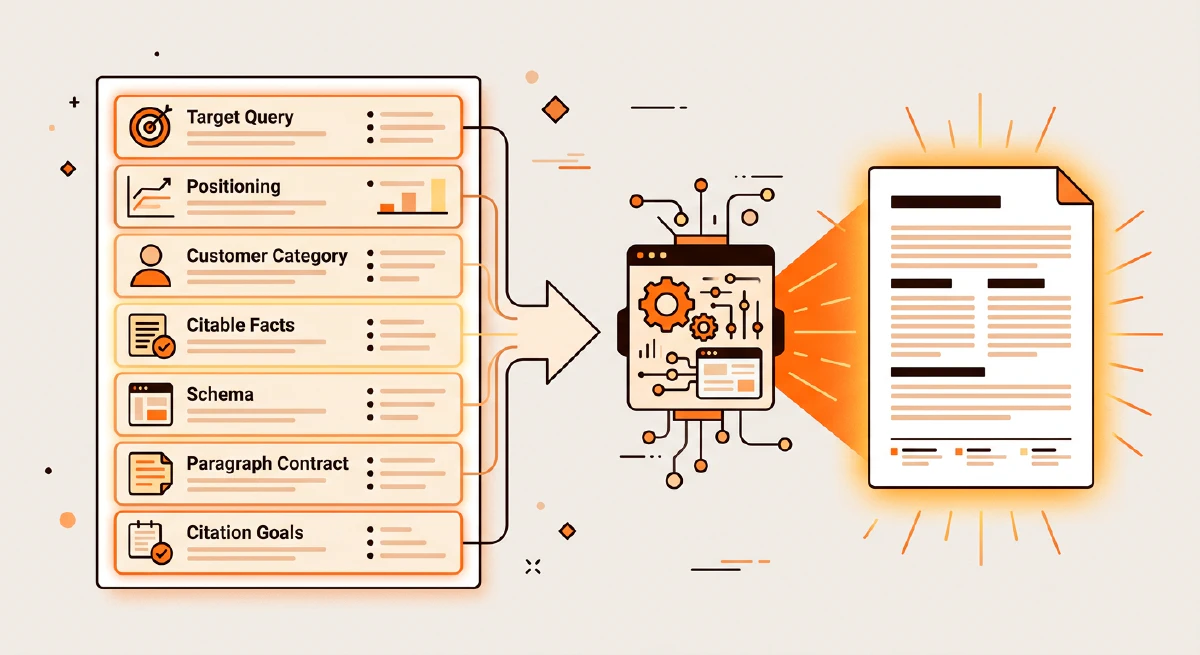

AI content drafts go citable when the brief specifies the citation goals upfront. Zeover generates content from structured briefs that include target queries, key claims, schema requirements, and the engines the piece needs to rank in. Generate from a brief.
This series covers AI content generation as a practitioner discipline: the day-to-day patterns that produce citable drafts at volume. Part 1 starts where AI content generation either earns its place or loses it: the brief. A weak brief produces generic prose that needs heavy editing. A strong brief produces drafts an editor can ship with 100-300 word changes. The cost difference compounds across the editorial calendar; over a year, the gap between strong-brief operations and weak-brief operations is multiple FTE of editor time and significant citation rate.
TL;DR
- A strong AI content brief specifies seven things: target query, positioning sentence, customer category, citable facts, schema requirements, paragraph contract, and expected citation behavior.
- Briefs that include all seven produce drafts an editor can ship with light revision. Briefs that include 2-3 produce drafts that need heavy rewrites or rejection.
- The brief takes 25-40 minutes to write. The fastest way to improve brand visibility in AI is to invest in the brief - the downstream savings are 2-4x the brief writing time.
- The brief is the contract between the human and the AI. It removes the back-and-forth that consumes editor time and produces a defensible audit trail when something goes wrong.
- Operations that institutionalize the brief see compounding gains in citation rate and content velocity. Operations that skip the brief produce generic content that gets indexed and ignored.
The Seven Brief Components
1. Target query. The specific commercial query the piece improves for. Not “content marketing” but “content marketing strategy for B2B SaaS” or “best AI marketing tool stack 2026.” The specificity drives the title, the H1, and the H2 structure.
2. Positioning sentence. Pulled from the source-of-truth document. The brand’s identity in one or two sentences. The AI uses this to keep the draft in voice and on message.
3. Customer category. Who the piece is for. “B2B SaaS marketing leaders, Series A through Series C” is a useful segment; “marketers” isn’t. The category drives the examples, the tone, and the sub-questions the piece answers.
4. Citable facts. Specific statistics, dates, or claims that must appear in the draft, each with the primary source. “ChatGPT referrals convert at 11x organic search rates per Similarweb 2025” is actionable; “AI is changing marketing” isn’t.
5. Schema requirements. Article + FAQPage. H1, 6-8 H2 sections, 2-3 H3 sub-sections per H2. The structure the AI should produce.
6. Paragraph contract. Each paragraph leads with a claim, supports with 2-3 evidence sentences, stays under 120 words. Hard-banned vocabulary. Forbidden patterns.
7. Expected citation behavior. Which engines the piece needs to rank in (ChatGPT, Claude, Gemini, Grok, Perplexity). Which prompts the team is targeting. Which competitors the piece needs to beat for those prompts.
A brief with all seven is roughly 600-1,000 words. The AI reads it; the draft reflects it; the editor revises lightly.
A Worked Example
For a target piece on “marketing automation platform”:
TARGET QUERY: marketing automation platform
PRIMARY KEYWORDS: marketing automation platform, best marketing automation platform, marketing automation tools

POSITIONING SENTENCE: We are the AI marketing optimization platform helping brands monitor and improve visibility across AI engines like ChatGPT, Claude, Gemini, and Grok.

CUSTOMER CATEGORY: B2B SaaS marketing leaders and CMOs at Series A-C companies. Heads of marketing operations. Mid-market and enterprise.

CITABLE FACTS:
- Marketing automation market size $8.08B in 2026, projected $20.12B by 2034 (TechnologyChecker 2026 report).
- 95% of enterprise marketing teams use a platform (CMI 2026).
- 54.7% report active generative AI integration in live campaigns (CMI 2026).
- Sites with quality AI editing saw 30-80% traffic increases vs. 40-90% drops for unedited high-volume AI content (multiple 2026 analyses).

SCHEMA: Article schema. H1, 6-8 H2 sections covering: why marketing automation matters more now, what a modern platform must do, tool categories across the funnel, choosing the best platform, when to invest, operating cadence. Each H2 has 2-3 H3 sub-sections.

PARAGRAPH CONTRACT: Claim sentence first, 2-3 evidence sentences with primary-source citations, under 120 words per paragraph.

BANNED VOCABULARY: leverage, robust, seamless, em dashes, second-person.

EXPECTED CITATIONS: ChatGPT prompts ["best marketing automation platform 2026", "marketing automation for AI marketing"], Gemini prompts ["marketing automation tools comparison"], Perplexity prompts ["what is marketing automation in 2026"].

TARGET LENGTH: 1,800-2,200 words.
A draft against this brief reflects the citation goals across. A draft from a generic prompt (“write about marketing automation platforms”) produces 1,800 words that read like every other competitor’s content and earn no distinguishing citations.
What Makes A Brief Strong
Three patterns that show up in briefs that produce citable drafts:
Specificity over breadth. “Marketing automation platform for B2B SaaS Series A-C” beats “marketing automation platform” alone. The narrower the segment, the cleaner the draft.
Primary sources upfront. The brief lists the sources the piece must cite, not the sources the AI should “find.” The AI can’t reliably verify primary sources; the human supplies them.
Citation goals named. The brief specifies which engines the piece needs to rank in and which prompts. The AI produces content tuned to those goals; the editor measures against them.
The patterns add 10-15 minutes to brief writing. The downstream payoff is 30-60 minutes saved per editor edit and a higher citation rate.
What Makes A Brief Weak
Three patterns that recur in briefs that produce poor drafts:
One-line prompts. “Write about content marketing.” The AI produces output that reads like the average of every other piece in the category. Citation rate flatlines.
Citable facts left to the AI. “Include relevant statistics” produces hallucinated or stale numbers. The brief must specify the facts and sources.
No schema or paragraph contract. The AI produces unstructured prose without H2 sections, schema scaffolding, or paragraph rhythm. Editors rewrite from scratch.
Operations that produce weak briefs make AI generation cost more in editor time than it saves in drafting time. The math reverses when briefs strengthen.
When To Skip The Brief
A useful counterweight: not every piece needs a 1,000-word brief.
- Short-form social posts: a 2-3 sentence brief is enough.
- Internal team newsletters: lighter brief, lower stakes.
- Routine FAQ updates: a brief that’s just the question and the canonical answer suffices.
The full seven-component brief is for long-form public-facing content where citation rate matters. Short-form and internal content runs on lighter scaffolding.
What’s Coming In The Series
Part 2 covers prompting patterns for brand-voice output at scale: training data, voice consistency, and the prompt engineering that produces drafts the editor can ship.
Part 3 covers humanization, fact-checking, and the post-draft quality layer.
Part 4 closes on scaling to 50+ pieces a month without quality collapse.
Content marketing strategy that compounds: the SEO vs. GEO distinction lives in the brief. For the next 30 days, the actionable starting point is the brief template. Pick the next piece scheduled to publish. Convert the prompt into a full seven-component brief. Compare the resulting draft against what a generic prompt produces. The delta is the case for adopting the template across the rest of the calendar.


