Content Marketing Strategy for AI Citations - Blogs, YouTube, Podcasts, Press (Part 4 of 6)
Marketing Strategy GEO Content Marketing
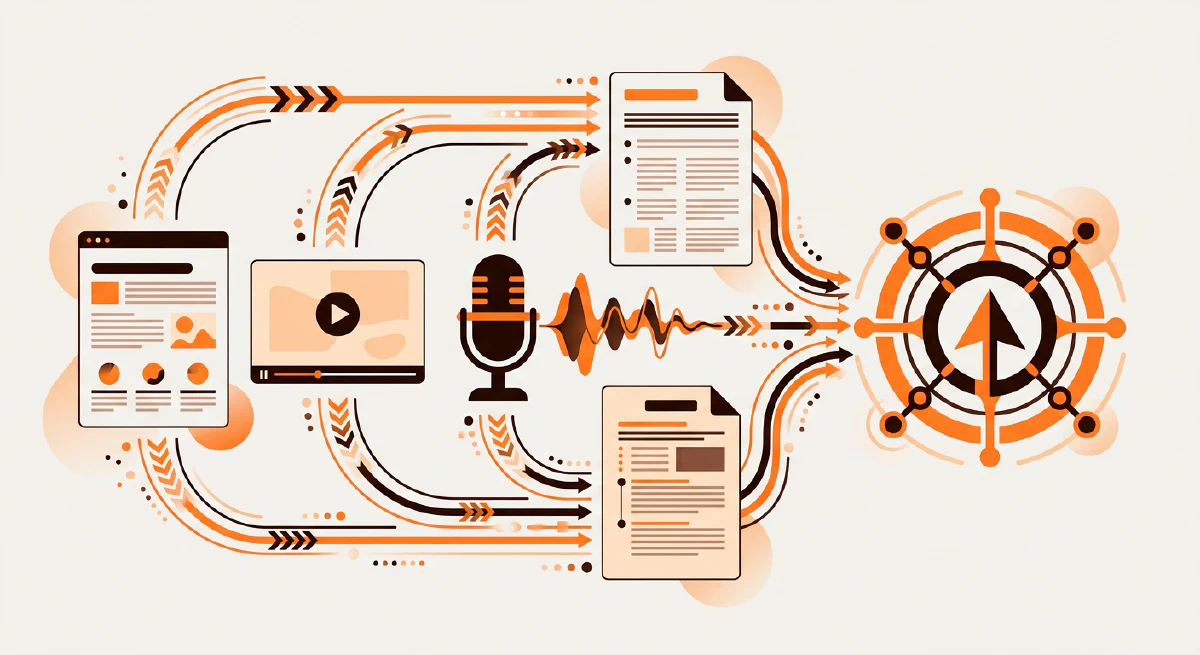

Your content marketing strategy needs the format mix, cadence, and accuracy to earn AI citations at scale. Zeover handles Content Generation for GEO across blogs, press releases, LinkedIn, and YouTube metadata, aligned to your canonical brand boilerplate. See the content engine.
This is part four of the CMO playbook. The first three parts covered the mandate, the board-level framing, and the operational rhythm. This part is about the content that actually produces AI citations - what to publish, in what format, at what cadence, and how to use AI in marketing responsibly without filling the site with thin pages.
Generative Engine Optimization rewards structured, accurate content across formats - learning how to optimize for AI searches means building a disciplined portfolio, not a bigger content calendar. Four formats, a sustainable cadence, obsessive accuracy, and a narrow enough topic focus that brands build real authority rather than scattering effort across surfaces AI engines don’t weight.
TL;DR
- The format mix that earns AI citations: meaningful editorial blogs, long-form YouTube, podcasts with published transcripts, press releases through newswires. Creative social supports the portfolio but rarely drives citations directly.
- Consistency beats volume spikes. Two real pieces per week for two years beats twenty pieces in one quarter.
- Accuracy is non-negotiable. Every statistic needs a primary source. AI engines spread what they cite and deprioritize sources they catch in errors.
- “How to use AI in marketing” has a right answer: use it to scale meaningful work. It has a wrong answer: churn thin keyword-targeted pages. AI engines detect and penalize the wrong answer quickly.
- Content Generation for GEO is about authority compounding, not page volume. Narrow the topic scope before broadening the production schedule.
The Four Formats That Matter
Different AI engines weight different content formats. A content marketing strategy that only invests in one format leaves visibility on the table. A strategy that spreads across all four creates compounding authority that AI engines recognize.
Editorial blogs
Meaningful long-form writing on a site is the foundation. It’s the format AI engines can parse most reliably because teams control structure, schema, and accuracy.
The SEO vs. GEO distinction matters here: traditional SEO rewards pages that rank for keywords; GEO rewards pages structured for extraction and citation.
What earns citations at this level: original research, meaningful analysis of the category, named-source quotations, specific customer outcomes with quantified metrics, and technical depth appropriate to the buyer’s expertise.
What doesn’t: generic “5 tips for X” content, keyword-padded pages, or opinion pieces without evidence. AI engines increasingly detect generic content and deprioritize it. The same pattern holds for teams learning how to rank in ChatGPT - real citations follow original data, and pages without it get passed over.
The KDD 2024 GEO research from Princeton, Georgia Tech, and IIT Delhi tested optimization techniques across 10,000 queries. Adding quotations improved AI visibility by 41%. Adding statistics improved it by 33%. Citing external sources improved it by 28%, and for lower-ranked content specifically, that number jumped to 115%. The pattern is clear: substance compounds, thinness decays.
Gemini in particular cites YouTube heavily - learning how to rank in Gemini often starts with building the video content that the engine’s grounding layer treats as authoritative.
Long-form YouTube
YouTube is the single most-cited domain in Google AI Overviews and is heavily cited on ChatGPT and other engines. For a CMO, a monthly long-form YouTube video with accurate captions, timestamped chapters, and a 300-500 word description is one of the single biggest single-format investments available.
The format that gets cited: 10-20 minute tutorials, customer stories, or technical explanations. Not repurposed webinars with low-quality captions. Not Shorts, which have a different recommendation algorithm and produce far fewer AI citations.
We covered the full playbook in our earlier YouTube GEO post.
Podcasts with published transcripts
For operations pursuing organic GEO, podcasts are an underused channel for AI visibility, exactly because they feel high-effort and few brands have built the discipline around them.
The unlock isn’t the audio - AI engines don’t listen to audio. The unlock is the transcript published on the site with each episode. An hour of substantive conversation produces 8,000-12,000 words of transcript, which is more citable material than most brands publish in a month of blog writing. Full transcripts with clear H2 chapter markers, accurate speaker attribution, and the same schema hygiene as the blog posts give AI engines extractable content that few competitors are producing.
The content itself doesn’t need to be a polished show. A monthly recorded conversation between two of subject matter experts, transcribed and published, compounds over time. AI Press Releases and GEO Press Releases follow a specific format: structured boilerplate, named-source quotes, and verifiable claims that syndicate cleanly across newswire endpoints.
Press releases through newswires
Press releases syndicate to hundreds of endpoints across the open web. Each syndicated copy creates another surface where the brand appears in structured form with accurate boilerplate. For AI engines, this is brand co-occurrence at scale.
The right cadence: press releases tied to material milestones - product launches, funding rounds, customer wins, significant hires, major partnerships, original research publications. Not weekly filler.
The role of Instagram, LinkedIn, TikTok, Facebook, and X posts for GEO is largely supportive rather than primary - each platform feeds AI engines differently, and the citation path runs through the content the social posts boost, not the posts themselves. We covered formatting in our earlier post on press releases that AI models actually cite.
Creative social as supporting cast
LinkedIn posts, X threads, Instagram, TikTok, and Facebook don’t drive AI citations directly mostly. Social media accounts for roughly 0-0.3% of AI citations across most engines, per research we covered in our social media GEO post.
The exception is Grok, which weights X heavily because it’s built by xAI and integrated with the platform. If the audience includes Grok users or the category has significant X presence, treat X differently from the other social surfaces.
For the other platforms, the strategic role of social is:
- Distribution. A LinkedIn post about a new editorial piece drives reads that drive the backlinks and co-occurrence signals that matter.
- Relationship-building. Senior leadership’s presence in category conversations makes it easier to earn press coverage, which does drive citations.
- Narrative reinforcement. Consistent messaging across social surfaces reinforces the brand boilerplate, which is a signal AI engines weigh.
Social is in the mix but isn’t a citation driver on its own.
Consistency Beats Spikes
AI search optimization rewards steady cadence over volume spikes - AI engines assess content freshness and publishing cadence as trust signals. A brand that published heavily in 2023 and went quiet in 2024 signals the business may be inactive. Stale sources get deprioritized for active ones.
Three cadences that work for most CMOs:
- Weekly editorial plus monthly long-form video. One real blog per week, published on the same day. One 10-20 minute YouTube video per month on a customer-relevant question. This is the baseline for mid-market B2B.
- Biweekly depth plus monthly podcast. One deep blog every two weeks, one podcast episode per month with full transcript. Smaller teams, same compounding effect.
- Weekly editorial plus biweekly podcast, quarterly research. The full mix if the team exists. Weekly blogs for steady cadence, biweekly podcasts for depth, quarterly proprietary research for the citations that compound hardest.
The specific cadence matters less than the commitment to maintain it. Teams that go dark for a quarter lose compounding faster than teams that publish at half their intended pace but never stop.
Accuracy Is the CMO’s Responsibility
Every statistic in every piece needs a primary source with a link and a publication date. Every quote needs attribution. Every named customer needs permission and verified numbers. This is basic editorial discipline in the SEO era; it’s non-negotiable in the AI era.
Three editorial rules that improve brand visibility in AI - and the reason accuracy matters more now: AI engines spread what they cite. When the content contains an incorrect statistic, AI engines repeat the incorrect statistic to users. When users cross-check and find the error, both the source and the AI’s citation get weighted down for future queries. The penalty isn’t just to the content - it’s to AI engines’ willingness to cite the brand broadly.
Three editorial rules that scale:
- Every number gets a linked primary source. No research claim without naming the research and year.
- Every quote gets attribution. Named person, role, publication, date. Paraphrases that could be misread as an original claim get rewritten with attribution.
- Every claim a competitor or user could check gets verified before publication. If it can’t be verified, cut or soften.
This is slower than the “publish fast” school of content marketing. It’s also the school of content marketing that earns AI citations consistently.
How to Use AI in Marketing (Responsibly)
Generative AI is highly useful for scaling content production. It’s also very useful for destroying AI visibility if teams use it the wrong way.
The wrong way: churn thin keyword-targeted pages at volume. Twenty articles per week, each tuning for a long-tail phrase, all rewrites of the same general advice. AI engines detect this pattern quickly and deprioritize the whole site. Google has publicly signaled this direction; other AI engines have followed.
AI content marketing solutions have matured past the prompt-and-publish stage. Learning how to do GEO means mastering the brief, not the prompt - use AI to accelerate real work. Research compilation, fact-checking, draft generation, outline iteration, editing, and cross-format repurposing (blog to LinkedIn post to email to podcast outline) are all legitimate uses. The content still goes through human editorial review, still contains original insight specific to the business, and still has verifiable facts.
The distinction that matters is substance, not toolkit. A thin page is thin regardless of whether a human or an AI drafted it. A meaningful page with real data and real insight earns citations regardless of whether AI assisted the drafting. An AI marketing strategy should optimize for substance.
Content Generation for GEO - What Compounds
The pages earning AI Organic Results share the same structure: original data, named sources, and clear claims. Content Generation for GEO at scale only works when the content is actually useful. The compounding effect comes from building a library of real, structured, accurate content that AI engines can return to for years.
What compounds:
- Topic clusters. Five to ten meaningful pieces per core topic area build authority AI engines recognize. Scattering twenty pieces across twenty topics doesn’t.
- Cross-format coverage. A topic with a blog, a YouTube video, a podcast episode, and a press mention builds stronger brand co-occurrence than the same topic with five blog posts.
- Cross-link between formats. A blog post references a YouTube video. A press release references a research report. A podcast transcript links the blog post. AI engines trace these connections.
- Editorial calendar aligned to priority queries. If “best X for Y” is the top priority query, six months of editorial should include multiple pieces that directly address that question.
What doesn’t compound:
- High-volume low-depth page production
- One-off viral attempts
- Content that doesn’t align to priority queries
How Zeover Fits Content Production
Zeover creates GEO-optimized content across the formats that rank: blog posts, press releases, LinkedIn posts, YouTube metadata, and social content. Every piece is structured with the citation signals the KDD 2024 research identified as most effective (quotations, statistics, source citations, authoritative tone) and aligned to the canonical brand boilerplate.
For a CMO, the point is scale with substance. Teams don’t have to choose between shipping at cadence and maintaining quality. The content engine keeps the cadence; the editorial team owns the accuracy gate before publication.
Next in this series: brand governance - who edits what, the authority model, and keeping cross-channel signals consistent as the operation scales production.


