Content Benchmarking Beyond Google - Citation Rate Across AI Engines (Part 4 of 5)
Content Marketing GEO Measurement
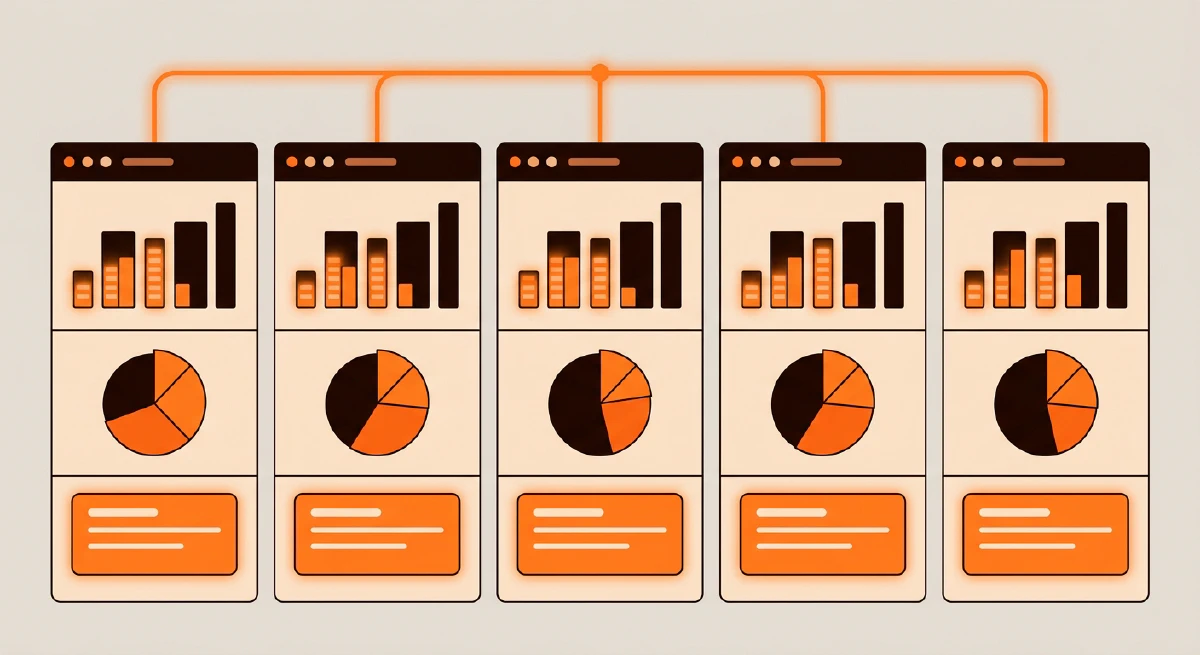

Google rank isn’t the scoreboard anymore. Zeover measures brand citation rate, sentiment, and competitive share of voice across ChatGPT, Claude, Gemini, Grok, and Perplexity on a continuous cadence, so content decisions are based on where the brand actually stands today. Start a cross-engine benchmark.
A marketing team in 2023 could review a single Google rank report and call it measurement. In 2026, that same report captures roughly the same slice of a much larger visibility surface, which means a team reading only the Google dashboard is making content decisions against a partial picture. Gemini’s rise has changed the math for teams that used to treat Google as a proxy: Google still matters, but Google’s own AI product now draws meaningfully from sources Google rank doesn’t surface.
This is Part 4 of a five-part series on content marketing strategy rebuilt for the AI era. Part 1 framed the strategic case. Part 2 covered brand governance. Part 3 covered the machine-readability work that doubles as SEO. Part 4 moves to the measurement layer that closes the loop on all three.
TL;DR
- ChatGPT’s market share has declined from a near-monopoly position to roughly 64-68% in early 2026, per SimilarWeb’s January 2026 analysis reported across the ecosystem. Gemini has scaled to 18-21%, with Perplexity, Claude, Grok, and DeepSeek holding smaller but growing shares.
- A 2026 benchmark that only tracks one engine captures between 40 and 70 percent of a brand’s AI visibility depending on audience. B2B enterprise skews Claude. Consumer retail skews ChatGPT. Research-heavy queries skew Perplexity.
- The three metrics that matter per engine are: citation rate for a defined prompt set, brand mention sentiment, and factual accuracy of the engine’s brand summary. Organic traffic isn’t on the list.
- Cadence for cross-engine benchmarking is monthly for most brands, weekly for high-volume or fast-changing categories. Daily benchmarking is overkill and wastes analyst time.
- The benchmarking function belongs to marketing operations, not to SEO. The scope of work, the data model, and the decisions that follow are closer to brand research than to rank-tracking.
The One-Engine Dashboard Misleads
Market share is the starting point. A marketing team that measures citation in ChatGPT only and ignores the other four engines is making a defensible choice if 100% of the brand’s buyers use ChatGPT exclusively. In 2026, that audience doesn’t exist.
Three data points on the current distribution:
First, SimilarWeb’s January 2026 referral data shows Gemini external referrals grew 388% year-over-year between September and November 2025 while ChatGPT grew 52% over the same window. Gemini is the fastest-growing referrer to web pages, which means pages cited by Gemini are getting a steeper traffic benefit than pages cited only by ChatGPT.
Second, Claude has captured a growing share of enterprise B2B workflows. Industry analyses in 2026 have repeatedly shown Claude winning the majority of head-to-head enterprise deployments against other chatbots, which means for any brand selling into enterprise buyers, Claude’s citation behavior is a direct input to pipeline.
Third, Perplexity’s citation-first design has produced year-over-year growth rates reported across the ecosystem at multiple hundreds of percent, driven by research-mode queries where citations are the product. Brands with academic or high-trust audiences see disproportionate Perplexity citation value.
A dashboard that covers only ChatGPT misses all three of those movements. A dashboard that covers all five catches them while they’re still early enough to act on.
The Three Metrics Per Engine
Once a team accepts that five engines need tracking, the next question is what to track per engine. The answer is three metrics, the same three across all five.
Citation rate for a defined prompt set. The team defines 20 to 50 prompts a qualified buyer would plausibly ask, then queries each engine and records whether the brand is cited, where in the answer it appears, and against which competitors. The prompt set is the invariant; running the same prompts weekly or monthly produces a trend line.
Brand mention sentiment. Citation is not enough. An engine that cites the brand as “a legacy player losing ground to newer tools” is citation with negative valence, which hurts, not helps. Sentiment scoring per citation separates presence from preference.
Factual accuracy of the brand summary. Every engine, asked “what is X Inc,” produces a one-to-three-sentence summary. That summary is what a buyer reads before clicking anything. If the summary gets the customer segment, pricing, or founding story wrong, the brand is fighting the engine’s description of itself. Accuracy scoring (typically a human-reviewed weekly sample) catches drift early.
Notice that organic traffic isn’t on the list. AI-sourced traffic is a second-order consequence of citation rate and summary accuracy. Tracking traffic alone gives the team a lagging indicator without the diagnostic power to explain it.
Cadence: Monthly for Most, Weekly for Some
The most common mistake in cross-engine benchmarking is overinstrumenting. Teams new to the discipline sometimes set up daily measurement, drown in noise, and abandon the program within a quarter.
For most brands, monthly cadence is right:
- The engines themselves update their underlying models and crawl sets on multi-week cycles. Daily measurement captures model variance more than brand reality.
- Content interventions (a new landing page, a revised entity page, an updated llms.txt) take one to two weeks to spread into engine citations. Faster cadence measures before the intervention lands.
- Analyst time is the scarce resource. Monthly benchmarking with weekly spot-checks on high-priority prompts produces the best ratio of signal to overhead.
Weekly cadence makes sense when:
- The brand operates in a category with rapid news cycles (finance, crypto, breaking B2B announcements).
- A content intervention is in flight and the team needs to measure whether it’s landing.
- The brand faces an active reputation issue where a wrong citation is actively hurting pipeline and the team needs to catch remediation impact.
Daily cadence is almost never worth the effort. Hourly cadence is never worth the effort outside of an active incident.
Share of Voice Is The Competitive Lens
Measuring the brand’s own citation rate produces a time series. Measuring the same prompts against competitors in the same category produces a share of voice. The second is the number that drives planning conversations.
A share-of-voice report answers the question “when a qualified buyer asks ChatGPT ‘what is the best X for Y,’ which category players show up and in what order, and how is that distribution moving over time.” A brand that holds 40% of Google rank-one slots but 10% of ChatGPT first-citation slots has a concrete gap to close, and the share-of-voice dashboard tells the content team exactly which prompts to target.
The practical implementation:
- Define the top 10-20 commercial prompts for the category, not the brand.
- Run the same prompts across all five engines on the benchmark cadence.
- Record which competitors appear in which position in each engine’s answer.
- Report deltas monthly.
This is the same playbook SEO teams ran for Google rank in 2018, applied to a five-engine surface. The work is familiar; the surface is new.
Who Owns Benchmarking
Cross-engine benchmarking isn’t a SEO task and it isn’t a content task. It sits in marketing operations, reporting to the head of marketing or the CMO. The scope crosses:
- Prompt design, which requires deep buyer knowledge.
- Engine queries, which require tooling or manual discipline.
- Sentiment and accuracy review, which requires editorial judgment.
- Share-of-voice analysis, which requires competitive context.
No single discipline covers the scope. The practical staffing pattern in mid-sized marketing organizations is a part-time analyst (or a shared platform) running the data collection, with the head of content and head of product marketing reviewing the report monthly and deciding which findings translate into content work.
For organizations not ready to staff the role, a GEO platform that runs cross-engine benchmarks on autopilot compresses the setup cost into tool selection. Part 5 of this series will cover that build-vs-buy calculus.
The Benchmarking Report That Drives Decisions
A benchmarking report that doesn’t drive decisions is theatrical measurement. The report that actually works has five components:
- Headline citation rate per engine, with the month-over-month delta.
- Share of voice against top 3 competitors, per engine, on the category prompt set.
- Summary accuracy score, flagging any factual drift since last cycle.
- Sentiment score on cited answers, flagging any negative-valence citations.
- One concrete content action recommended for the next cycle based on the above.
The fifth item is the one that closes the loop. A report that ends with a data summary and no recommendation becomes a passive artifact that gets filed. A report that ends with “recommend producing a comparison page for prompt P because competitor C holds 60% first-citation on it” turns measurement into content strategy.
The Takeaway
Cross-engine benchmarking isn’t optional in 2026. It’s the measurement layer that replaces the Google-rank-only dashboard and connects the governance and machine-readability investments from Parts 2 and 3 to actual decisions about what content to produce next. Marketing leaders who set up even a basic five-engine monthly benchmark this quarter have a working measurement function by end of year. Those who wait spend 2027 catching up to competitors who already have the data.
Part 5 closes the series on the workflow and platform-investment question: when AI content generation earns its place in the production pipeline, when it doesn’t, and how to decide whether the benchmarking, governance, and content functions described in this series are best served by a platform or by assembled in-house tooling.


