Machine-Readable Content That Wins Both GEO and SEO (Part 3 of 5)
Content Marketing GEO SEO
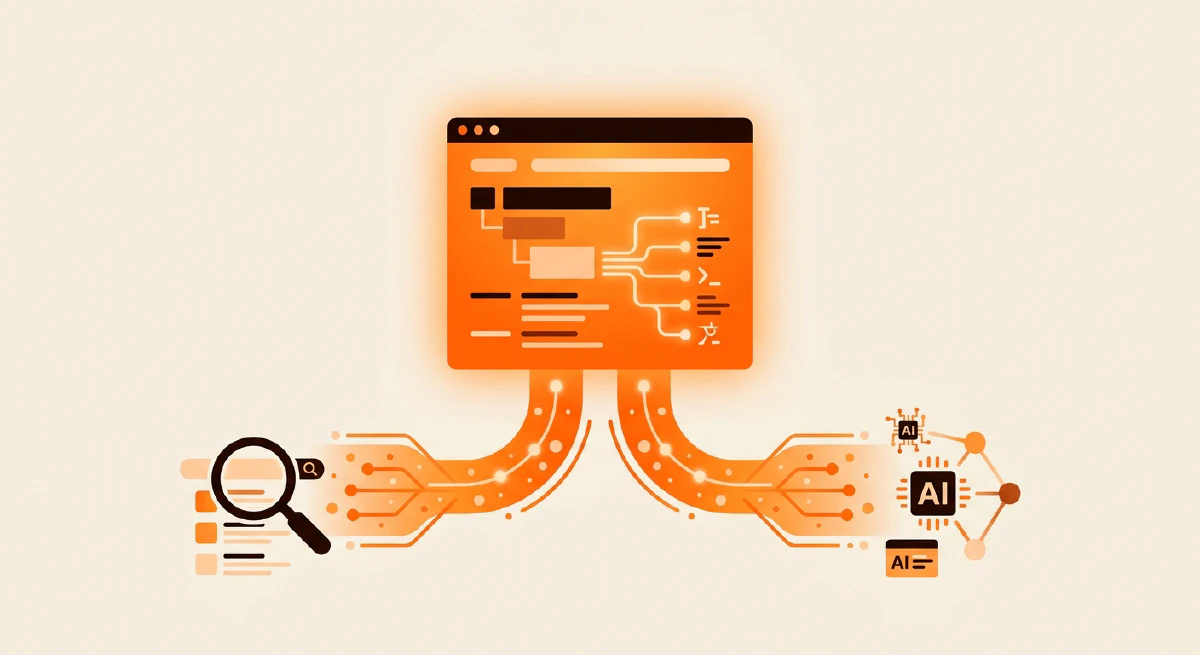

Machine-readable content gets cited by AI engines and still ranks on Google. Zeover audits schema coverage, heading hierarchy, llms.txt, and entity consistency in one pass, then generates content that reads naturally and compiles cleanly for both AI engines and traditional search. Run a machine-readability audit.
Marketing leaders in 2026 are often told that GEO is new work on top of SEO. The framing is half right: GEO is new, but the implementation work overlaps with SEO by 70 to 80 percent. The same structural habits that make a page cite-worthy to ChatGPT and Gemini still satisfy Google’s ranking systems. That overlap is the strongest single argument for any head of marketing making a case for content restructuring this quarter. The investment compounds on two channels, not one.
This is Part 3 of a five-part series on content marketing strategy for the AI era. Part 1 made the case that content matters more than it did in the SEO-only era. Part 2 covered brand governance across many producers. Part 3 moves to the page-level mechanics that turn governed content into machine-readable content.
TL;DR
- The machine-readability work for GEO overlaps with SEO by most of its scope. Schema, heading hierarchy, canonical URLs, and entity-consistent copy satisfy both AI engines and Google’s ranking systems.
- Pages with FAQPage structured data appear in AI-created answers at materially higher rates than unstructured prose. Google’s own FAQPage documentation confirms the schema was originally designed for rich results but continues to act as a structure signal for AI answer systems.
- Entity pages (product, person, organization, location) cited with internal links and consistent descriptions become anchor points AI engines resolve the brand against. A page without a clear entity is a page the engine can cite but can’t summarize.
- llms.txt is the one net-new primitive. It’s cheap to implement, zero downside, and gives AI crawlers an explicit map of the brand’s canonical content set.
- The 70-80 percent SEO/GEO overlap means marketing leaders asking for budget for GEO should frame it as “SEO infrastructure that also earns AI citations,” not as a net-new line item. The work is the same, the return is doubled.
Why The Overlap Exists
Google’s ranking systems and the citation mechanics of AI engines share a common root: both try to surface pages that are credible, well-structured, and unambiguously about the topic the reader asked about. That shared goal produces shared technical requirements.
Schema.org markup was originally a collaboration between Google, Microsoft, Yahoo, and Yandex, documented at schema.org, that gave search engines a machine-readable vocabulary to describe page content. That same vocabulary is now the fastest path for AI engines to understand the content of a page without parsing natural-language ambiguity. A single Article or FAQPage schema block does double duty: it improves the page’s chance of a rich result in Google and its chance of citation in ChatGPT, Claude, Gemini, and Perplexity.
Heading hierarchy has the same dual purpose. A clean H1-H2-H3 tree tells a Google crawler what the page is about and which sections answer which sub-questions. It tells an AI engine which paragraph to extract when asked a specific question. A 4,000-word page with a single H1 and no sub-structure is an opaque wall to both. Google can still rank it, but the probability of citation drops.
Canonical URLs, sitemap completeness, robots.txt discipline, and fast server response times are the other legacy SEO primitives that turned out to be GEO primitives in disguise. The work a sufficient SEO operation did in 2023 is still load-bearing in 2026.
Schema Is Still The Biggest Structural Win
If a team has time for one page-level improvement this quarter, it is adding the right schema types to the content that already gets the most organic traffic. The evidence is strong across multiple 2026 analyses that pages with rich structured data appear in AI-generated answers at meaningfully higher rates than pages without.
The practical prioritization for a marketing operation in 2026:
- Organization schema site-wide. Defines the brand entity: legal name, logo, sameAs links to social profiles, contact points. This is the anchor AI engines use to resolve any page on the domain back to the brand.
- Article schema on every blog post and editorial page. Specifies headline, author, datePublished, dateModified, and publisher. Freshness is a strong AI-citation signal;
dateModifiedtells the engine the page is current. - FAQPage schema where the page answers specific questions. Answer extraction is the default behavior of every AI engine, and a structured Q&A block is the path of least resistance to extraction.
- Product schema on category and comparison pages. Price, availability, review data, and identifier fields give the engine the atoms it needs to place the product in a recommendation set.
- BreadcrumbList across the site navigation. Cheap to implement, tells both Google and AI engines where a page sits in the content taxonomy.
The existing series “How to Optimize for AI Searches” - Schema Markup Is Not Optional covers the implementation mechanics line by line. For marketing leaders deciding whether to focus on this work, the directional answer is: if the schema work for the top 20 pages on the site hasn’t been done, it is the highest-ROI content investment available this quarter.
Heading Hierarchy And The Paragraph Contract
Beyond schema, the second largest machine-readability lever is the unglamorous heading-and-paragraph structure of the content itself.
AI engines extract answers at the paragraph level. A 2,500-word essay written as a continuous argument gives the engine one large chunk and hopes it picks the right sentence. A 2,500-word article with 8 H2 sections, each opening with a clear topic sentence and followed by 2-4 short paragraphs, gives the engine 24-32 extractable atoms, each cleanly scoped to a sub-question.
The paragraph contract that earns citation looks like this:
- Opening sentence states the claim the paragraph will defend.
- Second and third sentences provide evidence (a statistic, a quote, a primary-source link).
- Paragraph length under 120 words, ideally 60 to 90.
This isn’t a new writing rule. It’s the same “journalistic inverted-pyramid” pattern that SEO copywriting guides have recommended since 2015. What’s new is that AI engines enforce it with actual citation decisions, not just ranking-signal inference.
The deeper series “How to Optimize for AI Searches” - Make Your Content Machine-Readable covers the copy-level patterns. The takeaway for a content operation is that the writing-style rules are stricter now than they were in the SEO era, and the content calendar should build the new rules into briefs rather than retrofitting after the fact.
Entity Pages As Citation Anchors
AI engines resolve brand queries against entity pages: one canonical URL that defines who the organization is, what the product is, who a key person is. Without a clear entity page, the engine tries to synthesize an entity from scattered content, and that synthesis is where contradictions (the Part 2 problem) produce hedging.
A credible entity page has:
- A single canonical URL with Organization or Product schema.
- A clear definition in the first paragraph that matches the governance document’s positioning sentence.
- Internal links from every related content piece, creating a unambiguous semantic network.
- External
sameAsreferences to LinkedIn, Crunchbase, Wikipedia (where applicable), and any other authoritative source on the same entity.
Entity pages are where the Part 2 governance work and the Part 3 structural work converge. Consistent claims (governance) published on a schema-marked canonical URL with clean internal linking (structure) is the combined signal AI engines reward with high citation rates.
llms.txt: The One Net-New Primitive
llms.txt is the single machine-readability primitive that did not exist in the SEO era. It’s a markdown file at the root of the domain that lists the canonical content AI crawlers should index, with short descriptions and optional priority.
Implementation is cheap. A single file, committed to the root of the site, is the entire change. The upside is that AI engines with explicit llms.txt support (including Perplexity and multiple long-tail AI search tools) read the file first and prefer the listed pages for citation. The downside is effectively zero: a missing llms.txt has no penalty, a present one has no risk of breaking anything else.
The “How to Optimize for AI Searches” - Start With Your llms.txt piece covers the file format. For marketing leaders focusing on this quarter, llms.txt is the lowest-effort, zero-risk starting point, and it signals internally that the content operation takes AI-engine visibility seriously.
What The Overlap Means For Budget Conversations
The practical reason machine readability matters at the strategy level is that it reframes the budget conversation. A head of marketing who proposes “a GEO project” competes with every other new-category request in the planning cycle. A head of marketing who proposes “an SEO infrastructure refresh that also earns AI citations across ChatGPT, Claude, Gemini, Grok, and Perplexity” is proposing maintenance work on an asset the CFO already understands, with a GEO upside that arrives as a bonus.
The framing matters because the work is the same in either case. Schema, headings, entity pages, canonical URLs, llms.txt, and consistent entity copy are the deliverables. Framed as SEO, they compete against content-volume projects. Framed as machine-readability for all search surfaces, they are the foundation every other 2026 marketing channel depends on.
The Takeaway
The single most useful way to think about machine readability is that it collapses two quarterly projects into one. An SEO infrastructure pass that also gets the brand cited by five AI engines is cheaper and faster than running the two as separate streams, and it ships a content asset that compounds on both surfaces for years. Marketing leaders planning the next quarter should focus on the schema, hierarchy, entity, and llms.txt work before any net-new content creation. The existing inventory, structured properly, is worth more than new content poured into the same unstructured format.
Part 4 moves to measurement. Once the governance layer and the machine-readable layer are in place, the next question is which AI engines to track, what to measure per engine, and how often. That’s the cross-engine benchmarking discipline that replaces the Google-rank-only dashboard of the last decade.


