How to Rank in ChatGPT - A Content Marketing Strategy Built for AI Citations (Part 3 of 5)
Marketing Strategy GEO ChatGPT Content Marketing

Need a Content Generation for GEO engine that actually gets cited? Zeover generates GEO-optimized blog posts, press releases, LinkedIn posts, and YouTube metadata structured for ChatGPT citation - while you focus on your core product. See the content engine.
This is part three of our series on how to rank in ChatGPT. Parts one and two covered the foundation: what ChatGPT actually cites (48% third-party, 2.62 citations per answer) and how to make your site AI-readable (unblock crawlers, publish llms.txt, add schema). This part is about the content itself.
A content marketing strategy built for AI citations isn’t just “publish more blog posts.” The format mix matters. The cadence matters. The editorial accuracy matters. And the honest question most marketing teams now face - how to use AI in marketing responsibly to scale substantive content - has a right answer and a wrong one. This post lays out the AI marketing strategy that earns ChatGPT citations instead of churning thin pages ChatGPT ignores.
TL;DR
- ChatGPT’s citation mix pulls from multiple formats: editorial blogs, YouTube, podcasts, press releases, and third-party coverage. No single format is enough on its own.
- YouTube holds a 29.5% citation share in Google AI Overviews and is one of the biggest single format levers for ranking in ChatGPT too.
- Earned media accounts for the large majority of AI citations, with syndicated press releases growing meaningfully across the second half of 2025 based on public-relations industry tracking.
- Using AI in marketing to scale substantive content is the right play. Using AI to churn thin pages on keywords is the wrong one - AI engines deprioritize thin content aggressively.
- Consistency beats volume spikes. Brands publishing steadily for years outperform brands that launch a content burst and go quiet.
The Format Mix That Ranks in ChatGPT
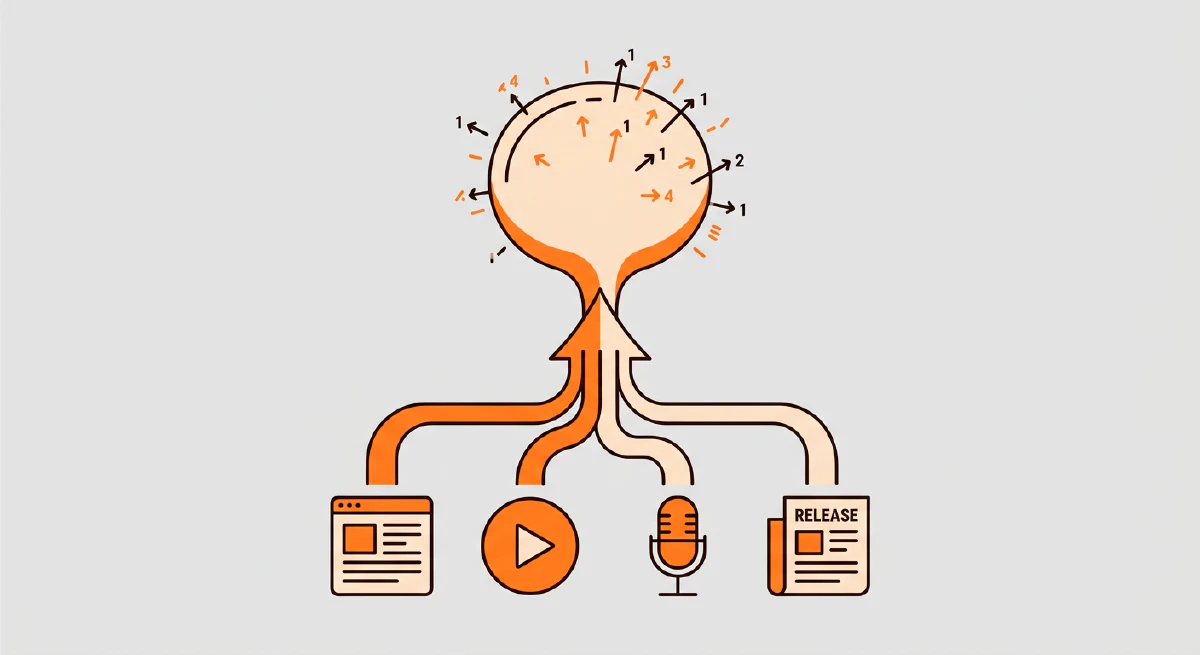
ChatGPT doesn’t have a preferred format the way Google historically favored long-form blog posts. It pulls from whichever format contains the cleanest, most citable answer to a specific query. In practice, that means a portfolio approach across four formats earns more citations than concentrating on any single one.
Editorial blog posts
Substantive long-form writing is still foundational. A well-structured blog post with statistics, named sources, and direct answers in the first 40-60 words of each section is a citation-ready asset. The KDD 2024 GEO research found specific techniques moving AI visibility by 14-41%: quotation addition (+41%), statistics addition (+33%), source citations (+28%).
What fails: generic “5 tips for X” content that could have been written by any competitor, keyword-padded pages, and opinion pieces without evidence. AI engines are increasingly good at detecting generic content and deprioritize it.
YouTube
YouTube is the single most-cited domain in Google AI Overviews at 29.5% share, and it’s heavily cited on ChatGPT too. A 2026 study of over 100 million AI citations across six AI search platforms found that 94% of AI-cited YouTube videos are long-form (not Shorts) and 32% fall in the 10-20 minute range.
One well-structured 15-minute tutorial with a detailed description, timestamped chapters, and corrected captions is worth more for ChatGPT visibility than months of social media activity. We covered the full playbook in our dedicated YouTube GEO post.
Podcasts
Podcasts are emerging, under-optimized, and competitively thin. Few brands have built podcast-specific GEO strategy because citation data on podcasts is still limited. But AI engines are beginning to cite podcast transcripts when those transcripts are published on the podcast’s website or in show notes.
The tactical move: publish full, accurate, searchable transcripts for every podcast episode on your website, with clear chapter markers and topic-specific H2 headings. This turns a podcast episode into a long-form text asset that ChatGPT can extract from. An hour of conversation produces 8,000-12,000 words of transcript, which is more citable material than most brands generate in a month of blog posting.
Press releases and earned media
Press releases distributed through newswires build brand co-occurrence signals across hundreds of syndication endpoints. Earned media accounts for the dominant share of AI citations, and syndicated press release citations grew sharply across late 2025 based on public PR industry tracking.
Press releases matter for ChatGPT specifically because of the third-party source bias we covered in Part 1. ChatGPT pulls roughly 48% of citations from third-party sites. A press release syndicated to 300+ endpoints creates 300+ third-party mentions of your brand with structured details ChatGPT can extract.
For how to format them, see our post on writing press releases that AI models actually cite.
Consistency Over Spikes
AI engines evaluate content freshness and publishing cadence as trust signals. A brand that published heavily in 2023 and went quiet in 2024 signals the business may no longer be active. Stale sources get deprioritized in favor of active ones.
Consistency is the signal that separates active authorities from dormant ones. A brand publishing two substantive pieces per month for three years has a stronger authority footprint than a brand that published twenty pieces in a single quarter and then stopped.
Three cadences that work:
- Weekly. One substantive piece per week, published on the same day. Predictable signal for AI crawlers and human readers.
- Biweekly depth cycle. One long-form piece every two weeks. Better for smaller teams that can’t hit weekly without sacrificing quality.
- Daily short-form + weekly long-form. LinkedIn posts, newsletter blurbs, or X threads daily, combined with a substantive blog post once a week. Higher surface area across channels.
The specific cadence matters less than the commitment to maintain it. Brands publishing reliably for two years outperform brands that burst and go dark.
How to Use AI in Marketing (The Responsible Version)
There’s a right way and a wrong way to use AI in marketing, and the two paths diverge on accuracy and substance.
The wrong way: Use generative models to churn thin keyword-targeted pages at volume. Twenty articles per week, each optimizing for a long-tail phrase, all rewrites of the same general advice. AI engines detect this pattern quickly and deprioritize the whole site. Google and other AI engines have publicly signaled that content produced without editorial review and substantive original insight is treated as lower quality.
The right way: Use AI to accelerate substantive work. Research compilation, fact-checking, draft generation, outline iteration, editing, and format repurposing (blog → LinkedIn post → email) are all legitimate uses. The content still goes through human editorial review, still contains original insight specific to your business, and still has verifiable facts with named sources.
The distinction that matters is substance, not toolkit. A human-written thin page is as unhelpful as an AI-written thin page. A substantive piece with real data and real insight is citable regardless of whether AI assisted the drafting. Your AI marketing strategy should optimize for substance, not for “feels human.”
Content Generation for GEO - What Compounds
Content Generation for GEO at scale only works when the content is actually useful. The compounding effect comes from building a library of substantive, structured, accurate content that AI engines can return to for years. A brand that has one strong page per target query is well-positioned. A brand that has twenty thin pages per target query is spam-filtered.
Content marketing strategy for AI citations, in one sentence: publish the kind of content you’d send to a qualified prospect before your first meeting, on a sustainable cadence, across the four formats AI engines cite. That’s it.
What that looks like in practice:
- Five to ten substantive blog posts per core topic area (not per keyword - per topic)
- One long-form YouTube video per month on a customer-relevant question
- A podcast with full transcripts published on your site
- Press releases for every meaningful company milestone
- Cross-linking between formats so a single topic has blog, video, and press coverage
The overlap between formats reinforces authority. ChatGPT seeing your brand mentioned across all four formats for a specific topic builds more citation confidence than seeing it mentioned twenty times in blog posts alone.
Accuracy Is Non-Negotiable
Every statistic needs a source. Every quote needs attribution. Every claim a competitor or user could check needs to hold up under checking. AI engines propagate what they cite, and sources that repeatedly cite numbers that don’t match other authoritative sources get deprioritized.
This matters more for AI visibility than for traditional SEO. A traditional SEO article with a wrong stat might hurt credibility with a skeptical reader. An AI visibility asset with a wrong stat gets AI engines to repeat the wrong stat to users, which then gets caught when users cross-check, which gets your whole source deprioritized.
The discipline: never publish a number without a linked primary source and a publication date. If you can’t verify a claim, cut it or soften it. Accuracy compounds the same way structured consistency does.
How Zeover Handles Content Generation for GEO
Zeover generates GEO-optimized content across the formats that rank in ChatGPT: blog posts, press releases, LinkedIn posts, YouTube metadata, and social content. Every piece is structured with the citation signals the KDD 2024 research identified as most effective - quotations, statistics, source citations, authoritative tone, clean heading structure - and aligned to your canonical brand boilerplate.
The platform also tests what’s working. Each generated piece is benchmarked against your tracked queries across ChatGPT, Claude, Gemini, and Grok, so you see which content is earning citations and which isn’t. Your team focuses on the product roadmap; we run the content engine and the measurement layer underneath it.


