Who Is Organic GEO Best For - The B2B Case: Low Traffic, High Stakes (Part 1 of 6)
Strategy GEO

Every B2B deal now starts with AI research. Zeover ensures your brand appears in the AI-generated answers your enterprise buyers see, across ChatGPT, Claude, Gemini, and Grok. Win the AI conversation.
This is part one of our series on who Organic GEO is actually best for. Not every business benefits equally from investing in GEO. The ROI calculus varies dramatically across segments, deal sizes, and customer acquisition models. This series breaks it down audience by audience, starting with the clearest case: B2B.
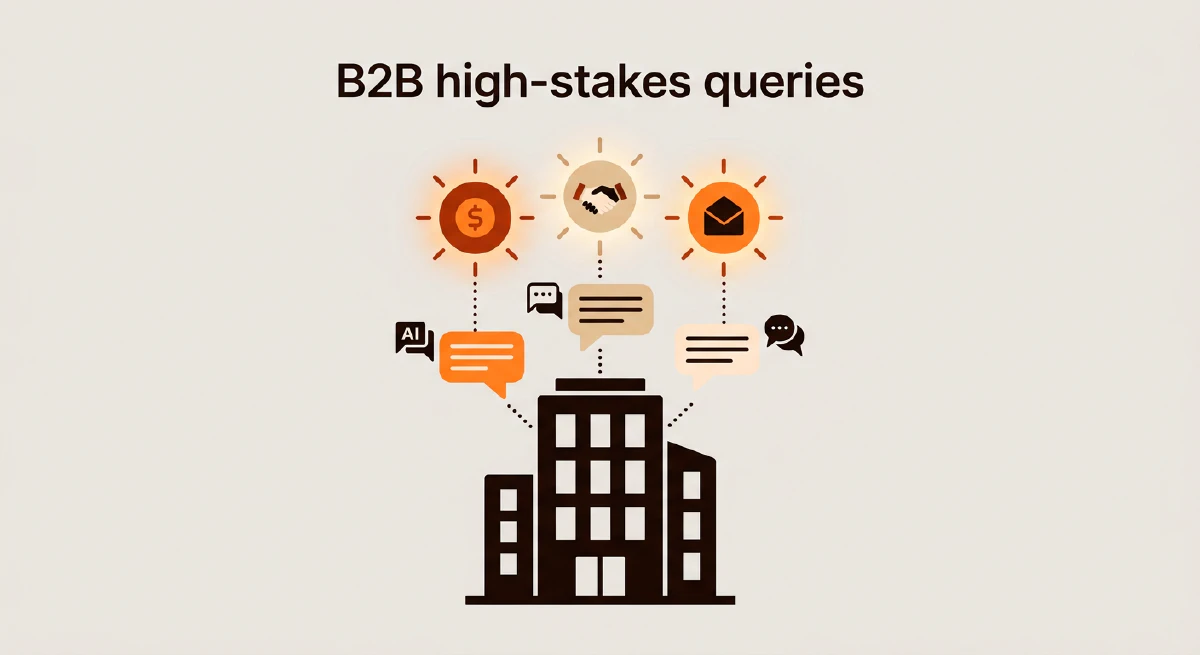
In B2B, the math of GEO is different from every other category. The search volume is low. The number of potential customers is small. The deal sizes are enormous. And every buyer now consults AI before they consult a sales rep.
TL;DR
- 89% of B2B buyers have adopted generative AI in less than two years and name it among top information sources across every buying phase.
- B2B technology queries trigger Google AI Overviews 82% of the time.
- AI-referred traffic converts at higher rates than traditional search, and for B2B SaaS specifically, AI visitors convert at 57.84%.
- By 2028, Gartner projects 90% of B2B buying will be AI-agent intermediated, pushing $15 trillion through AI exchanges.
- For B2B, owning three high-intent queries is worth more than appearing in thousands of low-intent ones.
The B2B Search Paradox
B2B sellers have always faced a paradox: the traditional SEO signals suggest their categories are tiny. A query like “self-hosted privileged access management for 500+ employees” might have 30 monthly searches globally. An SEO tool would score that as a low-priority keyword. The company serving that query might have a $2 million average contract value.
AI visibility flips the equation. A single B2B buyer asking ChatGPT “what’s the best privileged access management platform for a bank with 1,200 employees” isn’t one of 30 monthly searchers - they’re one decision-maker representing a deal worth hundreds of thousands or millions of dollars, and they’re asking AI the question before they’ll speak to a salesperson.
The math for B2B GEO is straightforward: if owning three queries brings in one enterprise customer a quarter, and each customer is worth seven figures over the contract lifetime, the ROI on GEO investment beats almost any other marketing spend.
How B2B Buyers Actually Use AI
The Forrester 2026 Buyer Insights report found that 89% of B2B buyers have adopted generative AI in less than two years and named it one of the top sources of self-guided information across every phase of the buying process. The typical B2B buying decision now includes 13 internal stakeholders and 9 external influencers.
Stakeholders ask AI different questions at different phases:
Discovery phase. “What tools exist for [specific problem]?” “Who are the major vendors in [niche category]?” Buyers at this stage are shaping their shortlist before speaking to anyone.
Evaluation phase. “How does [Vendor A] compare to [Vendor B]?” “What are alternatives to [Incumbent]?” Buyers are narrowing their shortlist based on AI-generated comparisons.
Validation phase. “Is [Vendor] secure enough for regulated industries?” “Has [Vendor] been used by companies our size?” Buyers are checking whether candidates meet specific requirements.
Justification phase. “What’s the ROI of [category]?” “How do companies typically measure success from [category] investments?” Buyers are building internal business cases.
If your brand isn’t cited in the AI responses at each of these phases, you’re not just losing visibility. You’re being excluded from the shortlist before any human at your company has a chance to engage.
The Conversion Math
AI-referred B2B traffic converts exceptionally well. A study covering January 2024 through December 2025 found that SaaS companies specifically saw AI visitors convert at 57.84% session rates compared to 37.17% for organic search. For retail the gap is narrower, but for SaaS and B2B tech, AI visitors convert at dramatically higher rates.
The reason is pre-qualification. When a B2B buyer arrives on your site from AI, they’ve already been educated by the AI about your category, your offering, and your fit. They’re further down the funnel than a cold organic visitor. They know what they’re looking at and often know whether you fit.
A Webflow data point shared publicly: 8% of their signups now come from LLM traffic, converting at 6x the rate of traditional Google Search. That isn’t a marginal improvement - it’s a category shift in conversion quality.
Which Queries Actually Matter
For B2B, the universe of queries worth optimizing for is small but specific. Three categories matter most:
Category-definition queries
“What is [your category]?” “How does [your category] work?” “Who are the vendors in [your category]?”
These are the shortlist-formation queries. If you’re not mentioned, you’re not considered. The good news is these queries are usually winnable because they reward clear, factual, educational content - exactly what B2B marketing teams produce anyway.
Comparison queries
“[Your product] vs [competitor].” “Alternatives to [incumbent].” “[Category] comparison.”
These queries are where deals are won or lost at the evaluation stage. Publish honest, substantive comparisons that name specific differences. AI engines cite these heavily because they directly address buyer decision-making.
Use-case queries
“[Category] for [specific industry].” “[Category] for [specific team size].” “[Category] with [specific requirement].”
These are the queries where you can win deals that your largest competitors don’t even pursue. An enterprise vendor with 10,000 customers may not have content targeting “GEO platforms for 50-person marketing agencies” - but a smaller competitor who explicitly serves that segment can own that query permanently.
Strategic Priorities for B2B GEO
1. Identify your 10-20 highest-value queries. Not your thousands of long-tail keywords. Your top 10-20 queries that, if you owned them, would materially change your pipeline. Start there.
2. Optimize your site for those queries specifically. Schema markup, answer-ready content structure, consistent boilerplate. The GEO fundamentals. But targeted specifically at these 10-20 queries.
3. Build third-party signal. AI engines weight external mentions and cross-channel consistency heavily. Press releases, earned media coverage, customer quotes in trade publications, LinkedIn activity from your leadership team. All of these reinforce your authority on your target queries.
4. Monitor weekly. B2B deal cycles are long, but AI visibility shifts are fast. A competitor publishing a substantive comparison piece can move the needle within weeks. You need to see changes as they happen, not in quarterly reports.
5. Close the loop to sales. When an AI-referred lead enters your pipeline, tag it. Track conversion rates by AI source. Over time, you’ll learn which AI engines send the highest-intent traffic for your specific category. That data informs where to concentrate future GEO effort.
Why This Is Especially Good for B2B
A few structural reasons B2B is an ideal GEO target:
- Query specificity. B2B queries are narrow enough that the competitor set on any given query is usually 3-8 brands, not 300. Becoming one of the cited sources is achievable.
- Content already exists. Most B2B companies have years of blog posts, white papers, and case studies. Optimizing existing content for GEO is often lower effort than creating new content.
- High-touch sales processes absorb GEO signals. When a prospect tells your sales rep “I read about you in ChatGPT’s response to my query about [X],” your GEO investment converts to pipeline visibility.
- Deal size justifies the spend. Even a modest GEO investment produces clear ROI when individual deals are worth six or seven figures.
How Zeover Fits B2B
Zeover is designed for exactly this use case. Track 20-50 queries that matter to your B2B pipeline. Benchmark your visibility on each across ChatGPT, Claude, Gemini, and Grok. See which competitors appear when you don’t. Generate content optimized for the specific gaps.
For B2B marketing teams without dedicated GEO staff, Zeover compresses the work of running a full GEO program into a single platform. You focus on your pipeline. The AI visibility audit, content generation, and measurement happen in the background.
Where This Fits in the Series
This is part one of a six-part series on who Organic GEO is actually best for. The following parts cover B2C, startups, local and multi-location businesses, agencies, and companies running both paid and organic acquisition. B2B and B2C operate by completely different GEO economics - low-volume high-intent queries for B2B versus volume-driven economics for B2C - and each subsequent part breaks down the specific strategy for that audience.


