How to Do GEO: A Step-by-Step Guide to Generative Engine Optimization
Strategy GEO

GEO starts with knowing where you stand. Zeover crawls your site, scores it against 100+ GEO metrics, benchmarks your brand across ChatGPT, Claude, Gemini, and Grok, and generates optimized content - all in one platform. Start your free analysis.
Generative Engine Optimization is the practice of making your brand’s content visible, citable, and accurately represented in AI-generated answers. When someone asks ChatGPT for a product recommendation, asks Perplexity to compare solutions, or gets a Google AI Overview summarizing their research topic, GEO determines whether your brand appears in those AI organic results.
The foundational GEO research, published at KDD 2024 by researchers from Princeton, Georgia Tech, and IIT Delhi, tested nine optimization strategies across 10,000 queries and found that specific techniques can improve content visibility in AI answers by 14-41%. Ninety-seven percent of marketers report positive impact from GEO initiatives, and 54% of U.S. marketers plan to implement GEO within three to six months.
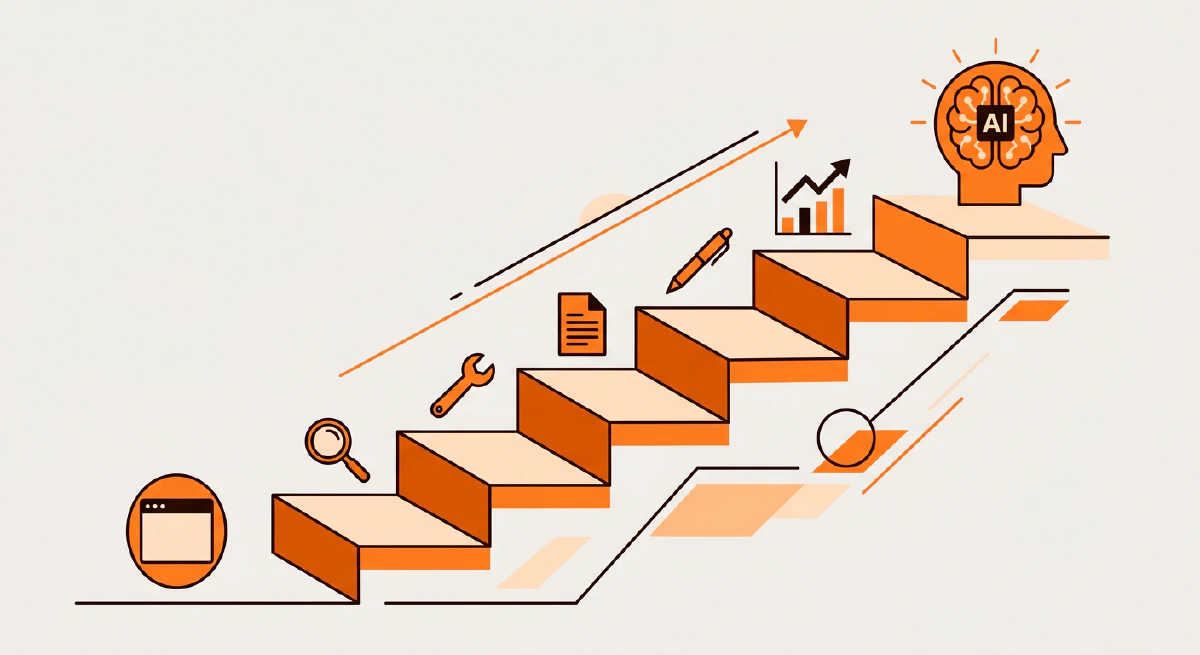
This guide covers the five core steps. Each one builds on the previous, and together they form a repeatable process for improving AI visibility.
TL;DR
- Measure where you stand first. You can’t optimize what you haven’t benchmarked across ChatGPT, Gemini, Perplexity, Claude, and Grok.
- Fix technical barriers: 73% of sites have issues blocking AI crawlers. Check robots.txt, add structured data, consider llms.txt.
- Optimize existing content for citation: add statistics (+33% visibility), quotes (+41%), and source citations (+28%).
- Generate new content targeting gaps where AI recommends competitors instead of you.
- Track benchmarks monthly. Each AI engine cites different sources - what works on Gemini may not work on ChatGPT.
Step 1: Measure Your Current AI Visibility
Before optimizing anything, you need a baseline. GEO measurement is fundamentally different from SEO measurement because there are no “rankings” to track. Instead, you’re measuring whether your brand appears at all in AI-generated responses.
The metrics that matter:
Brand visibility score - the percentage of relevant queries where AI engines mention your brand. This is the north star. If you sell cybersecurity software and AI engines mention your brand in 3 out of 20 relevant security queries, your visibility score is 15%.
Mention rate vs. recommendation rate - getting mentioned is different from getting recommended. An AI might mention your brand as one option among six, or it might name you as the top choice. For B2B specifically, recommendation rate is the stronger pipeline signal.
Share of voice - when AI discusses your category, how often does it reference you compared to competitors? This tracks your relative position in AI-mediated discovery.
Platform-specific visibility - each AI engine cites differently. An analysis of 40,000 AI responses with 250,000 citations found that Perplexity averages 6.61 citations per answer while ChatGPT averages 2.62. Only 11% of cited domains appear across multiple AI platforms. Aggregating hides the differences.
Zeover, an AI engine optimization platform, automates this measurement. You provide your domain and target queries, and the platform benchmarks your brand’s visibility across ChatGPT, Claude, Gemini, and Grok, showing exactly where you appear, where you’re missing, and who shows up instead.
Step 2: Fix Technical Barriers
Technical issues prevent AI engines from reading your content in the first place. Fixing them is usually the highest-return first step.
Robots.txt and AI crawlers
AI engines use their own crawlers: GPTBot (OpenAI), Google-Extended (Gemini), ClaudeBot (Anthropic), PerplexityBot, and others. Cloudflare’s analysis of web crawler traffic found that GPTBot’s share of AI crawler requests rose from 5% to 30% between May 2024 and May 2025, while PerplexityBot grew by over 157,000%. Nearly 60% of reputable sites now block AI user agents, forbidding an average of 15.5 AI crawlers each.
Check your robots.txt. If you’re blocking GPTBot, ClaudeBot, or Google-Extended, AI engines can’t crawl your pages and therefore can’t cite them. Unless you have a specific licensing reason to block, allow the major AI crawlers.
Structured data
Content with proper schema markup has a 2.5x higher chance of appearing in AI-generated answers. Microsoft’s principal product manager confirmed in March 2025 that schema markup helps LLMs understand content for Copilot answers. Google’s official May 2025 guidance recommends JSON-LD specifically.
Add these schema types to your site: Organization, FAQPage, HowTo, Product (if applicable), and Author. Author schema is particularly important because AI engines evaluate E-E-A-T signals when deciding what to cite. Pages with author credentials, bios, and attribution signal trustworthiness.
llms.txt
The llms.txt standard, proposed by Jeremy Howard of Answer.AI in September 2024, is a markdown file at your domain root that tells AI crawlers what your site is about and where to find key content. It costs nothing, takes minutes to set up, and while no LLM provider has confirmed they consistently follow it, the signal doesn’t hurt. Zeover can generate llms.txt files for your domain automatically.
Step 3: Optimize Existing Content for AI Citation
With technical barriers cleared, the next step is making your existing content more citable. The KDD 2024 GEO study identified specific techniques ranked by effectiveness:
Add quotations (+41% visibility). Include direct quotes from named experts, researchers, or your own leadership with attribution. AI engines value quotations as trust signals.
Add statistics (+33% visibility). Concrete numbers with cited sources make content more credible to AI models. “Our customers reduce onboarding time by 40%” is more citable than “our platform speeds up onboarding.”
Cite external sources (+28% visibility, up to +115% for lower-ranked content). Link to research papers, government data, and established publications. This signals that your content participates in the broader knowledge ecosystem rather than making unsupported claims.
Improve fluency (+29% visibility). Clear, well-structured writing with logical flow scores higher than dense or jargon-heavy content. Use clean heading hierarchies (H1, H2, H3), short paragraphs, and direct language.
Answer questions directly in the first 40-60 words of each section. AI engines build responses from the most relevant passages. If your answer is buried in paragraph four, you’re less likely to be cited. An analysis of LLM citation patterns found that 44.2% of all citations come from the first 30% of a page’s content.
What to prioritize
Start with your highest-traffic pages. Audit them against the five techniques above and make targeted edits. Then move to pages targeting queries where you know AI engines currently recommend competitors instead of you - Zeover’s benchmark reports highlight these gaps specifically.
Step 4: Generate New Content for AI Visibility
Optimizing existing content captures immediate opportunities. But GEO also requires new content built specifically for AI citation from the start.
Content formats that earn citations
Not all formats perform equally in AI answers. YouTube holds a 29.5% citation share in Google AI Overviews, making it the single most-cited domain. Structured listicles are cited at 5x the rate of standard blog posts. Earned media accounts for 82% of all AI citations, while syndicated press releases account for just 0.04%.
The takeaway: invest in authoritative editorial content, YouTube videos with structured metadata, and earned media coverage. Press releases have a role in building brand co-occurrence signals, but they aren’t a shortcut to AI citations on their own.
Building content clusters
AI engines evaluate topical authority. A single blog post about your category won’t establish you as a credible source. Build clusters of five to ten pieces around each core topic, covering different angles, depths, and formats. Cross-link between them. Include a comprehensive pillar page that the cluster supports.
Content generation for GEO with Zeover
Zeover’s content generation tools create GEO-optimized blog posts, press releases, LinkedIn posts, YouTube metadata, and social content designed for AI citation from the start. Each piece is structured with the citation signals that the KDD 2024 study identified as most effective: statistics, quotations, authoritative tone, and source citations.
Step 5: Track and Benchmark Over Time
GEO isn’t a one-time project. AI engines update their models, retrain on new data, and adjust citation behavior regularly. What appears in ChatGPT’s answers today may shift in a month.
Benchmark across every platform
Each AI engine has distinct citation preferences. A comprehensive analysis of 118,000 AI-generated answers found striking differences:
- Gemini favors official brand websites (52% of its citations) and leans heavily on Google’s search index.
- ChatGPT draws nearly half its citations from third-party sites like review platforms and directories.
- Perplexity cites roughly 3x more sources per response than ChatGPT, diversifying across niche industry sources.
- Claude cites user-generated content at 2-4x the rate of other models.
A strategy that works on Gemini (optimize your own website) may underperform on ChatGPT (where third-party mentions matter more). Track each platform separately.
Establish a review cadence
Check your GEO benchmarks monthly at minimum. Set up Zeover’s monitoring to alert you when your visibility score changes on any platform. When you see a drop, investigate: did a competitor publish new content? Did an AI model update change citation patterns? Did a technical issue block crawlers?
Brands earning both a mention and a citation are up to 40% more likely to maintain ongoing visibility. Early signals typically appear in two to four weeks after content changes, with sustained citation frequency building over two to three months.
The Full GEO Workflow in Practice
Putting it together:
- Week 1: Run your first Zeover analysis. Establish baseline visibility scores across all AI platforms. Identify the top 10 queries where competitors appear and you don’t.
- Weeks 2-3: Fix technical barriers. Audit robots.txt, add schema markup, set up llms.txt. These changes take effect as AI crawlers re-index your site.
- Weeks 3-6: Optimize your top 20 pages with statistics, quotations, source citations, and front-loaded answers. Re-benchmark after changes.
- Weeks 4-8: Generate new content targeting visibility gaps. Prioritize formats that earn the most citations - YouTube, structured listicles, earned media.
- Monthly: Review benchmarks, adjust strategy based on which platforms are moving, expand to new query clusters.
GEO is a continuous process, not a launch-and-forget campaign. The brands that build it into their monthly marketing rhythm are the ones that compound visibility over time. Start with a free Zeover analysis to see where you stand across every major AI engine.


