How to Write a Press Release That AI Models Actually Cite
Strategy GEO
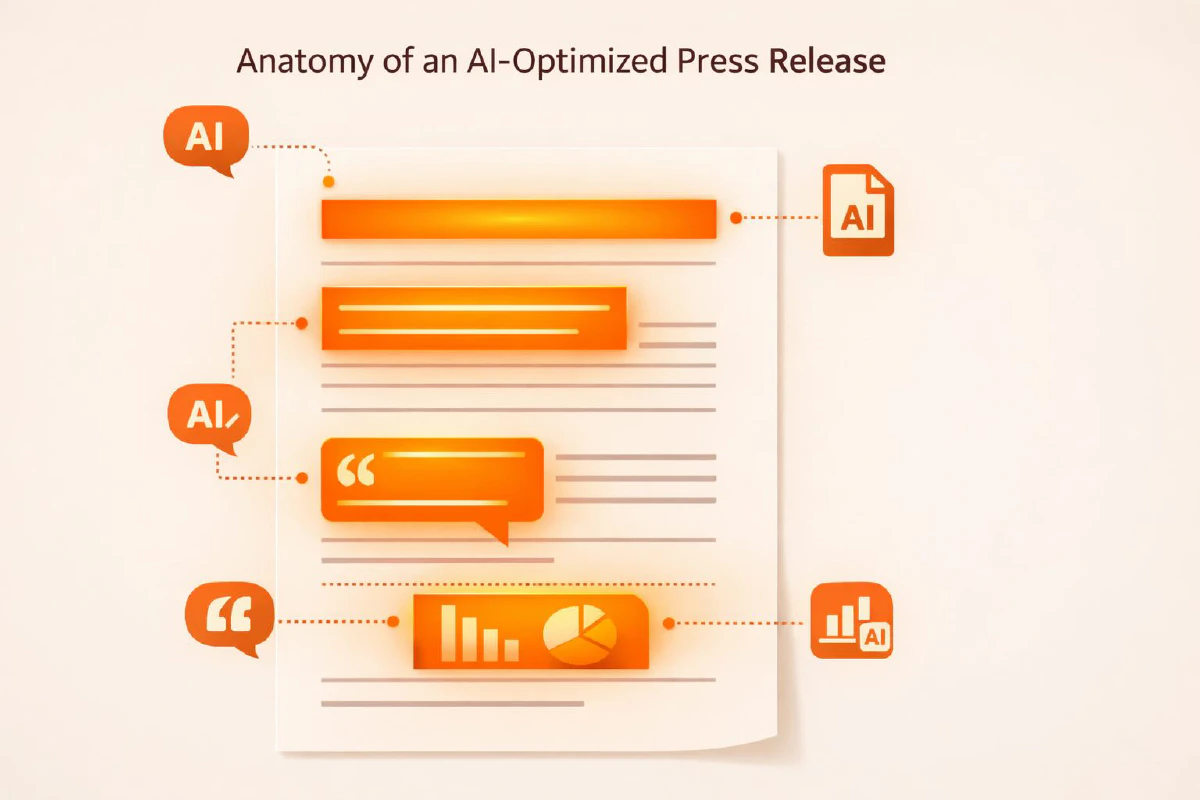

Zeover generates AI-optimized press releases and distributes them through CISION’s PR Newswire network. The platform applies every formatting principle in this guide automatically, using your locked brand boilerplate for consistency. Available on Premium (add-on) and Enterprise plans. Start writing.
A study of 200,000 press releases measured against 13 million AI citations found that releases with structured data, original quotes, and current metadata were 3.4x more likely to appear in AI-generated citations than releases without those elements. The same study found that a lesser-known B2B battery company outperformed a nationally recognized B2C retailer by 3.4x in AI citations and a sector peer by 23x, purely through better formatting.
Structure, not brand size, determines whether AI models cite your press release. The Princeton GEO study (ACM KDD 2024) quantified this: adding statistics to content increases AI visibility by 33%. Adding quotations increases it by 41%. Adding authoritative citations increases it by 28%. Keyword stuffing decreases it by 10%.
This guide covers what the academic research, PR Newswire’s own LLM formatting data, and structural optimization studies say about writing press releases that AI models actually pick up.
The First 50 Words Are Everything
AI models weight the opening of any document disproportionately. PR Newswire’s LLM formatting guide states it directly: “LLMs give more weight to the first 50 words.”
Your lead paragraph needs to answer who, what, when, where, and why in one to two sentences. This isn’t new advice - the inverted pyramid has been the standard for 150 years. What’s new is that AI models enforce it algorithmically. Research on LLM citation patterns shows that models “heavily favor content where the answer appears in the first 1-2 sentences.” Burying the answer after ambient setup language gets penalized.
What a bad lead looks like:
“We’re thrilled to announce that after months of hard work, our talented team has developed something we believe will change the way businesses think about customer engagement.”
That’s 29 words with zero extractable facts. No company name, no product, no data point, nothing an AI model can cite.
What a good lead looks like:
“Zeover, an AI Marketing Optimization platform, today launched press release distribution through CISION’s PR Newswire network, enabling brands to generate and distribute AI-optimized press releases across 500,000+ media outlets in 170 countries.”
That’s 33 words containing: the company name, what it does, the specific news, the partner, and two concrete numbers. Every element is extractable and citable.
Headline: Under 55 Characters, Under 8 Words
A PRSA analysis of 11,000+ press releases on BusinessWire found the average headline runs 120 characters, with 79% exceeding 65 characters. This is a problem. Google displays only the first 63 characters. American Press Institute research shows 8 words is the maximum for at-a-glance comprehension.
For AI visibility, your headline needs to function as a standalone answer to a query. AI models scan headlines to determine relevance before processing the full text.
Weak: “Leading Technology Company Announces Strategic Partnership to Enhance Customer Experience Across Multiple Channels” (112 characters)
Strong: “Zeover Partners with CISION for AI Press Distribution” (53 characters)
The strong version contains both entity names, the action, and the domain - in under 55 characters. Add a subheadline (H2) to expand with supporting data: “Brands can now generate and distribute press releases optimized for AI model citation across 170+ countries.”
Structure Your Sections at 150-300 Words
Research from the University of Tokyo (Yu et al., March 2026) studied how document structure affects AI citation probability across six generative engines including ChatGPT, Claude, Google SGE, and Perplexity. Their findings on section length are precise.
Sections of 150-300 words produce optimal citation rates. Chunks exceeding 300 words show 31% attention degradation in middle segments - the AI model literally loses focus on the content in the center of long sections. Chunks below 150 words reduce citation rates by 23% because they don’t provide enough context for the model to evaluate credibility.
The same study found that documents with a heading hierarchy of 3-5 levels perform best for search-then-synthesize engines like Google AI Overviews. Each H2 section should function as a self-contained unit that answers a specific question, because AI models can extract and cite individual sections independently of the surrounding document.
For a press release, this means:
- H1: Headline (under 55 characters)
- H2: Subheadline with supporting data
- H2: “Key Details” or specific product/partnership section
- H2: Quote from spokesperson
- H2: Additional context or industry data
- H2: Availability, pricing, or next steps
- Boilerplate: About [Company]
Each section stays within the 150-300 word range. Use clear, descriptive subheadings that contain the core topic - “Q1 2026 Revenue Results” rather than “Financial Performance Update.”
Pack Every Section with Statistics
The Princeton GEO study tested nine optimization methods across 10,000 queries and found that statistics addition produces a 33% visibility improvement on their primary metric, and 37% on Perplexity specifically. Combined with fluency optimization, statistics produced a 5.5% additional boost beyond either method alone.
Analysis of press releases that get cited versus those that don’t reveals a consistent pattern: cited releases contain 2x more statistics, 30% more action verbs, and 2.5x more bullet points than non-cited releases.
Every section of your press release should include at least one specific, verifiable number. Not “significant growth” but “34% year-over-year revenue growth to $12.7 million.” Not “expanding rapidly” but “added 1,200 enterprise customers in Q1 2026.” Not “industry-leading performance” but “99.97% uptime across 14 data centers.”
The Yu et al. structural research found that sections containing 25-35% structured elements (lists, tables, data) achieve 43% higher extraction accuracy than equivalent prose. For a press release, this means:
- Use bullet points for product specifications, key metrics, and availability details
- Present comparison data in lists rather than running sentences
- Include specific dates, prices, and quantities whenever possible
- Convert qualitative claims to quantitative ones: “fast” becomes “sub-200ms response time”
Write Quotes That AI Models Extract
Quotation addition is the single highest-impact GEO optimization the Princeton study measured: +41% visibility improvement. This makes the quote section of your press release one of its most valuable components for AI citation.
But not all quotes work equally well. AI models extract quotes that contain distinctive, citable claims. Generic executive enthusiasm adds nothing.
Low-value quote: “We’re excited about this partnership and look forward to delivering incredible value to our customers.”
Zero extractable facts. No AI model will cite this because it contains no information that answers any query.
High-value quote: “Our analysis of 500 million AI citations shows that 89% of brand recommendations come from third-party sources. Brands that don’t invest in earned media are invisible to the AI models their customers are consulting.” - Natasha Sommerfeld, Bain & Company
This quote contains a specific dataset reference, a concrete statistic, a causal claim, and a clear attribution. An AI model answering “how do brands get recommended by AI?” can extract and cite this directly.
Formatting guidelines for AI-optimized quotes:
- Attribute to a named person with their full title
- Include at least one specific number or data point within the quote
- Make the quote a self-contained statement that makes sense without surrounding context
- Use quotes from domain experts, not just company executives - a CTO’s technical assessment carries more weight than a CEO’s enthusiasm
- Place the strongest quote early in the release, within the first 300 words
Add Outbound Links as Citation Signals
The Princeton GEO study found that adding authoritative source citations increases AI visibility by 28% overall, and by 115.1% for lower-ranked sources specifically. PR Newswire’s guide confirms this: “Each outbound link to an original source acts as a citation, signaling to the AI that your information is well-researched and trustworthy.”
Every factual claim in your press release should link to its source. Types of outbound links that strengthen AI signals:
- Research citations: Link to the study, paper, or report your data comes from
- Regulatory filings: Link to SEC filings, patent numbers, or compliance documentation
- Partner announcements: Cross-link to partners’ own releases or pages
- Your own data: Link to the methodology page, product documentation, or technical specifications on your site
- Industry reports: Link to Gartner, Forrester, Bain, or other analyst research you’re referencing
A press release with 5-8 outbound links to authoritative sources signals higher source quality than one with zero links. Don’t link to your homepage generically - link to specific pages that verify specific claims.
Optimize Multimedia for Machine Reading
AI models don’t look at images. They read the text associated with them. PR Newswire supports captions of up to 500 characters per image, and every character counts.
Bad caption: “Product screenshot”
Good caption: “Zeover’s AI Marketing Optimization dashboard displaying brand visibility scores across ChatGPT (ranking #3), Claude (ranking #7), Gemini (not ranked), and Grok (ranking #2) for the query ‘best AI marketing platform 2026’ as of April 2026.”
The good caption contains: the product name, what it shows, specific data points, the AI models tracked, a sample query, and a date. An AI model processing this caption gets the same information density as a paragraph of text.
Additional multimedia optimization:
- Include transcripts for any embedded video content
- Use descriptive, keyword-rich filenames (not IMG_4523.jpg)
- Convert data tables and charts to HTML or structured text rather than images of data
- Add alt text that describes the content factually, not aesthetically
Expand the Boilerplate into an Entity Signal
The traditional 2-3 sentence boilerplate (“About [Company]: [Company] is a leading provider of…”) wastes an opportunity. AI models crawl boilerplate sections for entity classification and relevance signals. When the same boilerplate appears across dozens of syndicated placements, it reinforces how AI models categorize your brand.
An AI-optimized boilerplate should include:
- Full company name and what it does (one sentence, specific)
- Industries and audiences served (list them explicitly)
- Key products or services (name them)
- Differentiators (what makes you distinct, stated factually)
- Website URL and relevant links
Example:
“About Zeover: Zeover is an AI Marketing Optimization platform that helps brands monitor and improve their visibility across ChatGPT, Claude, Gemini, and Grok. The platform serves enterprise marketing teams, agencies, and SMBs with AI benchmarking across thousands of daily prompts, content generation for blogs, press releases, and social media, and brand reputation monitoring. Zeover is an official CISION partner for press release distribution through PR Newswire. Visit zeover.com.”
That boilerplate names the company, defines the category, lists the AI models it tracks, identifies three customer segments, describes three product capabilities, names a strategic partner, and provides a URL. Every syndication of this boilerplate reinforces these entity associations across AI training data.
What Kills AI Citation Potential
Some common press release practices actively harm your GEO visibility.
Keyword stuffing. The Princeton study measured a negative impact from keyword stuffing - it reduces AI visibility rather than increasing it. PR Newswire explicitly warns that “advanced AI penalizes keyword stuffing.” Use primary keywords in the headline, subhead, and lead. Weave secondary keywords naturally. Never repeat a phrase for density.
Dense marketing prose. PR Newswire’s guide contrasts two versions of the same sentence. The original: “The company will leverage its synergistic capabilities to effectuate a paradigm shift.” The rewrite: “The company will use its team’s skills to grow the business.” The simpler version provides “a real technical advantage” because “a dense wall of text is hard for an AI to process.” If it sounds like it was written by a committee, it will be ignored by an AI model.
Missing metadata. Press releases without accurate publish dates, modified dates, and “as of” timestamps for data points get deprioritized by AI models that use recency as a ranking signal. Sixty-five percent of AI citations target content from the past year. Stale or undated content gets skipped.
No structured data. Press releases on your corporate newsroom should include NewsArticle schema.org markup in JSON-LD format. Include headline, datePublished, dateModified, author, publisher, and description properties. Schema markup is the most direct way to tell AI systems what your content is and when it was published.
Vague quotes from unnamed sources. “A company spokesperson said the partnership would be beneficial” contains no citable information and no attribution. Every quote needs a name, a title, and a specific claim.
Timing: The Freshness Window
AI models have a strong recency bias, but the timing is more nuanced than “publish and wait.”
Research from Seer Interactive analyzing 5,000+ URLs found that Perplexity draws 50% of its citations from current-year content. Google AI Overviews draws 44%. ChatGPT is more willing to cite older material, with 31% from the current year but meaningful citation of content going back years.
The Arthur W. Page Society reported that “the most common publication date among journalistic citations was the day before the query was run.” This means AI models strongly favor fresh coverage. Your press release needs to generate journalist pickup quickly - within the first one to two weeks - to hit the citation window when recency signals are strongest.
The earned media coverage itself then has roughly an 11-month citation half-life. Half of all AI citations reference material published within the prior 11 months. After that, the coverage fades from AI responses unless it gets refreshed with new links, updates, or follow-up articles.
Practical implication: Don’t publish a press release and wait. Distribute through a high-reach network like CISION’s PR Newswire to maximize the number of journalists who see it within the first 48 hours. The faster you generate earned coverage, the sooner that coverage enters the AI citation pipeline.
The Formatting Checklist
Before distributing any press release, verify these elements:
- Headline under 55 characters containing the primary entity and news
- Subheadline expanding with supporting data or context
- Lead paragraph answers who/what/when/where/why in under 50 words
- Every section between 150-300 words with descriptive H2 subheadings
- At least one specific statistic per section
- At least one attributed quote with a named spokesperson and data point
- Five or more outbound links to authoritative sources
- All images captioned (up to 500 characters, factual, data-rich)
- Expanded boilerplate listing industries, audiences, products, and differentiators
- Accurate datePublished and dateModified metadata
- NewsArticle schema.org markup on your newsroom page
- AP Stylebook formatting throughout
- No keyword stuffing, no marketing jargon, no unnamed sources
- Distribution through a major newswire for maximum syndication reach
Where This Fits in Your GEO Strategy
Press releases are one component of a broader GEO approach. Gartner projects that PR and earned media budgets will double by 2027 as brands shift investment toward channels AI models actually cite. Their analysis shows 95% of LLM-cited links are non-paid, with 27% originating directly from earned media.
But a press release alone doesn’t guarantee AI visibility. It needs to generate the journalist coverage that AI models trust. Bain & Company’s research confirms that “the sources LLMs trust look more like a strong public relations and earned media strategy than a performance marketing dashboard.”
The press release is the catalyst. Proper formatting makes it more likely that journalists pick it up, that the resulting coverage contains citable facts, and that AI models extract and cite those facts when users ask relevant questions. Every formatting choice in this guide increases the probability at each step of that chain.
Zeover applies these formatting principles automatically when generating press releases, and distributes them through CISION’s PR Newswire network to maximize journalist reach. Use Zeover’s benchmarking to measure AI visibility before and after distribution - the data will show which topics and formats generate the strongest citation response for your brand.


